
Key takeaways
- Five large rain barrels built to link together for herb garden watering, with connector hoses, overflow ports and modular tanks from 51 to 55 gallons compared.
As an Amazon Associate I earn from qualifying purchases. This post may contain affiliate links at no extra cost to you.
Herb gardens drink in a particular pattern: small amounts, often, close to the kitchen door. A single 50-gallon barrel under the nearest downspout covers that pattern in a wet month and fails it in a dry one, which is why the best large rain barrels with linked barrel connectors for outdoor herb gardens are judged on a second quality beyond capacity. Each model below either ships with a way to connect a second barrel or is built as a modular system, so storage can grow from one downspout without moving the downspout, and a linked pair or chain fills together and drains as one reserve.
Every pick holds between 51 and 55 gallons per unit, the large end of the residential barrel range, and every linking claim in this article comes from the maker's own documentation opened during research: a connector supplied in the box, an overflow port the maker explicitly designs for linking, or a system architecture built around connected barrels. Barrels whose overflow is only a safety spill, with no maker-supported way to join a second unit, were left out even when their capacity fit.
The herb garden framing shapes the details that matter. These barrels stand near beds and borders, so footprint, spigot height for filling a watering can, and screened inlets that keep debris and insects out of water destined for edible plants all count. So does restraint: rainwater for herbs is typically applied at the soil line with a can or a short hose, and gravity feed from a single spigot is the normal pattern each of these barrels is built around.
Quick verdict
The BlueBarrel system is the strongest answer when linking is the whole point, because connected barrels are its architecture rather than an accessory: bottom-plumbed barrels fill and drain together from one downspout connection. The Rainwater HOG is the pick for narrow side yards and fence lines, a tall modular tank that strings together with threaded connector tubes included with each unit. The Enviro World FreeGarden RAIN is the simplest conventional barrel here, with multi-barrel installation designed in and the overflow hose and clamp in the box. The ORBIS SYSTERN is the utility choice, a plain 55-gallon barrel whose maker states the overflow hose can be linked to another SYSTERN. The Bushman RainSaver 54 is the decorative pick, a wood-grain barrel with the largest overflow port here and a maker T-connector made for chaining barrels in series.
Comparison table
| Product | Capacity | Linking method | Key spec | Best for |
|---|---|---|---|---|
| BlueBarrel Rainwater Catchment System | 55 gal per barrel | Bottom-connected plumbing in the RainKit | Starts at 2 barrels and 110 gal, scales upward | Gardeners planning a growing chain of barrels |
| Rainwater HOG | 51 gal per module | Threaded connector tubes included with each unit | 71 by 20 by 9.5 in, vertical or horizontal | Narrow spaces along fences and walls |
| Enviro World FreeGarden RAIN | 55 gal | Overflow to a second barrel; hose and clamp included | Square body, 34 in tall, higher spigot | Simple two-barrel setups by a herb bed |
| ORBIS SYSTERN (NPL 315) | 55 gal | Overflow hose linked to another SYSTERN | 26 by 26 by 34 in, 16 lb | Plain utility storage that can pair up |
| Bushman RainSaver 54 Gallon | 54 gal | Overflow T Connector (39011) joins barrels in series | 1.25 in overflow with 6 ft hose included | Decorative barrels chained along a wall |
How we chose
The linking requirement was the first and hardest filter. A model qualified only if the maker documents a connection path: supplied connector tubes, an overflow designed and described for a second barrel, a purpose-made linking accessory, or a system sold as connected barrels from the start. That rule removed several well-known decorative barrels whose overflows exist only to spill safely. It also shaped the mix: two of the five are modular systems, three are conventional barrels with maker-supported linking, and all five can grow past a single unit.
Capacity was the second filter. The keyword asks for large barrels, so every pick holds at least 50 gallons per unit, and the linked totals are stated where the maker states them. Physical fit was the third filter, because herb gardens sit in the leftover spaces of a yard: a nine-and-a-half-inch-deep tank for a fence line, a square barrel for a corner, a flat-backed decorative barrel for a wall. Dimensions below are the makers' own figures.
Finally, each barrel had to cover the herb gardener's basics without improvisation: a screened inlet, a spigot placed to fill a watering can, and an overflow route that does not dump against the house. Specifications come from maker pages, maker spec sheets, and retailer pages reproducing maker data, all opened during research.
BlueBarrel Rainwater Catchment System
- Barrels: repurposed 55-gallon food-grade HDPE barrels
- Configuration: starts at 2 barrels (110 gal) and scales upward; the maker cites customer systems beyond 2,800 gal
- Linking: barrels are plumbed together from underneath, so all barrels fill and drain simultaneously as one tank
- Connections: one downspout connection and one primary outlet for the whole system
- Diverter: downspout diverters in multiple sizes, which return overflow to the normal drainage path when the system is full
- Valves: isolation valves let sections be drained or expanded while the rest keep their water
- Kit: the DIY RainKit is custom-packed for the chosen capacity and arrangement, with illustrated instructions and a maintenance manual
BlueBarrel is the only entry here where linking is not a feature but the product. Instead of an overflow hose passing surplus water down a line of barrels, the system plumbs its barrels together at the bottom, so the group behaves as a single tank with a shared water level: every barrel fills together, every barrel drains together, and the single outlet draws on the whole reserve. For a herb garden that expands bed by bed, that architecture means storage can be added a barrel at a time without re-plumbing the downspout or accepting that the last barrel in a chain is always the emptiest.
The details support the pattern. Isolation valves let one section be taken offline for cleaning or expansion while the others stay in service. The downspout diverter handles a full system by returning water to the normal drainage path, so a storm at the wrong moment is a non-event. The honest costs are effort and uniformity: the barrels must sit level with one another, the installation is a genuine do-it-yourself plumbing project with drilling and glued PVC, and the barrels themselves are repurposed food-grade drums, sourced locally through the maker's exchange or supplied with the kit, so the look is industrial rather than decorative.
Pros:
- True single-tank behavior across all connected barrels
- Capacity scales from 110 gal upward with no change of downspout hardware
- Isolation valves allow expansion without draining the system
- One outlet serves the whole reserve
Cons:
- Installation is a real plumbing project, not a drop-in barrel
- Barrels must be level with each other to work as designed
- Repurposed drum appearance will not suit every garden
Rainwater HOG
- Capacity: 51 gal per module
- Dimensions: 71 by 20 by 9.5 in; footprint about 1.3 square feet
- Material: food-grade polyethylene, with quarter-inch-thick walls and UV additives
- Linking: modules are strung together with threaded connector tubes that come with each unit, so connected modules fill simultaneously
- Orientation: installs vertically against a wall or fence, or horizontally under a deck
- Design origin: modular system designed by architect Sally Dominguez
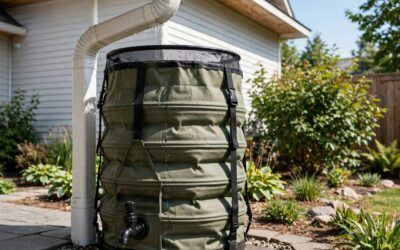
The HOG solves the space problem that stops most barrel chains before they start. At nine and a half inches deep, a module stands in the dead strip along a fence, a side wall, or a walkway where a round barrel cannot go, and its six-foot height turns that strip into 51 gallons of storage. Linking is native to the design: threaded connector tubes are included with each unit, and connected modules fill together, so a run of three along a fence is a 153-gallon reserve with the footprint of a narrow bench.
For herb gardens the placement is the point. Herb beds often occupy exactly those edges, along a sunny fence or beside a path, and the HOG puts the water in the same strip as the plants. The food-grade polyethylene and quarter-inch walls speak to longevity, and the maker rates the design life in decades with proper care. The compromises are shape-driven: the tall module needs its wall kit or a secure horizontal spot under a deck, the outlet arrangement is sold as a separate kit, and the price per gallon runs high against a plain barrel. Gardeners pay for the footprint, and for the right fence line it is worth it.
Pros:
- Fits spaces no round barrel can use, at 9.5 in deep
- Connector tubes included with every module
- Vertical or horizontal installation
- Heavy quarter-inch walls with UV additives
Cons:
- Outlet and leaf-catcher kit sold separately
- Tall modules need wall fixing or a suitable under-deck spot
- Premium price per gallon
Enviro World FreeGarden RAIN
- Capacity: 55 gal (208 litres)
- Dimensions: 34 in high by 24 in wide, square body for flush-to-wall and corner placement
- Linking: designed for easy multi-barrel installations, with overflow to a second barrel
- Included: installation instructions, spigot, screws, overflow hose, and clamp
- Inlet: insect-resistant stainless steel screen
- Spigot: higher placement fits most watering cans, with four additional spigot mount points lower on the barrel
- Lid: the maker lists a childproof lid design and a stable footprint
- Material: maximum recycled content balanced with virgin resin for durability, per the maker
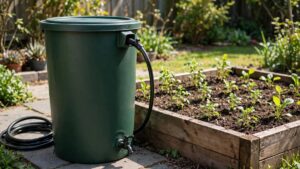
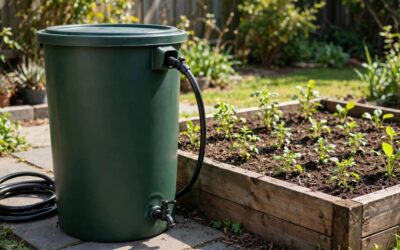
The FreeGarden RAIN is the conventional barrel done carefully. Its square body sits flat against a wall or into a corner beside a herb bed, the spigot is placed high enough that a watering can slides under it without a stand, and four extra mount points let the owner add lower outlets as the setup evolves. Linking is a designed behavior rather than a hack: the maker's material leads with easy multi-barrel installations and overflow to a second barrel, and the overflow hose and clamp are in the box.
The maker's own figures note that as many as three barrels fit in the back of a regular sedan, a small practical grace for a product bought in multiples. The stainless steel screen keeps insects out of the inlet, which matters when the water is destined for herbs eaten fresh. What the FreeGarden does not offer is decoration or modularity tricks; it is a square, honest barrel whose linking story is overflow-based, so a chain fills in sequence rather than all at once, and the second barrel should sit where the overflow hose can reach it at the right height.
Pros:
- Multi-barrel installation designed in, with hose and clamp included
- High spigot fills watering cans without a stand
- Square shape suits walls and corners by herb beds
- Extra spigot mount points for future outlets
Cons:
- Overflow linking fills barrels in sequence, not simultaneously
- Plain appearance beside decorative rivals
- Extra spigots for the spare mount points are separate purchases
ORBIS SYSTERN (NPL 315)
- Capacity: 55 gal (208 litres)
- Dimensions: 26 in long by 26 in wide by 34 in high; weight 16 lb
- Linking: the maker's spec sheet states the overflow hose can be linked to another SYSTERN or directed away from the house
- Inlet: mosquito mesh keeps insects and leaves out
- Spigot: contoured spigot fitted as standard
- Source handling: easily accommodates existing downspouts, per the maker
The SYSTERN comes out of the municipal rain barrel world, where ORBIS supplies barrels for city conservation programs, and it shows in the specification: a plain, light, 55-gallon barrel with the essentials done properly and nothing decorative added. Sixteen pounds empty makes it the easiest barrel here to position, clean, and store, and the square 26-inch footprint parks neatly against a wall or a shed beside the herb beds.
Its linking provision is stated in one unambiguous line of the maker's spec sheet: the overflow hose can be linked to another SYSTERN. That makes a pair of SYSTERNs a 110-gallon reserve joined at the overflow, the simplest two-barrel arrangement in this roundup after the FreeGarden. The contoured spigot and mosquito mesh cover the daily basics. What the SYSTERN lacks is ecosystem: there are no stands, connectors, or decorative variants in its line, and its program-channel availability can mean buying through municipal or distributor routes rather than a garden center shelf.
Pros:
- Maker states overflow linking to a second SYSTERN directly
- Lightest barrel here at 16 lb, easy to move and clean
- Mosquito mesh and a contoured spigot as standard
- Square footprint suits tight utility corners
Cons:
- Utility styling with no decorative options
- No accessory ecosystem of stands or connector kits
- Availability runs through program and distributor channels
Bushman RainSaver 54 Gallon
- Capacity: 54 gal
- Dimensions: 36 in high by 23 in wide
- Construction: one-piece, closed-top, rotationally molded; partially recycled, UV-protected plastic with wood-grain detail
- Inlet: screened intake filters debris and keeps insects out
- Overflow: recessed overflow channel on top, with a 1.25 in overflow port at the back with molded threads
- Included: 1.25 in diameter, 6 ft flexible overflow hose
- Linking: the maker's RainSaver Overflow T Connector (part 39011) connects multiple RainSaver barrels in series through the overflow port; one connector per additional barrel
- Spigot: threaded brass spigot with two access points, for watering cans or a hose
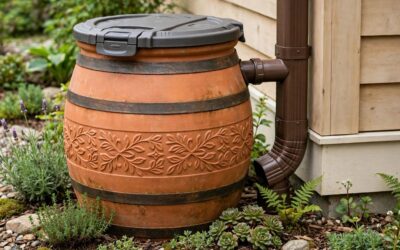
The RainSaver is the decorative barrel of the five, cast with a wood-grain finish that sits comfortably against a house wall or a garden fence, and it hides the best overflow hardware here. The overflow port is a full 1.25 inches with molded threads, the largest passage in this group, so a linked chain keeps up with a heavy downpour instead of throttling at a narrow hose. Bushman sells the linking piece explicitly: the Overflow T Connector threads into the overflow port and joins additional RainSavers in series, one connector per added barrel, using the six-foot overflow hose each barrel already ships with.
That combination, included hose plus a purpose-made connector, makes expansion a planned purchase rather than an improvisation. The closed one-piece top and screened intake keep the stored water clean for herbs, and the brass spigot offers two access points, one placed for cans and one for a hose. The connector is a separate purchase, which is the honest catch, and the overflow-series arrangement fills barrels in sequence like the other hose-linked designs here rather than all together like the BlueBarrel.
Pros:
- Purpose-made T Connector for series linking, sold by the maker
- Large 1.25 in overflow with a 6 ft hose included
- Decorative wood-grain finish with a closed, screened top
- Brass spigot with two access points
Cons:
- T Connector is bought separately for each added barrel
- Series linking fills barrels one after another
- One-piece closed top cannot be opened for scrubbing inside
Buying guide
Choose the linking style before the barrel, because it decides how the reserve behaves. Bottom-connected systems, represented here by BlueBarrel, equalize water across every barrel, so the whole reserve is always usable at one outlet. Overflow-linked barrels, the FreeGarden, SYSTERN, and RainSaver pattern, fill in sequence: the first barrel must fill before the second receives water, which is simple and cheap but means the far barrel is a storm reserve more than a daily source. Modular tubes, the Rainwater HOG pattern, fill connected modules together within a run along a wall or fence.
Size the reserve to the roof and the beds together. A rough working figure used by water conservation programs is that one inch of rain on 100 square feet of roof yields about 60 gallons, so even a modest roof section refills a linked pair quickly in the wet season. The dry season is the real test: herbs in beds and containers can draw a watering can or two a day, and a 110-gallon linked reserve stretches that supply across several rainless weeks where a single barrel gives up early.
Placement deserves more thought than the purchase. Barrels must sit level and on a base that can carry the full weight; a filled 55-gallon barrel weighs well over 400 pounds, and a linked chain multiplies that along one wall. Keep the chain on the same level, since overflow linking depends on gravity and small height differences decide which barrel fills first. Put the first barrel where its spigot clears a watering can, or plan a stand into the installation from the start.
Mind the water's path to the plants. Herb beds are usually watered at soil level, and gravity pressure from a barrel is gentle, which suits cans and short soaker runs and does not suit long hoses or sprinklers. If the beds sit below the barrels, a short hose works well; if they sit level or above, expect to carry cans, and choose the barrel whose spigot placement makes that easy. Screens and closed tops are not optional around edible plantings: every pick here screens its inlet, and keeping light and debris out of stored water is what keeps it pleasant to use.
Finally, plan the second barrel at the first purchase. Linking hardware differs by brand and rarely crosses over, so a gardener who expects to expand should buy into the line whose connector system they like: tubes included with the HOG, a T Connector stocked by Bushman, a hose in the FreeGarden box, a stated overflow link on the SYSTERN, or a full plumbing kit from BlueBarrel. Buying the second barrel of the same line later is always easier than marrying two brands at the overflow port.
FAQ
How many barrels can be linked together?
It depends on the system. The BlueBarrel architecture is built to scale from two barrels upward with no stated household limit, and the maker cites systems in the thousands of gallons. Overflow-linked barrels like the FreeGarden, SYSTERN, and RainSaver typically chain two to four units sensibly, since each link depends on the previous barrel filling first. The Rainwater HOG strings modules along a wall or fence as far as the run allows.
Do linked barrels fill at the same time or one after another?
Both patterns exist in this roundup. Bottom-connected and tube-connected systems, BlueBarrel and the Rainwater HOG, fill their units together and share one water level. Overflow-linked barrels fill in sequence: barrel one fills, its overflow feeds barrel two, and so on down the chain.
Is rain barrel water suitable for herbs?
Rainwater collected from a roof through a screened inlet is widely used on herb gardens, and every barrel here screens its intake against debris and insects. Water at the soil line rather than over the leaves, keep the barrel covered and screened, and empty and clean the system seasonally. Gardeners with roofs treated with chemical treatments should check the treatment maker's guidance before using runoff on edible plants.
How much does a full linked setup weigh?
Water weighs about 8.3 pounds per gallon, so a filled 55-gallon barrel comes to roughly 460 pounds including the barrel, and a linked pair approaches half a ton. Bases must be level, compacted, and able to carry that load without settling, which is why paving slabs or a gravel pad are the standard foundation.
Can a linked chain feed a drip line for the herb beds?
Yes, with gravity's limits understood. A barrel outlet can feed a short drip or soaker run laid below the barrel's water level, and flow slows as the barrel empties. Long runs, uphill beds, and pressure-compensating emitters ask for more head than a barrel provides, so keep gravity drip layouts short and downhill.
What maintenance does a linked system need?
Screens should be rinsed when they clog, overflows checked before the wet season, and each barrel drained and scrubbed at least once a year. In freezing climates the makers' shared advice is to drain barrels and hoses before hard frost and store or bypass the system for winter, since ice expansion is the common cause of cracked barrels and split connector hoses.
Conclusion
Linking turns a rain barrel from a fair-weather convenience into a reserve a herb garden can plan around. Gardeners who expect to keep adding storage should start with the BlueBarrel system, whose barrels behave as one tank from the first pair onward. Tight fence lines belong to the Rainwater HOG, simple two-barrel setups to the FreeGarden RAIN or the ORBIS SYSTERN, and a wall where looks matter to the Bushman RainSaver with its purpose-made connector. Every model here holds at least 50 gallons, screens its inlet, and documents its linking method in the maker's own material, which is the standard this category should be bought by.

Write Your Review
No reviews yet. Be the first to share your experience!