
Key takeaways
- Compare decorative rain barrels with linked barrel connectors for small backyard gardens, covering the linking kits, overflow ports, spigots and capacities.
As an Amazon Associate I earn from qualifying purchases. This post may contain affiliate links at no extra cost to you.
A single rain barrel under a busy downspout fills faster than most gardeners expect. One inch of rain on a modest roof section sends hundreds of gallons toward the gutters, and a fifty-gallon barrel catches only the first chapter of that story before the overflow takes the rest. The best decorative rain barrels with linked barrel connectors for small backyard gardens solve the arithmetic without ruining the view: they are barrels designed to be chained together, so a second or third barrel joins the first through a linking kit or a shared overflow port, and the whole row still looks like garden furniture rather than a water treatment plant. In a small backyard, where every object is on display, that combination of expandable storage and deliberate design is the entire point.
The five barrels in this roundup each offer a stated, physical way to link. One ships with a linking kit and linking tube in the box. One belongs to a maker's own link-kit system with printed assembly instructions covering the model by name. Two carry a second spigot positioned so it can serve as the overflow into a partner barrel. One is molded with dual rear overflow ports the maker describes for linking. Those linking paths, plus the screens, spigots, and overflow routing that keep a barrel row working through a storm season, are what the sections below weigh, along with the decorative finishes, stone, palm, woodgrain, and urn shapes, that let a barrel sit beside a patio instead of behind a shed.
A small-garden note before the picks: linked barrels share water by gravity, so they must sit level with each other, ideally on stands or a shared platform, and the first barrel in the chain takes the downspout. Planning that platform before the barrels arrive is the difference between a tidy installation and a muddy one.
Quick verdict
The FCMP Outdoor Raincatcher 4000 is the easiest linked system to own, because the linking kit, linking tube, and overflow tube are all in the box with the barrel. The Good Ideas Impressions Palm 50 is the decorative standout, with a planter top and a second brass spigot made to overflow into a partner barrel. The Impressions Stone 50 brings the same dual-spigot linking in a taller stone finish. The RTS Home Accents 35-gallon round barrel suits the smallest gardens, with a woodgrain finish, a planter top, and compatibility with its maker's own link kit. The Algreen Castilla 50 uses dual rear overflow ports for linking and adds a bottom drain that makes end-of-season cleaning simpler.
Comparison table
| Product | Key spec | Best for |
|---|---|---|
| FCMP Outdoor Raincatcher 4000 | 50 gallons, linking kit and tubes included | Owners who want linking hardware in the box |
| Good Ideas Impressions Palm 50 | 50 gallons, two brass spigots, planter top | Decorative linked pairs beside patios |
| Good Ideas Impressions Stone 50 | 50 gallons, two spigots, stone finish | Tall, narrow spots at a downspout |
| RTS Home Accents 35-Gallon Round with Planter | 35 gallons, link kit compatible, woodgrain | Smallest gardens and short downspout runs |
| Algreen Castilla 50 | 50 gallons, dual rear overflow ports | Linking through rear ports, easy draining |
How we chose
The linking claim came first, and it had to be physical, not decorative language. Each barrel here has a maker-stated connection path: an included kit, a named compatible kit from the same maker, a second spigot placed for overflow linking, or molded overflow ports described for linking barrels together. Barrels that merely sit near each other, or that need a hole drilled in an unmarked spot with no maker guidance, were left out, because a small-garden owner deserves a system the maker has actually thought through.
Capacity was weighed against footprint. Small backyards cannot give up a patio corner to a row of oversized tanks, so the set runs from thirty-five to fifty gallons per barrel, sizes that link into one hundred or one hundred fifty gallons of storage while each unit still fits under a standard downspout. Decorative finish was a genuine filter rather than a bonus: every barrel here is molded or finished to look like stone, wood, or a garden urn, since the keyword asks for barrels that earn their place in view.
Practical hardware completed the picture. A screened inlet keeps debris and insects out of stored water, a proper spigot with hose threads beats a plug, and an overflow route that directs surplus water away from the house foundation matters more in a small yard, where the barrel usually stands close to the wall. Warranty and material notes are recorded where the maker lists them.
FCMP Outdoor Raincatcher 4000
- Capacity: 50 gallons
- Linking: Linking kit with a 16 inch linking tube included in the box
- Also included: 66 inch overflow tube, 40 inch garden hose, debris screen, shut-off valve
- Material: Polyethylene, flat-back profile
- Dimensions: 24 by 24 by 32 inches
- Warranty: 1-year limited replacement warranty, as listed by the maker
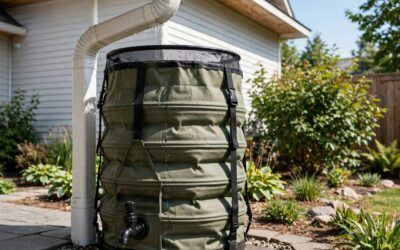
The Raincatcher 4000 is the only barrel here that builds linking in as part of the product rather than an accessory hunt. The box includes the linking kit and a sixteen-inch linking tube, and the side spigots are arranged so multiple Raincatcher barrels connect in series, each new barrel adding fifty gallons to the same downspout. The overflow connection takes a sixty-six-inch overflow tube that routes surplus water underneath and away, which protects the foundation the barrel stands against, a detail small-garden owners feel immediately because their barrels almost always live against the house wall.
The rest of the kit is equally complete: an aluminum mesh debris screen over the inlet, a forty-inch garden hose with standard connections and a shut-off thumb valve, and a hanging clip to keep the hose tidy. The flat-back shape sits flush to the wall, and the wide top opening makes the downspout connection straightforward. For a gardener who wants to start with one barrel this spring and link a second next spring without researching fittings, this is the lowest-friction path in the roundup.
Pros: Linking kit, linking tube and overflow tube all included; flat back suits tight wall-side spots; complete hose and valve kit in the box.
Cons: The brown finish is the plainest here; a single barrel still fills quickly on a large roof section.
Good Ideas Impressions Palm 50
- Capacity: 50 gallons
- Linking: Second brass spigot positioned to overflow into a second barrel
- Spigots: Two brass spigots in offset locations
- Top: Planter top for flowers or herbs
- Material: BPA-free polyethylene, made in the USA, as listed by the retailer
- Dimensions: 22.75 by 22.75 by 34 inches, 21 pounds
The Impressions Palm is the barrel in this roundup that most thoroughly disguises itself. The palm-textured finish and the planter top, which holds real flowers or herbs, turn it into a garden ornament that happens to store fifty gallons. Underneath the disguise, the plumbing is serious: two brass spigots sit in offset locations, and the retailer lists the second spigot as usable as an overflow into a second barrel, which is the linking path. Set two Palm barrels side by side, feed the first from the downspout, and surplus water crosses into the second instead of spilling down the wall.
An integrated overflow channel routes water to the front of the barrel once the system is full, away from the foundation, and the barrel carries a one-year warranty as listed by the retailer. Brass spigots matter more than they appear to: they take standard hose threads, they survive winters that crack plastic taps, and they look right on a barrel whose whole purpose is to be seen. For a linked pair flanking a patio or framing a garden door, the Palm pair is the most decorative arrangement here.
Pros: Planter top and palm finish hide the barrel completely; brass spigots; second spigot doubles as the link to a partner barrel.
Cons: Linking a second barrel uses the overflow path, so both barrels must sit level; planter top needs its own watering attention.
Good Ideas Impressions Stone 50
- Capacity: 50 gallons
- Linking: Two metal spigots in offset locations, second usable as overflow link
- Overflow: Integrated overflow channel routed to the front
- Inlet: Fine mesh screen, fits 2 by 3 and 3 by 4 inch downspouts
- Material: Polyethylene with UV inhibitors
- Dimensions: 20.5 by 20.5 by 42 inches, 19 pounds
The Stone 50 takes the same dual-spigot linking idea as its Palm sibling and stretches it vertically. At forty-two inches tall on a footprint just over twenty inches square, it is the barrel for the narrow gap beside a downspout where a wider barrel will not fit: a side yard sliver, the corner between a fence and a wall, the strip beside a garage door. The stone finish reads as a garden pedestal at that height, and the second of its two metal spigots can carry overflow into a linked partner barrel standing beside or behind it.
The fine mesh screen keeps the inlet clear of roof grit and insects, the barrel is molded to accept both common downspout sizes, and UV inhibitors in the polyethylene protect the finish through summers in full sun. The integrated overflow channel sends surplus to the front once the barrel, and any barrel linked behind it, is full. It carries a one-year warranty as listed by the retailer. Owners linking a Stone should keep the partner barrel's inlet at or below the Stone's second spigot height, since the link is gravity-fed like every system here.
Pros: Tall, narrow footprint fits tight downspout spots; dual spigots give a simple linking path; UV inhibitors for sunny placements.
Cons: Height makes it the most top-heavy barrel here when full, so a level, firm base matters; spigots are metal rather than brass.
RTS Home Accents 35-Gallon Round Rain Barrel with Planter
- Capacity: 35 gallons
- Linking: Compatible with the maker's own Rain Barrel Link Kit, which names this model
- Spigot: Brass spigot with hose hook-up and shut-off valve
- Top: Built-in planter
- Material: Rotomolded polyethylene, UV stabilized
- Dimensions: 24 by 24 by 28 inches, 19 pounds
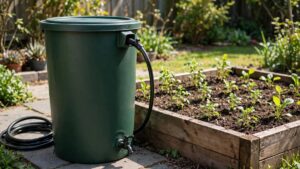
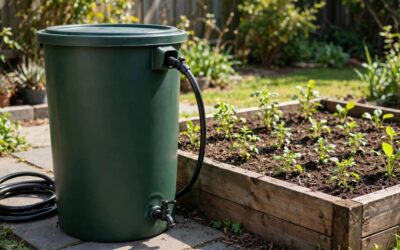
The RTS round barrel is the small-garden specialist. Thirty-five gallons is the right size for a short roof run, a shed or garage downspout, or a gardener whose watering is mostly containers and a few beds, and at twenty-eight inches tall it tucks under a window or beside steps where a taller barrel would loom. The woodgrain finish imitates a traditional oak barrel, the built-in planter softens the top with flowers, and the rotomolded, UV-stabilized body is listed as impact-resistant.
Its linking path is the most formal in the roundup: RTS publishes assembly instructions for its own Rain Barrel Link Kit, and those instructions name this thirty-five-gallon round model explicitly. The kit links barrels with a clear linking tube, an O-ring, a lock nut, and hose clamps over a hose barb, with the barrels placed no more than twelve inches apart on flat surfaces or stands. Dual overflow fittings give surplus water an exit and the link its route. For a gardener who expects to grow from one barrel to two or three over a few seasons, a maker-supported kit with printed instructions is the most orderly way to do it.
Pros: Maker's own link kit names this model in its instructions; compact size suits the smallest gardens; planter top and woodgrain finish.
Cons: The link kit is a separate purchase; thirty-five gallons fills fast under a whole-house downspout.
Algreen Castilla 50
- Capacity: 50 gallons
- Linking: Dual rear overflow ports described by the maker for linking
- Spigot: Brass spigot in a reinforced threaded fitting
- Drain: Bottom drain fitting for cleaning and emptying
- Top: Recessed, screened top
- Dimensions: 23 inches diameter by 33 inches high, roto-molded resin
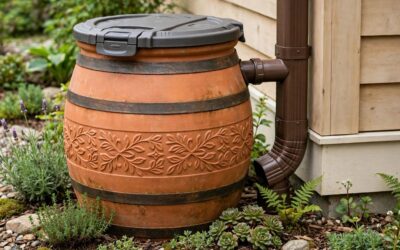
The Castilla links through its back. Two rear overflow ports are molded into the roto-molded body, and the maker's description gives those ports two jobs: managing excess water and linking the barrel to additional storage. Rear ports keep the linking hose hidden behind the barrel, which suits a barrel placed against a wall in full view of a patio, and they leave the front of the barrel clean: just the brass spigot, set in a reinforced threaded fitting with a sealing gasket, and the urn-like profile of the barrel itself.
The details underneath are well judged. A lower drain fitting lets the barrel be emptied completely for cleaning or winter, something barrels without a bottom drain make genuinely awkward, and the recessed top carries a corrosion-proof screen guard over the inlet. Algreen does not sell a dedicated linking kit for this model, so the link itself is the owner's hose and fittings between the rear ports, which is simple plumbing but worth knowing before purchase. Gardeners comfortable choosing their own hose length gain a flexible system; gardeners who want everything in one box should look at the Raincatcher first.
Pros: Rear overflow ports keep linking hoses out of sight; bottom drain simplifies cleaning and winter emptying; brass spigot in a reinforced fitting.
Cons: No dedicated linking kit from the maker, so hose and fittings are bought separately; round footprint uses more floor space than flat-back designs.
Buying guide
Plan the chain before the barrels. Linked barrels fill in sequence and drain as one system only if they sit level with each other, so build or buy a shared platform or matching stands first. Stands also raise the spigot high enough to fill a watering can by gravity, which in a small garden is the difference between using stored water daily and ignoring it. Keep the run short: link kits and overflow spigots assume barrels standing side by side, roughly within a foot of each other, not scattered across the yard.
Understand the two linking styles. A dedicated link near the top of the barrels, whether a kit tube or a second spigot, shares water once the first barrel rises to that height, so both barrels fill together during a storm. An overflow link only passes water after the first barrel is completely full, which is simpler but means the second barrel works only in heavier rain. Neither is wrong; the choice depends on whether storms at the property are long and steady or short and intense.
Mind the overflow's destination. Once every linked barrel is full, the surplus has to go somewhere planned: an overflow channel or tube routing water away from the foundation and toward a bed, a path, or a dry well. In a small backyard the barrel almost always stands against the house, which makes this routing a foundation issue, not a cosmetic one. Barrels with front-routed overflow channels or included overflow tubes handle it by design.
Screens and spigots decide daily satisfaction. A fine mesh or corrosion-proof screen keeps mosquitoes and roof debris out of the water, which keeps the water pleasant to use on vegetables and herbs. A brass spigot with standard hose threads accepts a watering hose, a soaker line, or a can filled directly, and outlasts plastic taps by years. If the garden's watering is mostly by can, spigot height above the ground matters more than any other dimension on the page.
Finally, think about winter and cleaning on the day of purchase. Barrels in freezing climates must be drained, disconnected, and ideally stored upside down or indoors, and a bottom drain fitting turns that chore into minutes. A barrel that cannot be fully emptied will eventually grow algae in the last inch of water it never releases, and no decorative finish makes that charming.
FAQ
How many barrels can be linked together?
Most of these systems link comfortably in pairs or triples. Each added barrel must sit level with the others and close enough for the link tube, hose, or overflow spigot to reach, and every added barrel increases the load on the platform, so stands and bases should be sized for the full row, not the first barrel.
Do linked barrels fill evenly?
It depends on the link height. Links near the top share water once the first barrel reaches the connector, so levels rise together after that point. Overflow-style links fill the second barrel only after the first is full. Both arrangements end with the same total storage; they differ in how they behave during light rain.
Where should the downspout feed a linked row?
Into the first barrel, always. The downspout connects to the lead barrel's screened inlet, and the links carry water onward. Feeding the middle of a row leaves the end barrels dependent on water flowing backwards through the links, which gravity does poorly.
Can I water vegetables with barrel water?
Roof runoff stored in a screened, covered barrel is widely used on vegetable gardens, and the screens and lids on these barrels exist partly to keep that water clean. Water the soil rather than the leaves, keep the screen intact, and empty and rinse the barrel if the water ever develops an odour.
Do I need a diverter, or can the downspout pour straight in?
A barrel with a screened top opening can take a shortened downspout directly, which is how most of these are installed. A diverter is tidier in winter because it lets the barrel be taken offline without rebuilding the downspout, and it is worth considering in freezing climates.
How do I winterize a linked barrel system?
Drain every barrel fully, using the bottom drain where one is fitted, disconnect the links, leave spigots open, and store the barrels upside down or under cover so meltwater cannot collect and freeze inside. Reconnect in spring after the last hard freeze, checking the link seals as the first storm fills the row.
Conclusion
Linking turns a decorative barrel into a water system. The FCMP Raincatcher 4000 makes it effortless with its kit in the box, the Good Ideas Palm and Stone barrels link through a second spigot while hiding behind planter tops and stone or palm finishes, the RTS thirty-five-gallon round barrel suits the smallest gardens with a maker-supported kit, and the Algreen Castilla keeps its linking hoses behind dual rear ports. Choose by the space at the downspout and the linking style that fits local rain, set the row level, route the overflow away from the wall, and a small backyard can store two or three barrels' worth of water without looking like it does.

Write Your Review
No reviews yet. Be the first to share your experience!