
Key takeaways
- Compare solar and battery submersible pond pumps for garden fountains without outlets, with panel size, battery, flow, lift, tubing and nozzle details here.
What's inside
As an Amazon Associate I earn from qualifying purchases. This post may contain affiliate links at no extra cost to you.
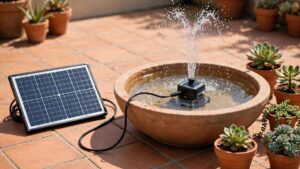
A garden fountain often sits in the exact spot where no outdoor socket exists. It might be at the far end of a bed, beside a path, in a corner shaded by shrubs, or in the middle of a lawn where running a cable would mean crossing soil, stone, and foot traffic. Extending power to that spot can involve trenching, weatherproof fittings, and a layout change that many gardeners would rather avoid. A solar or battery powered submersible pump offers a different route. The pump sits under the water, a separate panel or a panel built into the unit gathers light above the surface, and the fountain runs without any connection to household power at all.
That freedom comes with a clear trade. Output follows the sun, the panel needs a bright position even when the pond itself sits in shade, and a small kit that suits a shallow bowl will not move enough water for a larger pond or a tall spout. Choosing well means matching panel wattage, battery capacity, flow, and lift to the size of the feature and to how long the display should run when clouds pass. The best submersible pond pumps for garden fountains without outlets are the kits on this page, and every one of them runs on a solar panel, a stored battery charge, or both, with no plug and no socket in the setup.
This guide covers six kits that fit that brief. Two come from POPOSOAP, a maker that publishes full manuals with model numbers, flow, lift, cord length, and battery size. One comes from Sunnydaze, with a manual that describes separate solar and battery modes and replaceable cells. The remaining kits, from Biling, SZMP, and AISITIN, cover glass panels, evening light, and compact floating use. Each entry below uses only figures that the maker lists or that the product page lists, so the numbers can be compared on a like for like basis before any money changes hands.
Quick verdict
For most small ponds and garden fountains without a nearby socket, the POPOSOAP 12W kit with its 4200mAh battery is the strongest all round choice in this group. The maker lists 80 GPH of flow, a 5 ft lift, eight nozzles, and 5 ft of PVC tubing, and the battery is described as carrying the fountain through cloud and into the night. Gardeners with a smaller bowl or a modest patio pond may prefer the Biling 8W kit, which pairs an 8W glass covered panel with a 3600mAh battery and five nozzles. The POPOSOAP 6.5W kit covers similar ground at a smaller scale, with the same 80 GPH flow rating, a 3000mAh battery, and a panel on a separate stake that can sit away from the water.
Evening use points in a different direction. The Sunnydaze AMP-P022C kit runs in a solar mode by day and a battery mode after dark, with up to four hours of running on a full charge according to the maker manual, plus an LED light ring for night display. The SZMP 3.5W kit is smaller and lighter in output, but the product page lists six LED modes, seven nozzles, and a 2000mAh battery that keeps the display going for a few hours after sunset. The AISITIN 3W kit is the compact option for a small basin, with a 1200mAh battery, six nozzles, and an automatic power off function listed among its features.
None of these kits should be read as a match for a large pond, a tall tiered fountain, or a strong waterfall. Their flow figures sit in the range suited to bowls, small ponds, container water gardens, and short spouts. Within that range, the differences that matter are battery size, panel size, cord length, and whether the kit includes tubing for a raised spout or only spray heads for a surface display.
| Product | Key spec | Best for |
|---|---|---|
| POPOSOAP 12W Solar Fountain Pump P112D | 12W panel, 4200mAh battery, 80 GPH, 5 ft lift | Best for small ponds needing longer stored running |
| Biling 8W Solar Fountain Pump | 8W glass panel, 3600mAh battery, 5 nozzles | Best for patio ponds up to about 100 gallons |
| POPOSOAP 6.5W Solar Fountain Pump P1065D | 6.5W panel, 3000mAh battery, 80 GPH, 5.6 ft lift | Best for bird baths and small ponds in passing cloud |
| Sunnydaze Solar Pump and Panel Kit AMP-P022C | 2.5W panel, AA Ni-MH battery, 250 litres per hour | Best for evening running with an LED light ring |
| SZMP 3.5W Solar Fountain | 3.5W glass panel, 2000mAh battery, 7 nozzles | Best for small ponds and bowls with evening light |
| AISITIN 3W Solar Fountain Pump | 3W panel, 1200mAh battery, 6 nozzles | Best for compact basins and partly cloudy days |
How we chose
The first filter was the wording of the keyword itself. Without outlets rules out every corded pump that needs household power, every kit that offers solar only as a secondary feature while still needing a plug, and every pump sold on its own with no panel in the box. A kit counted only when the opened page stated solar panel operation, battery backup operation, or both for that exact model. That single rule removed a large share of the submersible pumps sold for garden ponds, because most of them are mains powered units with a cord and a plug.
The second filter was submersible use in a garden fountain or pond setting. Each kit here places its pump under the water, either sitting on the bottom, held on suction cups, or supported on a floating board or foam. Kits built only as floating surface discs with no separate pump placement were given lower weight, and kits aimed at large waterfalls or heavy circulation were set aside because their panel and battery figures did not match the small fountain use in this keyword.
The third filter was published detail. A model needed a page that listed at least a panel rating and a battery figure, plus flow or lift or spray height, so that a reader could judge fit without guessing. The POPOSOAP and Sunnydaze manuals were useful here because they name the model, the panel wattage, the pump power, the cord length, and the battery type on one page. For the Biling, SZMP, and AISITIN kits, the figures come from product listings as reported on the opened pages, and each entry below says so in plain terms.
The fourth filter was fit for the feature size named in the sources. Where a maker states a pond range, a bowl width, or a water depth range, that range shapes the recommendation. The POPOSOAP 6.5W page, for example, names bird baths about 12 to 24 inches wide and small ponds up to 40 to 160 gallons for light fountain movement, and it also names the uses the kit is not built for. Those limits are kept in the entries below rather than smoothed over, because a pump bought for the wrong size of feature is the most common reason a solar fountain disappoints.
The final filter was upkeep. Solar pumps sit in water that carries leaves, pollen, algae, and fine grit, so a filter sponge, a washable intake, a low water sensor, or a dry run shutoff all count in favour of a kit. Battery design counts too. A built in battery keeps the kit simple, while replaceable cells, as on the Sunnydaze kit, let the owner renew the stored power side of the system when the original cells fade after many charge cycles.
POPOSOAP 12W Solar Fountain Pump with Battery, Model P112D
- Solar panel: 12W, separate panel with flexible placement
- Built in battery: 4200mAh, rechargeable
- Pump power: 3W brushless pump
- Maximum flow: 80 GPH, as the maker lists
- Maximum lift: 5 ft; spray height up to 6.8 ft
- Power cord length: 9.85 ft between panel and pump
- Nozzles: 8 interchangeable nozzles
- Tubing: 5 ft PVC tubing included
- Protection: low water dry run protection with a water sensor
- Water depth: 1.2 to 8 inches, as the maker lists
- Night running: 1 to 8 hours if partly charged, or 8 to 12 hours if fully charged, as the maker lists
The POPOSOAP 12W kit is the largest battery model among the single panel kits in this guide, and the maker page is unusually complete. It names the model as P112D, gives the pump as a 3W brushless unit, and separates the figures for lift and spray height, which many listings blur together. The 5 ft lift matters for a raised spout or a short run of tubing to a small cascade, while the spray height figure describes the open fountain display above the surface. With eight nozzles and a length of PVC tubing in the box, the same kit can run as a spray fountain in a pond or as a feed for a bamboo spout or a simple dripper line.
Battery size is the main reason to choose this kit over the smaller POPOSOAP model. The maker lists a 4200mAh built in battery and states that it stores solar energy so the fountain can keep running on cloudy days or at night. The stated night running range is wide, from one hour on a partial charge to as much as eight to twelve hours on a full charge, and that spread is honest about how much the result depends on the day of sun that came before. A garden that gets long, bright days will see the upper end more often than a garden where the panel sits in broken light.
Setup is helped by the 9.85 ft cord. The panel can sit on a sunny edge, a low wall, or a patch of open soil while the pump stays in the pond, which matters when the water itself sits under a tree or beside a fence. The maker also lists a filter box and a replacement filter sponge in the package contents described on the page, and a low water sensor that stops the pump when the level falls too far. That shutoff is worth having in summer, when a shallow feature can lose a surprising amount of water to evaporation and splash in a single hot week.
Pros: Largest battery in this group at 4200mAh, eight nozzles plus PVC tubing for either spray or spout use, long cord for panel placement, low water shutoff, and a full manual with model level figures.
Cons: Flow is listed at 80 GPH, which suits small ponds and bowls rather than larger features, the stated water depth range tops out at 8 inches on the maker page, and night running varies widely with the charge gathered during the day.
Biling 8W Solar Fountain Pump with 3600mAh Battery
- Solar panel: 8W monocrystalline, glass covered
- Built in battery: 3600mAh
- Nozzles: 5 included
- Tubing: 5 ft included, as the product page lists
- Protection: dry run protection with a water shortage sensor
- Motor detail: ceramic motor shaft, as the product page lists
- Placement: floating sponges included for shallow or deeper water
- Best for: patio ponds up to about 100 gallons, as the product page lists
The Biling 8W kit sits between the two POPOSOAP models in panel size and battery size, and it adds two details that the others do not list in the same way. The product page describes a glass covered monocrystalline panel, which is a sturdier face than the plain film covered panels found on many small kits, and a ceramic motor shaft in place of a stainless steel one. The page also lists a built in debris filter and a water shortage sensor that shuts the pump off if the level falls, which addresses the two most common causes of a short pump life in a small outdoor pond: grit in the intake and running in too little water.
With a 3600mAh battery, the Biling is described as keeping the pump going when a cloud passes and for a while after sunset. That is the practical value of a mid sized battery. It smooths the display through the broken light of a partly cloudy afternoon, when a panel only kit would start and stop with every passing cloud, and it extends the display into the early evening without promising a full night of running. Five nozzles and 5 ft of tubing give the usual choice between a spray pattern above the surface and a low spout fed through the tube.
This kit reads as a good fit for a patio pond, a half barrel, or a container water garden where the owner wants a single kit with a filter, a sensor, and a battery in one box. It is not presented as a pump for a large pond, and the page places it at patio ponds up to about 100 gallons. Owners of bigger features should look at flow first and treat this as a decorative fountain pump rather than a circulation pump for the whole volume.
Pros: Glass covered 8W panel, 3600mAh battery for cloud cover and early evening running, water shortage shutoff, ceramic motor shaft as listed, floating sponges and tubing included.
Cons: Five nozzles is fewer than the eight offered by the POPOSOAP kits, the page gives no maximum lift figure in the details gathered here, and the stated fit stops at patio ponds of about 100 gallons.
POPOSOAP 6.5W Solar Fountain Pump with Battery, Model P1065D
- Solar panel: 6.5W, tempered glass with rainproof film, separate panel
- Built in battery: 3000mAh, mounted on the back of the panel
- Pump power: 3W
- Maximum flow: 80 GPH, as the maker lists
- Maximum lift: 5.6 ft; spray height 3.6 ft
- Power cord length: 9.85 ft
- Spray modes: 8, with a double layer nozzle set
- Tubing: 5 ft PVC tubing included
- Water depth: 1.2 to 8 inches, as the maker lists
- Recommended bowl size: 12 to 24 inches wide, as the maker lists
- Small pond use: up to 40 to 160 gallons for light fountain movement, as the maker lists
The 6.5W POPOSOAP kit shares its 80 GPH flow rating and its 3W pump power with the 12W model, but the panel and battery are smaller and the intended feature is smaller too. The maker page is direct about that. It names bird baths and shallow basins about 12 to 24 inches wide as the best fit, gives a water depth range of 1.2 to 8 inches, and lists the uses the kit is not built for, including large tiered fountains, strong waterfalls, koi ponds, and deep ponds. That kind of plain limit is useful, because this kit is easy to buy for the wrong feature.
The battery role also differs from the 12W model, and the maker states the difference clearly. The 3000mAh battery helps provide steadier daytime flow when sunlight changes, but this model is not designed for all night operation. In practice that means the display holds up better through passing cloud and weak afternoon light, rather than running long after dark. For a bird bath or a small pond that is mainly enjoyed during the day, that trade is reasonable, and the smaller panel is easier to place on a stake at the edge of a bed.
Placement is a strength. The panel sits on a mounting bracket and stake, the cord runs 9.85 ft, and the box includes a floating board, a nozzle set, and 5 ft of PVC tubing. The maker suggests keeping a DIY dripper height under 1 to 2 ft for best results, even though the maximum lift figure is higher, which is a sensible note: lift figures are maximums at the pump outlet, and flow falls as height rises. Used within those limits, this is a tidy kit for a bowl, a small patio tub of 1 to 10 gallons, or a small pond where light movement is the goal.
Pros: Clear published limits for bowl size, depth, and pond size, eight spray modes, separate panel on a stake with a long cord, tubing included for a small dripper or spout, battery support for steadier daytime flow.
Cons: Battery is for steadier daytime flow rather than all night running, spray height of 3.6 ft is lower than the 12W kit, and the maker lists several uses it is not built for, including koi ponds and large tiered fountains.
Sunnydaze Solar Pump and Panel Kit with Battery and LED Light, Model AMP-P022C
- Solar panel: 2.5W
- Pump operation voltage: 6V to 9V DC, as the maker manual lists
- Maximum flow rate: 250 litres per hour, as the maker manual lists
- Maximum water lift: 1.2 metres, as the maker manual lists
- Battery: 4 AA Ni-MH rechargeable cells, 1500mAh, replaceable
- Battery running: up to 4 hours on a full charge, as the maker manual lists
- Modes: solar powered mode and battery powered mode
- Protection: dry run protection, as the maker manual lists
- Light: LED light ring, designed to work at night in battery mode
- Warranty: 1 year, as the maker manual lists
The Sunnydaze kit takes a different approach to stored power. Instead of a sealed battery built into the panel housing, the manual describes four AA Ni-MH rechargeable cells that the owner installs in the battery case of the solar panel and can replace later by opening the cover. That matters over time, because rechargeable cells lose capacity after many charge and discharge cycles, and a kit with replaceable cells can be renewed without replacing the panel, pump, and light as one unit. The manual also gives a boost charge method: disconnect the pump and light cables for two to three sunny days so the cells reach a full charge.
Operation is split into two named modes. In solar powered mode, recommended for daytime, the pump runs in bright or good sunlight and surplus power charges the battery, and the manual states plainly that the pump will not work on cloudy days in that mode because there is not enough power. In battery powered mode, recommended for night or a cloudy day, the pump draws on stored power and can run up to four hours on a full charge, with an adjustable water rate controlled from the panel button. The LED light ring is designed to work only at night and only in battery mode, which keeps the light from draining the cells during the day.
Output is modest. The manual lists a maximum flow of 250 litres per hour and a maximum lift of 1.2 metres, figures that suit a small fountain, a bird bath, or a small pond rather than a large feature. Panel placement guidance in the manual is practical: face the panel south in the northern hemisphere, angle it toward the sun at its highest point, and keep trees, shrubs, and buildings from shading it. The manual also notes that the pump must stay submerged, and suggests flat stones or bricks to raise the pump if the fountain tubing is short.
Pros: Replaceable AA rechargeable cells, a named battery mode with up to four hours of running on a full charge, adjustable water rate in battery mode, LED light ring for night display, dry run protection.
Cons: Panel is only 2.5W, so charging and daytime output depend heavily on strong sun, solar mode does not run on cloudy days according to the manual, and flow of 250 litres per hour is the lowest in this group.
SZMP 3.5W Solar Fountain with LED Lights and 2000mAh Battery
- Solar panel: 3.5W glass panel
- Built in battery: 2000mAh
- Nozzles: 7, plus 4 fixers, as the product page lists
- Spray height: 40 to 60 cm in sun, 10 to 20 cm when cloudy, as the product page lists
- Lights: 6 LED lights, as the product page lists
- Evening running: about 3 to 4 hours after dark, as the product page lists
- Extras: water shortage probes and three spare filter sponges, as the product page lists
- Panel size: 6.3 by 6.3 inches, as the product page lists
The SZMP kit is built around evening display in a small feature. The product page lists a 3.5W glass panel, a 2000mAh battery, and six LED lights, with stored power running the pump and the lights for about three to four hours after dark. That makes it a showpiece for a patio tub, a small pond near a seating area, or a bird bath that is still in view after sunset, rather than a pump chosen for flow. The glass panel face is also noted on the page as a step up from plain plastic panels, which can cloud over time in strong sun.
The spray figures show the limits of a 3.5W panel clearly. The page lists 40 to 60 cm of spray height in sun and only 10 to 20 cm when cloudy, a drop that will be visible in the display. Battery storage softens that fall, but it cannot turn a small panel into a large one. Seven nozzles and four fixers give a fair range of patterns and help hold the unit in place in a basin, and the page lists water shortage probes plus three spare filter sponges, which is a thoughtful touch for a small pump that will need its sponge rinsed often in summer.
This is the kit to choose when light and pattern matter more than lift or volume, and when the feature is small enough that a gentle spray looks right. It is not the kit for a pond where fish need strong surface movement, nor for a raised spout, since no tubing based setup is listed in the details gathered here. Read it as a decorative fountain with a useful battery buffer, sized for tubs and small basins.
Pros: LED lights with about three to four hours of evening running as listed, glass panel, seven nozzles with fixers to hold position, spare filter sponges included, compact panel size for small spaces.
Cons: Spray height falls sharply in cloud, from 40 to 60 cm down to 10 to 20 cm as listed, panel wattage and battery are both small, and no lift or tubing figure is given in the details gathered here.
AISITIN 3W Solar Fountain Pump with 1200mAh Battery
- Solar panel: 3W
- Built in battery: 1200mAh
- Maximum flow rate: 1.76 gallons per minute, as the product page lists
- Nozzles: 6 included
- Protection: automatic power off protection function, as the product page lists
- Dimensions: 7.76 by 7.52 by 1.85 inches, as the product page lists
- Use: partly cloudy days, with stored energy for weak light, as the product page lists
The AISITIN 3W kit is the smallest and simplest option in this guide, aimed at a compact basin, a small bird bath, or a modest container feature where a large panel would look out of place and would be hard to site. The product page lists a 3W panel and a built in 1200mAh battery that stores energy for use in weak lighting conditions, including at night and on partly cloudy days. That battery is much smaller than the cells in the POPOSOAP, Biling, and Sunnydaze kits, so the stored running should be read as a buffer for passing cloud and a short extension into the evening, not as a long night run.
Flow is given on the page as 1.76 gallons per minute, which converts to a figure in line with the other small kits here when read as an hourly rate, and six nozzles give a basic range of spray patterns. The automatic power off protection function listed on the page is the feature that matters most in a shallow basin, where the water level can drop below the pump on a hot day or where the unit can drift and tip in a small bowl. A shutoff in that moment guards the motor from running dry in air.
Because the panel, battery, and pump are all small, placement and expectations decide whether this kit satisfies. It needs direct sun on the panel, a basin deep enough to keep the pump covered, and a spray pattern low enough that water lands back in the bowl rather than on the surrounding stone, where it is lost. In a large pond it would look lost and move little water. In a small feature close to a sunny wall or a bright patio edge, it offers moving water with no wiring and very little setup.
Pros: Compact size for small basins, battery buffer for partly cloudy days, six nozzles, automatic power off protection as listed, simple setup with no separate panel to site.
Cons: Smallest battery in this group at 1200mAh, 3W panel limits spray in weak light, no lift, cord, or tubing figures are given in the details gathered here, and it is not sized for larger ponds.
Buying guide
Start with the feature, not with the pump. Measure the bowl or pond, note the water depth at the shallowest point where the pump will sit, and decide whether the display should be a spray above the surface, a bubbler, or a spout fed through tubing. Those three choices narrow the field quickly. A spray needs spray height and a bowl wide enough to catch the falling water. A spout needs lift and tubing in the box. A bubbler needs very little of either and is often the best choice for a shallow bird bath, where a tall spray loses water over the rim on a windy day.
Panel wattage is the next decision, and it should be read alongside battery size rather than on its own. Wattage describes how much power the panel can supply in strong sun, which drives spray height and how fast the battery charges. A 12W panel with a 4200mAh battery, as on the larger POPOSOAP kit, gathers and stores more than a 3W panel with a 1200mAh battery, and the difference shows up on cloudy afternoons and in the length of the evening run. Small panels are not a fault in themselves. They suit small features, they are easier to place, and they cost less to replace. They simply cannot be asked to do the work of a large panel.
Battery capacity deserves a careful read, because makers describe its role in different ways. On the POPOSOAP 12W page, the battery is presented as storage that carries the fountain through cloud and into the night, with a stated range of running hours that depends on the charge. On the POPOSOAP 6.5W page, the battery is presented as support for steadier daytime flow, with an explicit note that the model is not designed for all night operation. On the Sunnydaze manual, battery mode is a separate setting that the owner switches on, with up to four hours on a full charge. Those are three different promises, and the right one depends on whether the fountain is a daytime feature or an evening one.
Flow and lift need to be read together. Flow, given in gallons per hour or litres per hour, describes how much water the pump can move at its outlet under the stated conditions. Lift describes how high it can push that water. As lift rises toward the stated maximum, flow falls, so a kit that looks strong on flow alone may give a weak stream at the top of a raised spout. For a surface spray in a bowl, spray height is the more useful figure. For a spout, a cascade, or a dripper, lift and tubing length matter more, and the maker guidance to keep a DIY dripper low is worth following even when the maximum lift figure looks generous.
Cord length is easy to overlook and hard to fix later. A separate panel on a 9.85 ft or longer cord lets the pump stay in shaded water while the panel sits in full sun, which is the common layout in a real garden, where ponds are often placed under light tree cover to keep the water cooler. A kit with the panel built into the floating unit has no such choice: the whole unit must sit in sun, which suits an open bird bath and suits a shaded pond poorly. Check where the panel will actually go before choosing, including whether a stake, a bracket, or a wall fixing is included.
Water depth and shutoff protection belong together. Every pump here must stay submerged while it runs. Shallow features lose water fast in summer, so a low water sensor or a dry run shutoff is more than a convenience; it is the difference between a pump that stops and waits and a pump that runs in air and wears out. Note the stated depth range where a maker gives one, and plan to top up the feature during hot spells. A spare filter sponge in the box, as listed for the SZMP kit, or a replacement sponge, as described for the POPOSOAP 12W kit, also signals that the maker expects regular cleaning and has made it easy.
Maintenance is light but not optional. Rinse the intake and filter sponge when flow weakens, clear leaves and grit from the nozzle holes, wipe the panel face clean so dust and pollen do not cut the light reaching it, and keep the panel free of shade from plants that grow up over the season. In freezing weather, the Sunnydaze manual advises drying all components and storing the kit inside, and that advice applies in spirit to every kit here: ice in a small pump housing and a battery left flat through winter both shorten the life of the system. Before storing, charge the battery as the maker directs, so the cells do not sit empty for months.
Finally, set expectations for what solar can and cannot do in this size range. These kits move modest amounts of water, they follow the weather, and their output in midwinter at northern latitudes will be a fraction of their summer output. They are not a substitute for a filtration system on a stocked pond, and moving water from a small fountain should not be read as a complete answer to water quality. What they do well is specific and valuable: they put moving water, sound, and light reflection into a part of the garden that has no power, with no cable to bury and no socket to install.
FAQ
Do solar pond pumps really work without any outdoor outlet?
Yes, for the kits in this guide. Each one draws its power from a solar panel, and most also store power in a battery for cloud cover or evening use. No plug, extension lead, or household socket is part of the setup. The limit is not the absence of an outlet but the amount of light available: the panel must sit in direct sun for the pump to run at its listed output and for the battery to charge.
Will a battery backed solar pump run all night?
Only for a limited number of hours, and the figure differs by model. The maker lists 8 to 12 hours of night running for the POPOSOAP 12W kit on a full charge and 1 to 8 hours on a partial charge. The Sunnydaze manual lists up to four hours on a full charge in battery mode. The POPOSOAP 6.5W page states that its battery supports steadier daytime flow and that the model is not designed for all night operation. Read the battery as stored running time, not as a full night of power in every case.
How much sun does the panel need, and where should it go?
The manuals and product pages gathered here call for direct sunlight and warn that shade, cloud, and a dirty panel face all reduce output. Place the panel where it receives the longest stretch of unshaded sun, angled toward the sun at its highest point, and facing south in the northern hemisphere, as the Sunnydaze manual directs. Where the kit has a separate panel on a long cord, the pump can stay in cooler shaded water while the panel sits in the open. Keep plants, fences, and buildings from shadowing the panel as the season changes.
What size pump does a small garden pond or bird bath need?
Match the kit to the stated fit rather than to flow alone. The POPOSOAP 6.5W maker page names bird baths about 12 to 24 inches wide, patio bowls of 1 to 10 gallons, and small ponds up to 40 to 160 gallons for light fountain movement. The Biling page places its 8W kit at patio ponds up to about 100 gallons. Larger features, deep ponds, and tall tiered fountains need more lift and more flow than these kits list, and two of the maker pages name those uses as ones their kits are not built for.
What happens when the water level drops in hot weather?
A shallow feature can lose water to evaporation and splash faster than expected in a hot week. Kits with a low water sensor, a water shortage sensor, or dry run protection stop the pump when the level falls, which guards the motor from running in air. The Sunnydaze manual describes dry run protection, the Biling page lists a water shortage sensor, and the AISITIN page lists an automatic power off protection function. Topping up the water regularly remains the simplest habit, and choosing a lower spray or a bubbler pattern reduces splash loss.
How much cleaning do these pumps need?
A small amount, done often. Rinse the filter sponge and intake when the flow weakens, clear debris from the nozzle holes, and wipe the panel face with a soft cloth so dust and pollen do not reduce the light reaching it. The POPOSOAP 6.5W page suggests checking the pump and nozzle weekly at first and rinsing the intake, sponge area, and nozzles whenever flow drops or debris builds up. In freezing weather, dry the components and store the kit inside, as the Sunnydaze manual advises.
Conclusion
A fountain without a nearby socket is a solvable problem, as long as the kit is chosen for the size of the feature and for the hours it should run. The POPOSOAP 12W P112D is the most complete option here for a small pond, with the largest battery, eight nozzles, tubing, a long cord, and a low water shutoff, all set out in a model level manual. The Biling 8W kit is a close alternative for a patio pond, with a glass covered panel, a 3600mAh battery, a filter, and a water shortage sensor. The POPOSOAP 6.5W P1065D suits a bird bath or small pond where steadier daytime flow matters more than a long evening run, and its maker is clear about the sizes it fits and the uses it does not.
For evening display, the Sunnydaze AMP-P022C offers a separate battery mode, replaceable cells, an adjustable water rate, and an LED light ring, at the cost of a small panel and the lowest flow in the group. The SZMP 3.5W kit puts its effort into light and pattern for a small basin, with six LEDs and about three to four hours of evening running as listed. The AISITIN 3W kit is the compact choice for a small feature in a bright spot, with a modest battery buffer for partly cloudy days.
Whichever kit is chosen, three habits decide most of the result: give the panel the sunniest position available, keep the pump submerged and its filter clean, and size the spray to the bowl so the water lands back in the feature. Do those three things and a solar or battery pump will keep a garden fountain moving in a corner of the garden that no cable reaches.

Write Your Review
No reviews yet. Be the first to share your experience!