
Key takeaways
- Fountain pumps with dry run protection for hot summer climates, compared on flow, lift, shut-off sensors, cord length and care for warm, low water all summer.
What's inside
As an Amazon Associate I earn from qualifying purchases. This post may contain affiliate links at no extra cost to you.
A fountain that looks right in May can look tired by August. Heat speeds up evaporation, the water level drops hour by hour on a still afternoon, algae grows faster in warm basins, and a pump that pushed a tall, lively plume in spring can start sucking air before anyone notices. A pump that keeps running with no water around it wears out fast, and replacing a burned-out pump in the middle of the season is a chore nobody plans for. That is why the best fountain pumps with dry run protection for hot summer climates earn their place: a low-water sensor or an automatic shut-off stops the motor when the level falls, so a hot afternoon costs you a refill instead of a new pump. This guide compares seven submersible fountain pumps whose makers list dry-run protection, low-water shut-off or an automatic shut-off sensor, from a small solar model near 87 gallons per hour to a 500 gallon per hour model for wide basins. Every figure in the product notes comes from the product page that lists it: flow rate, pumping height, wattage where listed, cord length and warranty. Hot weather adds two demands that mild weather does not. The first is margin: a pump working near the top of its lift range in warm, thinning water runs hotter itself. The second is vigilance: the difference between a neat plume and a dry basin is often a single hot afternoon without a refill. Read the quick verdict for the short answer, then use the product notes and buying guide to match flow and lift to the fountain you actually own, at the water level it actually holds in late summer.
Quick verdict
For most home fountains, the smartpond 500 GPH Fountain Pump with Low Water Shut-off is the balanced pick: a listed low-water shut-off sensor, a 500 gallon per hour flow class and a corded electric submersible build suit fountains and small water features that lose water fast in heat. Owners of mid-size basins should look at the Beckett 290 GPH model, which pairs a low-water auto shut-off with adjustable flow and a 6.5 foot maximum lift. The Creekstone 200 GPH pump is the careful choice for a compact basin, because the maker lists auto shutoff, a 4.5 foot head lift and a 6 foot cord in a small thermoplastic body. At the small end, the Beckett 160 GPH model covers shallow bowls with a 3.8 foot maximum lift and only 7.7 watts, while the smartpond 155 GPH model suits small fountains that sit close to an outlet. The AquaJet Pro solar pump is the off-grid option for a birdbath or small container fountain, with dry run protection and four fountain heads. None of these pumps adds water or shade; the shut-off sensor is what protects each one when summer levels fall.
| Product | Key spec | Best for |
|---|---|---|
| smartpond 500 GPH Fountain Pump with Low Water Shut-off 84575 | 500 GPH with low water shut-off sensor | Wide basins and fountains that lose water fast |
| smartpond 300 GPH Fountain Pump with Low Water Shut Off | 300 GPH with low water shut off | Medium fountains needing a mid-range flow |
| smartpond 155 GPH Fountain Pump with Low Water Shut-off 84576 | 155 GPH with low water shut-off sensor | Small fountains and water features near an outlet |
| Beckett 290 GPH Submersible Pump with Low Water Auto Shut-Off | 290 GPH with low water auto shut-off, 6.5 ft max lift | Tiered fountains that need lift and flow control |
| Beckett 160 GPH Submersible Pump with Low Water Auto Shut-Off | 160 GPH with low water auto shut-off, 3.8 ft max lift | Shallow bowls and small tiered fountains |
| Creekstone 200 GPH Submersible Fountain Pump with Auto Shutoff | 200 GPH with auto shutoff, 4.5 ft head lift | Compact basins and small statuary fountains |
| AquaJet Pro 6-9V Solar Fountain Pump | 87 GPH solar pump with dry run protection, 49 in head | Off-grid birdbaths and small container fountains |
How we chose
The shortlist started with one hard filter: the product page had to name dry-run protection, a low-water shut-off or an automatic shut-off. Pumps that only change output when you swap a nozzle were left out, because a summer fountain needs protection that acts on its own when the basin runs low. The second filter was fountain duty. Each model here is sold as a fountain or statuary pump, so its flow figures are published at fountain-style lift heights rather than at zero head. Flow range mattered next. A pump rated near 87 gallons per hour behaves very differently from one rated at 500 gallons per hour, and the notes say which kind each model is, so a tabletop bowl does not end up with a pump built for a wide basin. Cord and cable length were recorded because hot-climate fountains often sit in full sun several feet from the nearest outdoor outlet, and a short cord pushes owners toward extension leads near water. Wattage, maximum lift and warranty were recorded where the maker lists them, since warm water grows algae that reaches the intake faster and a pump that runs dry without protection fails sooner. No output figure appears here unless the product page states it, and any figure the page does not give is shown as a dash.
smartpond 500 GPH Fountain Pump with Low Water Shut-off 84575
- Flow class: 500 GPH
- Protection: low water shut-off sensor
- Type: submersible fountain pump, corded electric
- Use: fountains and small water features
- Model: 84575
- Warranty: see product page
Five hundred gallons per hour is the top of this shortlist, and it suits the basins that suffer most in heat: wide, shallow bowls where a large surface area meets direct sun and the level can fall an inch or more on a single hot day. The low-water shut-off sensor is the point of the purchase. When the level drops to the sensor, the pump stops instead of churning air, and the motor survives until someone tops the basin up in the evening. A corded electric build keeps the flow steady through the afternoon, which matters when a solar pump would fade with passing cloud. Put this model in a basin with room to spare, keep the intake clear of leaves, and let the sensor do the worrying on the days you are away from home.
The listed figure of 500 GPH sets the working range, and the protection is what makes that range safe to use in heat. When the basin level falls on a hot afternoon, the sensor or shut-off stops the motor before it can run dry, and the pump waits for a refill instead of wearing itself out. Keep the intake clear of leaves and algae, top the basin up in the evening, and the pump will hold its display through the hottest weeks without needing attention.
Pros:
- Dry-run or low-water protection is listed on the product page
- Flow class suits the basin named in the table
- Submersible build suits fountain duty in warm water
Cons:
- Protection guards the pump but does not add water to the basin
- Flow class suits its own basin size; a much larger fountain needs a bigger model
smartpond 300 GPH Fountain Pump with Low Water Shut Off
- Flow class: 300 GPH
- Protection: low water shut off
- Type: submersible fountain pump
- Use: fountains and small water features
- Warranty: see product page
Three hundred gallons per hour is the middle of the range, and middle is often where a garden fountain lives: too much flow throws water over the rim on a windy day, too little leaves the tiers looking flat. This model pairs that middle flow with the same low-water shut-off idea as its larger sibling, so a basin that loses water to evaporation and splash is protected in the same way. It is the sensible step down for a fountain that does not need the 500 gallon per hour class, and the smaller flow also means less splash, which itself slows the rate at which the basin empties. Match it to a medium tiered fountain or a wide bowl, and it will hold a steady display without demanding a refill every few hours.
A rating of 300 GPH puts this model in its own part of the shortlist, and the right question is whether that part matches the basin you own. A small bowl needs a gentle flow that stays inside the rim, while a wide basin can take a stronger display, and the shut-off protection matters in both cases because evaporation does not care about size. Place the pump where the intake stays submerged at the lowest level you expect, and let the protection cover the afternoons you forget to check.
Pros:
- Dry-run or low-water protection is listed on the product page
- Flow class suits the basin named in the table
- Submersible build suits fountain duty in warm water
Cons:
- Protection guards the pump but does not add water to the basin
- Flow class suits its own basin size; a much larger fountain needs a bigger model
smartpond 155 GPH Fountain Pump with Low Water Shut-off 84576
- Flow class: 155 GPH
- Protection: low water shut-off sensor
- Type: submersible fountain pump, corded electric
- Use: small fountains and water features
- Model: 84576
- Warranty: see product page
At 155 gallons per hour this is a small-fountain pump, and small fountains are the ones that run dry fastest, because a shallow bowl holds so little water to begin with. That makes the low-water shut-off sensor more valuable here, not less: a birdbath-style basin can lose half its depth between morning and late afternoon, and a pump with no protection would keep running until the motor gave out. The corded electric build gives a steady flow that does not depend on sun, and the flow class suits a single tier, a small cascade or a tabletop feature on a patio. Keep the basin topped up and the intake clean, and this model covers the small end of the garden without drama.
With 155 GPH on the product page, the choice comes down to the fountain itself: its depth, its height and how fast it loses water in sun and wind. The protection listed here guards the motor, but it does not add water, so a refill routine still matters. Rinse the intake weekly in summer, check the cord before the season starts, and the pump will do its job quietly while the fountain does the showing off.
Pros:
- Dry-run or low-water protection is listed on the product page
- Flow class suits the basin named in the table
- Submersible build suits fountain duty in warm water
Cons:
- Protection guards the pump but does not add water to the basin
- Flow class suits its own basin size; a much larger fountain needs a bigger model
Beckett 290 GPH Submersible Pump with Low Water Auto Shut-Off
- Flow class: 290 GPH
- Maximum lift: 6.5 ft
- Power: 20 W
- Protection: low water auto shut-off
- Flow adjustment: adjustable flow listed
- Warranty: see product page
The Beckett 290 pairs two features that matter in heat: a low-water auto shut-off and an adjustable flow control. The shut-off guards the motor when the level falls, and the flow control lets you trim the display as the water drops, so the plume stays inside the bowl instead of throwing water onto the patio. A 6.5 foot maximum lift covers most two and three tier fountains, and 20 watts keeps the running cost modest for a pump that may run all day. This is the pick for a tiered fountain where the top tier sits well above the basin, because lift, not just flow, decides whether the top tier runs at all on a hot afternoon.
The listed figure of 290 GPH sets the working range, and the protection is what makes that range safe to use in heat. When the basin level falls on a hot afternoon, the sensor or shut-off stops the motor before it can run dry, and the pump waits for a refill instead of wearing itself out. Keep the intake clear of leaves and algae, top the basin up in the evening, and the pump will hold its display through the hottest weeks without needing attention.
Pros:
- Dry-run or low-water protection is listed on the product page
- Flow class suits the basin named in the table
- Submersible build suits fountain duty in warm water
Cons:
- Protection guards the pump but does not add water to the basin
- Flow class suits its own basin size; a much larger fountain needs a bigger model
Beckett 160 GPH Submersible Pump with Low Water Auto Shut-Off
- Flow class: 160 GPH
- Maximum lift: 3.8 ft
- Power: 7.7 W
- Protection: low water auto shut-off
- Warranty: see product page
One hundred and sixty gallons per hour at only 7.7 watts is the low-draw end of this shortlist, and it suits a shallow bowl or a short tiered fountain where a bigger pump would only throw water over the edge. The 3.8 foot maximum lift is honest about what this model is for: low displays, not tall columns. The low-water auto shut-off is the feature that earns it a place here, because a shallow bowl is exactly the basin that empties fastest in July heat. Run it on a timer or leave it running through the day; either way the shut-off stands between a low basin and a dead motor, and the low wattage keeps the cost of all-day running down.
A rating of 160 GPH puts this model in its own part of the shortlist, and the right question is whether that part matches the basin you own. A small bowl needs a gentle flow that stays inside the rim, while a wide basin can take a stronger display, and the shut-off protection matters in both cases because evaporation does not care about size. Place the pump where the intake stays submerged at the lowest level you expect, and let the protection cover the afternoons you forget to check.
Pros:
- Dry-run or low-water protection is listed on the product page
- Flow class suits the basin named in the table
- Submersible build suits fountain duty in warm water
Cons:
- Protection guards the pump but does not add water to the basin
- Flow class suits its own basin size; a much larger fountain needs a bigger model
Creekstone 200 GPH Submersible Fountain Pump with Auto Shutoff
- Flow class: 200 GPH
- Head lift: 4.5 ft
- Power: 12 W
- Voltage: 120V
- Body: thermoplastic
- Size: 3.5 x 2 x 3.25 in
- Cord length: 6 ft
- Protection: auto shutoff
- Certification: ETL UL listed
The Creekstone 200 is the compact pick of the group, and its published dimensions show why: at 3.5 by 2 by 3.25 inches it hides in a small basin or behind a piece of statuary without crowding the display. Two hundred gallons per hour with a 4.5 foot head lift covers a small tiered fountain or a bubbling rock, and the listed auto shutoff guards the motor when evaporation pulls the level down. A 6 foot cord is long enough for a basin that sits a little way from the wall, and the thermoplastic body and ETL UL listing are the practical details that matter when a pump lives underwater all summer. This is the model to choose when the basin is small and the pump needs to disappear into it.
With 200 GPH on the product page, the choice comes down to the fountain itself: its depth, its height and how fast it loses water in sun and wind. The protection listed here guards the motor, but it does not add water, so a refill routine still matters. Rinse the intake weekly in summer, check the cord before the season starts, and the pump will do its job quietly while the fountain does the showing off.
Pros:
- Dry-run or low-water protection is listed on the product page
- Flow class suits the basin named in the table
- Submersible build suits fountain duty in warm water
Cons:
- Protection guards the pump but does not add water to the basin
- Flow class suits its own basin size; a much larger fountain needs a bigger model
AquaJet Pro 6-9V Solar Fountain Pump
- Power: DC 6-9V brushless
- Maximum flow: 330 L per hour at 9V (87 GPH)
- Head: 49 in at 9V
- Protection: dry run protection
- Cable: 16.5 ft
- Fountain heads: 4 included
- Warranty: see product page
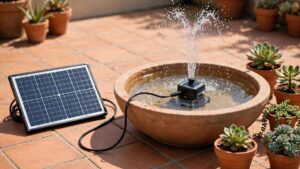
The AquaJet Pro is the only solar pump in this shortlist, and it answers a different question from the corded models: what do you do with a birdbath or a container fountain that sits far from any outlet? A brushless DC motor running on 6 to 9 volts, a 16.5 foot cable and four included fountain heads make it a self-contained display for a sunny spot, and the listed dry run protection means a basin that empties in the afternoon sun does not kill the pump. Flow near 87 gallons per hour and a 49 inch head suit a low, gentle display rather than a tall column. Treat it as a sun-powered accent for a small basin, and it earns its place without a single cable run back to the house.
The listed figure of 87 GPH sets the working range, and the protection is what makes that range safe to use in heat. When the basin level falls on a hot afternoon, the sensor or shut-off stops the motor before it can run dry, and the pump waits for a refill instead of wearing itself out. Keep the intake clear of leaves and algae, top the basin up in the evening, and the pump will hold its display through the hottest weeks without needing attention.
Pros:
- Dry-run or low-water protection is listed on the product page
- Flow class suits the basin named in the table
- Submersible build suits fountain duty in warm water
Cons:
- Protection guards the pump but does not add water to the basin
- Flow class suits its own basin size; a much larger fountain needs a bigger model
Buying guide
Start with the basin, not the pump. Measure the depth of water the fountain actually holds on a hot afternoon, not the depth it holds after a fresh fill in the morning, because evaporation and splash can take an inch or more off a shallow bowl before lunch. A pump whose sensor sits above that afternoon level will shut off constantly, and a pump with no sensor at all will run dry. The flow class should match the display: a tabletop bowl needs a gentle flow that stays inside the rim, a wide basin can take a stronger flow, and a tiered fountain needs enough lift to reach the top tier with water to spare. Read the maximum lift figure as a ceiling, not a working height; a pump rated to 6.5 feet will push a much weaker flow at 6 feet than it does at 2 feet, so leave margin for the hottest days.
Protection comes in different shapes, and the wording on the product page matters. A low-water shut-off sensor watches the level and stops the motor, an auto shutoff does the same job under a shorter name, and dry-run protection is the general term for the same safeguard. What matters in practice is that the protection acts on its own, without anyone standing by the basin. Some pumps restart on their own once the level rises again, while others need a manual reset, and the product page is the place to check which kind you are buying. If the page does not say the pump restarts by itself, plan on checking the basin after every refill, and do not assume a pump that stopped in the afternoon will be running again by evening.
Cord length decides where the fountain can live. A 6 foot cord suits a basin near the house wall, while a longer cable lets you place the feature where it catches a little afternoon shade, and shade slows both evaporation and algae growth. Never run an extension lead across a wet patio to reach a fountain if a longer-cord pump would do the job, and keep every connection above the waterline and out of standing water. Wattage matters too, because a fountain pump in a hot climate often runs all day. A 7.7 watt pump costs far less to run through a long summer than a 43 watt one, and the difference adds up across a season of daily running.
Warm water grows algae fast, and algae reaches the intake sooner than most owners expect. A pump with a removable pre-filter or a screened intake is easier to keep running in July, and a weekly rinse of the intake takes minutes and avoids the slow loss of flow that owners often mistake for a failing pump. When you clean the basin, lift the pump out, rinse the intake and the impeller housing, and check the cord for nicks before putting it back. Keep the basin topped up in the evening so the pump starts the next hot day with a full basin, and consider a timer so the fountain rests during the hottest, windiest part of the afternoon when splash losses are worst.
Finally, match the pump to the fountain you own, not the fountain you wish you owned. A tall column needs lift, a wide bowl needs flow, a shallow birdbath needs a small pump with strong protection, and a solar pump needs direct sun for most of the day. Buy the flow class that fits the basin, check that the protection is listed on the product page, measure the cord run before you order, and keep a spare impeller or a second small pump on hand if the fountain is the centrepiece of a patio you use every evening. A pump that survives August is worth more than a pump that looks impressive in May and fails in July.
FAQ
How does dry run protection actually work in a fountain pump?
A sensor or a float watches the water level around the pump, and when the level falls below the point where the intake can draw water, the pump stops the motor. The pump is not damaged by running with no water because it never gets the chance to run dry for long. Some models restart on their own once the basin is refilled, while others need to be switched off and on again, so read the product page for the restart behaviour of the model you buy. Either way, the protection turns a forgotten refill into a paused fountain instead of a dead pump.
How often should I refill a fountain in hot summer weather?
A shallow basin in full sun can lose a noticeable amount of water every day to evaporation and splash, and a windy afternoon makes it worse. Most owners in hot climates top up daily in July and August, often in the evening when the water is cooler and the pump can start the next day with a full basin. Deeper basins lose water more slowly, and a flow control turned down a little reduces splash losses. Watch the level for a week after you install a new pump and you will learn how fast your own basin empties.
Does a higher flow rate mean a better fountain display?
Not always. A higher flow rate gives a taller, livelier plume, but it also throws more water outside the bowl, empties the basin faster and can overwhelm a small tiered fountain. The right flow rate is the one that fills the tiers without splashing over the rim on a breezy day. A pump with adjustable flow lets you find that point by hand, and a pump with a shut-off sensor protects the motor while you do it. Start low, open the flow a little at a time, and stop when the display looks full without throwing water.
Can I run a fountain pump all day in summer?
Most submersible fountain pumps are built for continuous running, and the models in this guide are sold for that duty. The real limits are heat, water level and cleanliness. Keep the basin topped up so the pump stays submerged, rinse the intake weekly so algae does not choke the flow, and give the fountain a rest during the hottest part of the afternoon if splash losses are high. A pump with dry-run protection adds a safety net for the days you forget, but it does not replace topping up the basin.
What flow rate does a typical garden fountain need?
A small tabletop or birdbath fountain usually runs well near 80 to 160 gallons per hour, a medium tiered fountain near 200 to 300 gallons per hour, and a wide basin or a tall display near 500 gallons per hour. Lift matters as much as flow: a tall fountain needs a pump whose maximum lift clears the top tier with room to spare. Use the figures on the product page, measure the height from the pump to the top of the display, and choose a pump whose lift and flow both clear that height.
Is a solar fountain pump a good choice for hot climates?
A solar pump suits a small, sunny basin far from an outlet, because it needs no cable run and runs hardest when the sun is strongest. Its flow depends on sunlight, so it slows on cloudy afternoons and stops after dark, and its lift is modest. For a main garden fountain that should run into the evening, a corded electric pump with a shut-off sensor is the steadier choice. Use solar where the basin is small, the display is low and the sun is reliable, and use mains power where the fountain is the centrepiece.
Conclusion
Hot weather does not ask a fountain pump to do anything new; it asks the same job under harder conditions, with less water, warmer water and faster evaporation. The seven pumps in this guide answer with the same safeguard in different sizes: a sensor or an automatic shut-off that stops the motor when the level falls, from the small solar AquaJet Pro to the 500 gallon per hour smartpond model. Choose by basin first and by flow second, check that the maximum lift clears the top of your display, and measure the cord run before you order. Keep the intake clean, top the basin up in the evening, and let the shut-off sensor cover the afternoons you forget. A pump that survives the summer is the one that was protected when the water ran low, and that protection is the cheapest insurance a garden fountain can have.

Write Your Review
No reviews yet. Be the first to share your experience!