
Key takeaways
- Compare solar pond pumps for small backyard ponds by listed flow, lift, battery status and cord length, from direct-sun kits to battery models for cloudy days.
What's inside
As an Amazon Associate I earn from qualifying purchases. This post may contain affiliate links at no extra cost to you.
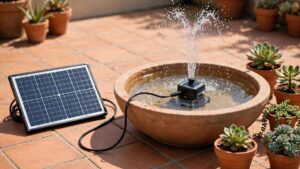
A small backyard pond asks little from a pump, but it asks for the right things. The water volume is modest, the distance from the pond edge to a sunny patch of ground is usually short, and most owners want movement, a small spray, or a gentle feed to a raised spout or a short run of tubing rather than a large waterfall. That is exactly the job solar kits are built for, as long as the expectations match what sunlight can actually deliver on a given day.
This guide compares the best solar pond water pumps for small backyard ponds by the figures their makers and product pages actually list: panel wattage, maximum flow, maximum lift where a clear figure is given, cord length, and, most importantly, battery status stated plainly for each model. Some of the kits below include a battery. Some include a battery only as a buffer for passing cloud. Some have no battery at all and run only while the panel sits in direct sun. Those are three different products in daily use, even when the boxes look similar in a photograph.
Read the battery line for each kit before anything else. A direct-sun kit that stops in shade is not a faulty kit; the product page lists it that way. A battery kit that stops at sunset is also working as its maker describes, even if the word battery on the box led a buyer to expect night running. Only one kit in this set is described by its maker as running after dark, and its runtime figure, its manual switching step, and its shorter runtime on cloudy days are all covered in its section below.
Quick verdict
For a small pond that needs the strongest listed flow in this set and a feed for tubing or a DIY feature, the POPOSOAP 12W kit leads on panel size and flow, and it is a direct-sun model with no battery included. For a pond in a spot that loses sun to passing cloud or brief shade, the POPOSOAP 6.5W model with a built-in 3000mAh battery adds a buffer, though its maker says it stops once the sun sets. For evening running, the Sunnydaze AMP-P022C is the kit in this set with a battery mode its maker rates at up to four hours on a full charge. For a sunny pond that only needs a light spray in bright hours, the plain POPOSOAP 6.5W P1065 covers the basics with no battery to maintain. For the simplest and smallest setup, the Sunnydaze AMP-P001B1 pairs a very small panel with a long cord and runs in direct sun only.
None of the product pages opened for this guide lists a decibel figure for any of these kits. That gap is stated plainly here and in the buying guide, rather than filled with a guessed noise number. Buyers who need a confirmed sound level for a quiet seating area will need to ask the maker directly, because the listings themselves do not provide one.
| Product | Key spec | Best for |
|---|---|---|
| POPOSOAP 12W Solar Water Pump | 12W panel, 160 GPH, 4.9 ft max lift on the product page, no battery | Stronger flow and tubing feeds in full sun |
| POPOSOAP 6.5W Solar Fountain Pump with 3000mAh Battery (P1065D) | 6.5W panel, 80 GPH, 5.6 ft max lift, built-in 3000mAh battery | Ponds that lose sun to passing cloud |
| Sunnydaze 65 GPH Solar Pump and Panel Kit (AMP-P022C) | 2.5W panel, 65 GPH, 47 in max lift, battery included | Evening running for up to four hours on a full charge |
| POPOSOAP 6.5W Solar Fountain Pump (P1065) | 6.5W panel, 80 GPH, 5.6 ft max lift, no battery | Sunny ponds that need a spray in bright hours only |
| Sunnydaze 40 GPH Solar Pump and Panel Kit (AMP-P001B1) | 1.3W panel, 40 GPH, 16 ft cord, no battery | The simplest small direct-sun setup |
How we chose
The first filter was size. Every kit in this guide is a small separate-panel kit suited to a small backyard pond, not a large mains-powered circulation pump and not a tiny floating disc with no published maker figures. Each product is a specific model with a name or model number that a buyer can match on a listing, and each one is sold for pond and outdoor water feature use.
The second filter was published figures. A kit stayed in the set only if its maker page, manual, or product page lists panel wattage and a maximum flow figure in plain numbers. Where lift figures conflict between a maker's own sources, no lift figure is printed for that kit in this guide, and the conflict is noted in that product section instead of picking the larger number. Flow and lift in this article are given only as listed on the pages opened for each product.
The third filter was honest battery wording. Battery status is reported exactly as the opened page states it: battery included, battery backup built in, an optional battery sold separately, or direct-sun only with no battery. No direct-sun kit in this guide is described as having backup power, and no battery buffer kit is described as a night-running kit unless its maker says so. This matters more than any other line in the specs, because it decides whether the pond moves on a cloudy afternoon and whether it moves after sunset.
The fourth filter was practical pond fit: cord length long enough to place the panel in sun while the pump stays in the pond, a stated water depth range where the maker gives one, dry-run protection where the maker lists it, and cleaning steps a pond owner can actually follow. Kits also had to be freshwater products, since every manual opened for this set limits use to freshwater.
No recalled model from the standing recall list for this programme appears in this set, and no product here is a floating disc with unpublished specs. Prices and ratings are not used in this guide at all; the comparison rests on listed figures and stated features only.
POPOSOAP 12W Solar Water Pump
- Solar panel: 12W, 18V, listed at 13.4 by 8.6 inches
- Maximum flow: 160 GPH, with adjustable flow
- Maximum lift: 4.9 ft, as listed on the product page
- Battery status: direct-sun only; the product page lists no power storage function, no battery included, and states the pump does not work at night
- Cord: 16.4 ft cable between panel and pump
- Pump size: 4.1 by 2.0 by 2.3 inches, submersible
- Included: solar panel, pump, plastic stake, PVC tubing, 2 filters, 4 nozzles, and a user manual
- Extra features the product page lists: dry-run protection and replacement sponge filters
This is the strongest kit in the set on listed numbers, and the product page is unusually blunt about its limit: it has no power storage function and works only when sunlight reaches the panel. That honesty makes it easy to place. Put it on a small pond that sits in a sunny part of the yard, where a spray or a tubing feed is wanted during bright hours and still water in the evening is acceptable. The adjustable flow helps here, because a small pond rarely needs the full 160 GPH turned toward a fountain head; the same pump can feed a gentler display or push water through the included tubing to a spout or a small raised feature.
The 16.4 ft cord is the other practical strength. In many backyards the pond is dug where it looks right, not where the sun is strongest at midday, and a long cord lets the panel sit on a stake in open sun while the pump stays submerged in the pond. The maker also notes the pump housing can be opened for cleaning when dirt blocks it, and that the pump must sit fully underwater with the nozzle above the surface. Plan on regular cleaning in a real pond, where leaves, algae, and sediment reach any intake far faster than they do in a clean display bowl.
Pros: Highest listed flow in this set at 160 GPH; adjustable flow; long 16.4 ft cord; tubing and four nozzles included; dry-run protection listed on the product page.
Cons: No battery at all, so it stops at night and in heavy shade; the product page states this plainly, so buyers who want evening movement should choose a battery model instead; needs the panel in direct sun for steady running.
POPOSOAP 6.5W Solar Fountain Pump with 3000mAh Battery (P1065D)
- Solar panel: 6.5W, tempered glass with rainproof film
- Pump: 3W
- Maximum flow: 80 GPH
- Maximum lift: 5.6 ft; spray height up to 3.6 ft
- Battery status: battery backup built in; a 3000mAh battery built into the back of the panel
- Cord: 9.85 ft
- Water depth: 1.2 to 8 inches, as listed
- Filter: two-way pre-filter plus 2 spare sponges
- Extra features the maker lists: dry-run sensor that stops the pump when the water drops below the sensor
This model takes the plain 6.5W POPOSOAP kit below and adds a built-in 3000mAh battery on the back of the panel. The maker describes what that battery does in narrow terms, and this guide keeps those terms: the battery helps on cloudy days or in shade, and the pump stops working once the sun sets. The maker publishes no runtime figure for this battery, so no hours are claimed for it here. Think of it as a buffer that smooths out passing cloud and brief tree shade during the day, not as stored power for the evening.
For a small backyard pond, that buffer is often the difference between a display that sputters every few minutes and one that keeps a steady pattern through a mixed afternoon. The rest of the kit matches the plain version: the same 80 GPH flow, the same 5.6 ft lift figure, a dry-run sensor, and a pre-filter with spare sponges. The maker also lists what this kit is not for, naming large tiered fountains, strong waterfalls, and deep ponds, which fits the small-pond scope of this guide. One open point is battery replacement: the battery is built into the panel, and the maker does not state whether it can be replaced, so buyers who keep equipment for many seasons should weigh that before choosing it over a kit with replaceable cells.
Pros: Built-in 3000mAh battery smooths flow through passing cloud and light shade; dry-run sensor; pre-filter with two spare sponges included; separate panel on a stake with a 9.85 ft cord.
Cons: Stops at sunset by design, according to the maker; no battery runtime figure is published; the built-in battery's replacement path is not documented on the maker page.
Sunnydaze 65 GPH Solar Pump and Panel Kit with Battery and LED Light (AMP-P022C)
- Solar panel: 2.5W, listed at 9 by 7.5 inches
- Pump operation: 6V to 9V DC
- Maximum flow: 65 GPH, listed as 250 litres per hour in the manual technical data
- Maximum lift: 47 inches, listed as 1.2 metres in the manual technical data
- Battery status: battery included; 4 AA Ni-MH rechargeable batteries, 1500mAh, user-replaceable, installed in the battery case of the solar panel
- Battery runtime: up to 4 hours on a full charge in battery-powered mode, according to the manual; significantly less after cloudy days
- Cord: panel placed within 16 ft of the pump
- Light: LED ring, 6V DC operation, works at night only in battery-powered mode
- Included: panel, pump, 4 extension tubes, 6 spray heads, and a ground stake
- Warranty: 1-year manufacturer warranty, as stated in the manual
This is the only kit in the set whose maker describes true after-dark running. The manual sets out two modes. In solar-powered mode, recommended for daytime, the pump runs in bright or good sunlight and surplus power charges the batteries; the manual states the pump will not work on cloudy days in this mode because there is not enough power. In battery-powered mode, recommended for nighttime or a cloudy day, the pump draws on the stored charge for up to four hours after a bright day. When the battery runs low, the kit switches back to solar-powered mode on its own, and battery mode must be turned back on by hand; the manual is clear that this step is not automatic.
The replaceable batteries are a genuine long-term point in this kit's favour. The manual explains that rechargeable batteries grow less efficient with repeated charge and discharge cycles, describes a boost charge of two to three sunny days with the pump and light cables disconnected, and gives steps for opening the battery cover and replacing the four AA rechargeable batteries with compatible ones. The flow figure is the smallest-but-one in this set, so this kit suits a small pond where evening movement and the LED ring matter more than a tall or forceful spray. Its dry-run protection is also stated in the manual, which describes the pump as designed with that protection for fountain and pond use.
Pros: Battery included and user-replaceable; battery mode runs the pump at night or on an overcast day for up to four hours on a full charge; LED ring for evening use; full manual with battery care and boost charge steps.
Cons: Battery mode must be switched on by hand each time; only a 2.5W panel must both run the pump and charge the batteries; runtime drops sharply after cloudy days, according to the manual; modest 65 GPH flow.
POPOSOAP 6.5W Solar Fountain Pump (P1065)
- Solar panel: 6.5W glass panel on a 180-degree ground stake
- Pump: 3W brushless
- Maximum flow: 80 GPH
- Maximum lift: 5.6 ft; spray height up to 3.6 ft
- Battery status: no battery; direct-sun only
- Cord: about 10 ft, listed as 9.8 ft
- Water depth: 1.2 to 8 inches, as listed
- Nozzles: 8 spray styles plus a double-layer nozzle, with 5 ft of tubing
- Extra features the maker lists: dry-run sensor, and a pump that can float on a foam ring or sit submerged on suction cups
- Warranty: 1-year replacement, as listed
The plain P1065 is the direct-sun twin of the battery model above, and the maker does not soften the limit: with no battery, it will not work at night or during heavy cloud cover. In return, there is nothing to charge, no battery to fade, and no mode to switch. On a small pond that gets full sun for the main part of the day, that simplicity is a fair trade, and the 80 GPH flow with a 5.6 ft lift figure is enough for a spray pattern or a small tubing feed to a pot or dripper feature.
The panel stake rotates 180 degrees and can be set in the ground or mounted, which helps aim the panel at the sun in a yard where the best angle changes with the season. The dry-run sensor is described in the manual in concrete terms: if the water drops below the silver sensor, a light turns red and the pump stops on its own. That is a useful guard in a small pond in summer, where evaporation can lower the level faster than owners expect. The maker recommends a light cleaning every week, taking off the front cover and rinsing the filter sponge, and that rhythm is worth accepting before purchase rather than discovering it later.
Pros: Simple direct-sun kit with no battery to maintain; 80 GPH flow and 5.6 ft listed lift; dry-run sensor stops the pump at low water; eight spray styles plus tubing included; panel stake rotates 180 degrees.
Cons: No battery, so it stops in shade, heavy cloud, and at night; weekly cleaning is recommended in the manual; needs at least 1.2 inches of water depth as listed, which rules out the very shallowest basins.
Sunnydaze 40 GPH Solar Pump and Panel Kit with 5 Spray Heads (AMP-P001B1)
- Solar panel: 1.3W on a ground spike
- Pump: 6V DC brushless
- Maximum flow: 40 GPH, listed as 150 litres per hour in the manual technical data
- Maximum lift: no figure is printed in this guide, because the maker's own product page and manual give different lift figures for this kit
- Battery status: no battery; the manual states the kit is designed to operate only during daytime hours while the panel receives direct sunlight
- Cord: 16 ft cable, listed as 5 metres in the manual; the maker also sells a further extension
- Nozzles: 5 spray heads plus four 2-inch extension tubes
- Water temperature range in the manual: above freezing and no warmer than 95 degrees Fahrenheit
- Extra features the maker lists: dry-run protection, so the motor does not run unless the pump is wet
- Warranty: 1-year manufacturer warranty
This is the smallest and simplest kit in the set, built around a 1.3W panel and a 40 GPH pump. That output will not drive a tall feature, and this guide does not print a lift figure for it at all, because the maker's own sources disagree on the number; a buyer who needs a specific spray height should confirm the figure on the current listing for model AMP-P001B1 before ordering. What the kit does offer is a long 16 ft cord for a product of this size, five spray heads for changing the pattern, and dry-run protection, all in a package with very little to set up or maintain.
For a small backyard pond, the fit is narrow but real: a sunny corner pond where a gentle spray during bright hours is the whole goal, and where still water at other times is no drawback. The manual adds plain care rules that suit pond use: operate in freshwater only, do not use bleach to clean any part of the kit, and dry the components and store them inside during freezing weather. The manual also suggests a gentle tap on the side of the pump to release trapped air bubbles if the pump will not start, a small detail that can save a new owner a return.
Pros: Simplest kit in the set; long 16 ft cord for panel placement; five spray heads included; dry-run protection listed; clear manual guidance on cleaning and winter storage.
Cons: Smallest panel and flow in the set at 1.3W and 40 GPH; no battery, so direct sun only; the maker's own sources disagree on lift, so no lift figure can be stated with confidence; freshwater use only.
Buying guide
Start with the sun, not the pump. Walk to the pond at mid-morning, at midday, and in mid-afternoon, and note when direct sun reaches the water and the ground beside it. A solar kit runs on the light that reaches its panel, so the honest hours of sun at the panel spot decide which type of kit fits. A pond with long, open sun can use a direct-sun kit and never miss a battery. A pond shaded by a fence or a tree for part of the day will show every passing shadow in its spray pattern unless the kit has a battery buffer or the panel can be placed, on its cord, in a sunnier spot some feet away.
Then separate the three battery situations, because they are the most common source of disappointment with these products. A direct-sun kit, like the POPOSOAP 12W, the plain POPOSOAP P1065, and the Sunnydaze AMP-P001B1 in this guide, has no battery and stops when the panel is shaded or the day ends; the product pages state this, in the POPOSOAP 12W's case in capital terms. A battery buffer kit, like the POPOSOAP P1065D, carries a built-in battery that helps through cloud and shade during the day, but its maker says it stops at sunset and publishes no runtime. A battery mode kit, like the Sunnydaze AMP-P022C, stores charge for use at night or on an overcast day, with a stated runtime of up to four hours on a full charge and a manual step to switch that mode on. Match the purchase to the situation named on the page, not to the word battery alone.
Flow comes next. The listed figures in this set run from 40 GPH to 160 GPH, and all of them are maximum figures reached in strong sun. For a small pond, flow decides the character of the display more than its size: a lower figure gives a soft spray and gentle surface movement, while a higher figure can feed tubing, a spout, or a more lively pattern. If the plan involves pushing water upward to a raised outlet, lift matters as much as flow. Lift is the highest point the maker rates the pump to push water through a tube, and the working height in a real feature will sit below that maximum. Note the honest gap in this set: for the Sunnydaze AMP-P001B1, the maker's own sources give different lift figures, so this guide prints none, and a buyer set on that kit should confirm the number on the current listing.
Cord length is the quiet deciding factor in many yards. The kits here list cords from about 10 ft to 16.4 ft. A longer cord means the panel can sit in open sun on the far side of a path or a planting bed while the pump stays in the pond. Measure the distance from the pond's edge to the sunniest suitable ground before ordering, and use only the maker's own extension where one is offered; the manuals warn against altering components, and one manual states that modification voids the warranty. Never lift a pump by its cable, a warning repeated across the manuals opened for this guide.
Water depth and dry-run protection deserve a look before the first fill. Two POPOSOAP models here list a working depth range starting at 1.2 inches, and the 12W POPOSOAP kit needs deeper water than the birdbath-sized models, so a very shallow pond edge may not suit it. Every kit in this set lists some form of dry-run protection or sensor, which stops the pump when the water level falls too low. That feature guards the motor, but it is not a substitute for topping up the pond in hot weather, when evaporation and splash-out from a lively spray pattern can lower a small pond's level quickly. Choosing a gentler nozzle in a small pond reduces splash-out and the refilling that follows it.
Noise is the one common question these listings do not answer. None of the product pages or manuals opened for this guide lists a decibel figure for any kit here, so this guide states that gap plainly rather than assigning a sound level. Small solar pumps move modest volumes of water and run only in daylight or for a few stored hours, but a buyer who plans to sit close to the pond and needs a confirmed figure should ask the maker for one in writing before ordering, because the published pages provide none.
Filtration and cleaning shape the weekly routine. These are fountain and circulation kits, not full pond filter systems. The POPOSOAP models include sponge filters or a pre-filter, and their manuals recommend a light cleaning every week: unplug the pump, remove the front cover, rinse the sponge, and clear the impeller if flow still lags. The Sunnydaze manuals cover the same steps and add that bleach must not be used on any component. In a pond with fish, falling leaves, or string algae, expect the intake to need attention more often than in a clean ornamental bowl, and choose a kit whose housing opens easily if the pond carries a lot of debris.
Panel care is simple and often skipped. Dust, pollen, and droppings on the panel face cut the power the pump receives, so a wipe with a soft cloth matters. One maker advises cleaning the panel early or late in the day because panels grow very hot in sunshine, and aiming the panel south in the northern hemisphere, angled toward the sun at its highest point, with no shade from trees, shrubs, or buildings falling on it during the day.
Winter care closes the loop. The Sunnydaze manuals instruct owners to dry all components and store them inside during freezing weather, and not to allow the kit to freeze. Freshwater use only is another rule repeated across these manuals, along with upper water temperature limits on some models. A small solar kit that is cleaned weekly, kept submerged, and stored dry over winter is the version of these products that owners keep running season after season; the manuals are consistent on that point even where their specs differ.
FAQ
Do solar pond pumps work on cloudy days?
It depends on the battery status of the kit. Direct-sun kits in this guide stop or falter when the panel is shaded or the sky is heavily overcast, and their makers say so: the Sunnydaze manual states the AMP-P022C will not work on cloudy days in solar mode, and the POPOSOAP 12W product page states it works only when sunlight provides power. A kit with a built-in battery buffer, like the POPOSOAP P1065D, is described by its maker as helping on cloudy days or in shade. A kit with a battery mode, like the AMP-P022C switched to battery power, can run on stored charge on an overcast day, for less time than after a bright day.
Can a solar pond pump run at night?
Only a kit whose maker builds it for night running. In this set, that is the Sunnydaze AMP-P022C: its manual describes a battery-powered mode for nighttime use that runs the pump for up to four hours on a full charge, with its LED ring working at night in that mode. The POPOSOAP P1065D battery model stops once the sun sets, according to its maker, and the direct-sun kits here do not run at night at all. Check the battery line of any kit before assuming evening operation.
How much flow does a small backyard pond need?
For a spray, a bubbler, or gentle surface movement in a small pond, the listed range in this set, from 40 GPH up to 160 GPH, covers most setups. Lower figures suit a soft display in a small volume of water. Higher figures suit a pond where the pump also feeds tubing or a raised spout. All of these figures are maximums reached in strong sun, so a kit will move less water on a weaker day. The POPOSOAP 12W page suggests its kit for ponds in a modest size range and lists an adjustable valve, which lets an owner turn the flow down rather than run a small pond at full output.
Why does a solar pond pump keep stopping and starting?
The manuals opened for this guide point to a short list of causes: shade or cloud crossing the panel, a dirty panel face, a clogged filter sponge, intake, or impeller, and low water tripping the dry-run protection. On battery models, an aging battery is a further cause; the Sunnydaze manual notes that rechargeable batteries grow less efficient with repeated cycles and describes a boost charge and, if that fails, replacement of the AA cells in the AMP-P022C. Checking those items in that order resolves most stop-and-start behaviour described in the manuals.
How deep does the water need to be?
Deep enough to keep the pump fully submerged at all times, which every manual here requires. Beyond that general rule, figures vary by model: the POPOSOAP 6.5W models list a water depth range of 1.2 to 8 inches, while the Sunnydaze kits state the submersion rule without a numbered minimum. In a small pond, place the pump in the deeper part of the basin rather than at a shallow edge, and top up the level in hot weather so evaporation does not expose the pump or trip its dry-run shutoff.
Are these solar pond pumps loud?
The honest answer from the pages opened for this guide is that no sound figure is published. None of the product pages or manuals for the five kits here lists a decibel rating, so this guide does not assign one. A buyer for whom a confirmed noise level matters should ask the maker directly before ordering, rather than relying on general descriptions in listings, which do not state a measured figure for these kits.
Conclusion
The right solar pump for a small backyard pond is the one whose listed limits match the pond's sun. Choose the POPOSOAP 12W for the strongest listed flow and a tubing feed in a sunny yard, and accept that it stops when the sun does. Choose the POPOSOAP P1065D when passing cloud interrupts an otherwise sunny pond and a daytime buffer is enough. Choose the Sunnydaze AMP-P022C when evening movement is the point, with replaceable batteries and up to four hours of battery running on a full charge. Choose the plain POPOSOAP P1065 for simple bright-hours spraying with nothing to charge, and the Sunnydaze AMP-P001B1 for the smallest, simplest direct-sun setup on a long cord.
Whichever kit fits, the same habits keep it running: place the panel in unshaded sun on its cord, keep the pump submerged, rinse the sponge and clear the intake on a weekly rhythm, and store the kit dry before freezing weather. Read the battery line and the flow and lift figures on the listing one last time before ordering, confirm any figure the maker states two ways, and the small pond will get exactly the movement the page promised, no more and no less.

Write Your Review
No reviews yet. Be the first to share your experience!