
Key takeaways
- Compare rain barrel systems for vegetable gardens, with capacity, spigots, overflow, screens, stands, and diverter kits for watering beds by gravity flow daily.
What's inside
As an Amazon Associate I earn from qualifying purchases. This post may contain affiliate links at no extra cost to you.
Vegetable gardens drink steadily through the season, and they drink most exactly when the sky gives least. A barrel under a downspout turns a single storm into days of watering for tomatoes, beans, and salad beds, and a linked set of barrels stretches that store further. That is why best rain barrel systems for vegetable garden watering are judged here as systems, not as bare tanks: the screen, the spigot, the overflow route, and the way barrels join together decide how useful the stored water really is.
Every barrel in this guide holds 50 gallons, which keeps the comparison honest. What differs is the working detail around that capacity: one model arrives with a diverter kit, one stands raised for easy can filling, one hides a planter on top, and several link in series so capacity can grow with the plot. Specs are taken from the page opened for each model, including dimensions, weight, spigot type, and overflow design.
For vegetables, gravity is both the charm and the limit of a barrel. Water flows freely to cans and to beds below barrel level, and slows as the store empties. Placement, height, and hose route therefore matter as much as capacity, and the buying guide below works through those choices before the individual reviews ask you to pick a favourite.
Quick verdict
The FCMP Outdoor Raincatcher 4000 is the most complete system here for a growing vegetable plot, thanks to its linking spigots and included hose. The Rain Wizard 50 with Diverter Kit is the easiest first installation, the Newport is the pick for daily can filling, and the Urn 50 and Athena suit spots where the barrel stays in view.
| Product | Key spec | Best for |
|---|---|---|
| FCMP Outdoor Raincatcher 4000 (RC4000-BLK) | 50 gallons, flat back, linkable side spigots, debris screen fitted | Best complete system for linking barrels in series |
| Good Ideas Rain Wizard 50 | 50 gallons, brass spigot, flat back, front overflow channel | Best classic barrel for a single downspout |
| Good Ideas Rain Wizard Urn 50 | 50 gallons, two brass spigots, self-draining planter top | Best for a visible spot near the vegetable beds |
| RTS Home Accents 50-Gallon Flat Back Rain Barrel | 50 gallons, flat back, brass spigot, UV-resistant polyethylene | Best value pattern for wall-side vegetable watering |
| Algreen Athena 50 Gallon Rain Barrel (86312) | 50 gallons, brass spigot with shut-off, two overflow ports | Best decorative barrel with a planter-style top |
| RTS Home Accents 50-Gallon Newport Rain Barrel | 50 gallons, included stand, brass spigot, overflow on both sides | Best for filling watering cans without stooping |
| Good Ideas Rain Wizard 50 with Diverter Kit | 50 gallons, diverter kit included, brass spigot, flat back | Best ready-made kit for a standard downspout |
How we chose
- Only complete barrels and kits with a listed spigot, screen, and overflow route were included, so each pick works as a system from the day it is installed.
- Capacity, dimensions, and empty weight were taken from the page opened for each model, so footprint planning uses the maker's own figures.
- Spigot material was recorded for every pick, because a brass spigot handles seasons of hose and can use better than a thin plastic tap.
- Linking and overflow designs were compared closely, since expanding storage and routing storm overflow decide how a system copes at its limits.
- Formats were varied on purpose: flat-back wall barrels, a raised barrel on a stand, planter-top models, and a diverter kit, covering the main ways vegetable gardeners install barrels.
Each product below is presented in the same order as the comparison table, with the maker's listed specs first, a short discussion of where the product fits, and a plain statement of its strengths and limits. No prices appear in this article, and no rating is quoted for any product, because neither is needed to judge fit for a particular garden.
FCMP Outdoor Raincatcher 4000 (RC4000-BLK)
- Capacity: 50 gallons
- Size: 24 x 24 x 32 inches, flat back for wall placement
- Material: recycled plastic, UV resistant listing
- Debris screen: yes, with closed lid design
- Overflow: 1 built-in overflow connection at the back
- Hose included: yes, with side spigots for linking barrels in series
- Weight when empty: 25 lb
A rain barrel earns the word system when the parts for collecting, storing, and using water arrive together, and the Raincatcher 4000 is built that way. The flat back sits against a wall under a downspout, the debris screen covers the inlet, and the side spigots let a second and third barrel join in series as a vegetable plot grows. For vegetable watering, that linkable design is the practical headline: one barrel rarely covers a thirsty bed of tomatoes in a dry week, while two or three linked barrels smooth out the gaps between storms. The overflow connection at the back routes excess water down and away from foundations, which matters when a summer storm fills the barrel faster than the garden can take it. The included hose gives a gravity feed for a watering can or a slow soak at the base of plants near the barrel.
Pros: Linking spigots support a growing multi-barrel system; Debris screen and closed lid keep the store covered; Overflow connection directs excess water away from the wall.
Cons: Rigid body does not collapse for winter storage; A single barrel still fills and empties quickly in peak season.
Good Ideas Rain Wizard 50
- Capacity: 50 gallons
- Size: 23 in wide x 22 in deep x 30 in high
- Weight: 20 lb
- Spigot: standard 3/4 inch brass spigot included
- Screen: fine mesh screen at the inlet
- Design: flat back with front-facing overflow, linkable to other barrels
The Rain Wizard 50 is the long-running pattern for a home rain barrel: a faux oak finish, a flat back that rests against the house, and a brass spigot for a hose or watering can. The front-facing overflow is a thoughtful detail for vegetable gardens beside a house wall, because excess water is directed out into the yard rather than down the foundation line. The mesh screen at the top keeps leaves and roof grit out of the store, which keeps the water cleaner for use on beds. Linking points allow a second barrel later, using a separately sold linking kit, so the first barrel does not lock you into a fixed capacity. At 20 lb empty, one person can position it, level the base, and connect the downspout without help, which suits a weekend setup before the growing season starts.
Pros: Brass spigot suits hose and watering can use; Front overflow protects the wall behind the barrel; Light enough for one person to position and level.
Cons: Linking kit is a separate purchase; Planter-free top gives no extra growing space.
Good Ideas Rain Wizard Urn 50
- Capacity: 50 gallons
- Size: 23 in wide x 22 in deep x 30 in high
- Weight: 17 lb
- Spigots: two brass spigots, lower for use and upper for buckets or linking
- Top: self-draining planter top with meshed screen
- Overflow: integrated routed channel directs overflow to the front
- Material: polyethylene resin with a terra-cotta urn appearance
Where a barrel must sit in view, beside a patio or at the end of a vegetable bed, the Urn 50 hides its working parts inside an urn shape with a planter top for herbs or flowers. The two spigot positions are the useful detail: the lower spigot draws the barrel down fully for hoses, while the upper spigot fills a bucket without a hose at all, which is how much vegetable watering actually happens in a small garden. The planter top self-drains, so a pot of basil on top does not sit in standing water after rain. The routed overflow channel moves excess water to the front of the barrel, away from the wall. At 17 lb empty it is the lightest rigid barrel in this guide, which helps when the chosen spot needs adjusting after the first season shows where runoff really falls.
Pros: Two spigot heights suit both hoses and bucket filling; Planter top adds herbs or flowers above the store; Lightest rigid barrel in this group when empty.
Cons: Urn shape holds the same 50 gallons in a taller visual profile; Planter top space is shallow, for small herbs rather than crops.
RTS Home Accents 50-Gallon Flat Back Rain Barrel
- Capacity: 50 gallons
- Size: about 21 x 19 x 34 inches
- Weight: about 18 lb
- Material: UV-resistant polyethylene
- Spigot: brass spigot fitted
- Design: flat back to sit flush against a wall, linkable to a second barrel
The RTS Flat Back follows the same proven layout as the other wall-side barrels here, with a flat back, a brass spigot, and an overflow that can link onward to a second barrel. Its taller, narrower footprint suits the strip beside a garage or shed where vegetable gardeners often have room for storage but not for a wide tank. The UV-resistant polyethylene body is the listing detail that matters for a barrel that will live outdoors through summer sun, season after season. For vegetable watering, the working pattern is simple: fill cans at the spigot for seedlings and containers, and run a hose or soaker from the spigot for beds within gravity reach. Pairing two of these barrels is a common way to double storage without changing the downspout work, since the first installation sets the level base and overflow route for both.
Pros: Flat back and narrow depth fit tight wall-side strips; Brass spigot and linking overflow support expansion; UV-resistant body listed for long outdoor exposure.
Cons: Gravity flow only, so distant beds need cans or a pump; Oak-look finish may not suit a modern garden scheme.
Algreen Athena 50 Gallon Rain Barrel (86312)
- Capacity: 50 gallons
- Size: 24 in long x 18.3 in wide x 31.7 in high
- Weight: 14.5 lb
- Spigot: brass spigot with shut-off nozzle
- Screen: corrosion-proof screen guard at the inlet
- Overflow: bottom fitting attachment with 2 overflow ports for a collection system
The Athena presents itself as a large planter first and a barrel second, with a brownstone-style finish that sits comfortably among pots and raised beds. Under that finish, the listed fittings are complete for vegetable watering: a brass spigot with a shut-off nozzle for controlled filling of cans, a screen guard that keeps debris out of the inlet, and two overflow ports that let the barrel join a wider collection system or shed excess water in a storm. The maker notes compatibility with a separate rain barrel pump kit, which is worth knowing for gardeners whose beds sit uphill or far from the barrel, where gravity flow fades. At 14.5 lb empty, it is easy to place precisely under a downspout, and its footprint is narrower front to back than several barrels here, which helps on a crowded patio edge.
Pros: Two overflow ports give flexible system layouts; Shut-off nozzle on the spigot controls can filling; Narrow depth suits patio and bedside placement.
Cons: Pump kit for distant beds is a separate purchase; Decorative finish shows scratches more than plain barrels.
RTS Home Accents 50-Gallon Newport Rain Barrel
- Capacity: 50 gallons
- Size: footprint about 22.7 x 21.7 inches, height 44.5 inches
- Stand: included stand raises the barrel for can filling
- Spigot: brass spigot fitted
- Overflow: overflow nozzle can be installed on either side
- Lid: removable lid, with screen kit included
- Material: UV-resistant polyethylene
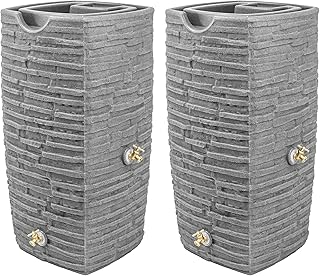
Most barrels sit on the ground, which leaves the spigot low and the last gallons slow. The Newport answers that with an included stand that lifts the whole barrel, so a watering can slides under the brass spigot and fills at a useful rate, and more of the stored water is reachable by gravity. For vegetable gardens, where cans of water go to seedlings, containers, and newly planted rows every day in a dry spell, that raised working height is a daily convenience rather than a minor detail. The overflow nozzle can be fitted on either side, which gives freedom when the barrel stands in a corner and only one side is reachable for a hose route. The removable lid and screen kit keep the inlet covered and make cleaning at the end of the season a simple job.
Pros: Included stand improves gravity flow and can filling; Overflow side can be chosen at installation; Removable lid makes end-of-season cleaning easy.
Cons: Taller profile needs a level, stable spot out of strong wind; Stand footprint must be planned into the layout.
Good Ideas Rain Wizard 50 with Diverter Kit
- Capacity: 50 gallons
- Size: 31 x 23 x 22 inches as listed for the kit
- Weight: 22 lb
- Diverter: two-piece diverter kit included for a 2 x 3 inch downspout, with a 6 ft vinyl tube
- Spigot: brass spigot included for hose or overflow use
- Design: flat back with front-side overflow and debris screen
Fitting a barrel to a downspout is where many first installations stall, and this version of the Rain Wizard 50 answers by including the diverter kit in the box. The two-piece diverter fits in line with a standard downspout, and the vinyl tube carries water to the barrel and returns overflow to the downspout when the barrel is full, so the wall and foundation stay out of the overflow path entirely. That closed route also keeps the system tidy in winter, when the diverter can send water straight down the pipe again. The barrel itself follows the familiar Rain Wizard pattern of flat back, front overflow, brass spigot, and debris screen. For a vegetable gardener setting up a first system before spring planting, having the diverter, tube, spigot, and barrel arrive together removes the guesswork of matching parts from separate listings.
Pros: Diverter kit included, with tube for fill and overflow return; Closed diverter route keeps overflow in the downspout; Familiar flat-back barrel with brass spigot and screen.
Cons: Diverter fits the listed downspout size, so measure first; Kit weight is higher than the barrel alone.
Buying guide
Planning a barrel system around vegetable beds
Begin with the roof and the downspout, not with the barrel. A modest roof section delivers far more water in one storm than a single 50-gallon barrel can hold, so overflow routing is a core part of the system rather than a detail. Choose where overflow goes before the first rain: back into the downspout through a diverter, out through a front channel into the yard, or onward into a second barrel. Each model in this guide handles that moment differently, and the right answer depends on your wall, your soil, and how close beds sit to the house.
Capacity planning follows the garden, not the catalogue. A 50-gallon barrel waters a small bed of vegetables for days in mild weather and for a much shorter stretch in a hot week, so keen growers treat one barrel as a starting point. Linking is the clean way to grow: the Raincatcher connects barrels in series through its side spigots, the Rain Wizard line links with a kit, and the RTS barrels link through their overflow fittings. Keep linked barrels on one level base so they fill evenly, and leave room to walk around them with a full can.
Height is the quiet spec that decides daily ease. A barrel on the ground gives a slow trickle at the spigot once the level drops, while a raised barrel, such as the Newport on its stand, or any barrel set safely on a sturdy platform, fills cans faster and feeds a soaker hose with more push. Whatever raises the barrel must carry serious weight, because 50 gallons of water weighs over 400 pounds before the barrel itself is counted. A level, solid base of slabs or blocks is part of the system, not an optional extra.
Water quality for vegetables is mostly about keeping the store clean and covered. A mesh or debris screen at the inlet keeps leaves and roof grit out, a closed lid keeps the water dark, and an annual clean removes sediment before it reaches the spigot. Use stored rainwater at the base of plants, on the soil rather than on leaves and fruit, and water in the morning so beds dry through the day. Gardeners who follow that pattern get the full value of a barrel without turning it into a chore.
In cold climates, winter care protects the investment. Drain the barrel before hard freezes, leave the spigot open, and set the diverter or downspout back to its winter route so ice has no trapped water to split. Rigid barrels in this guide do not fold away, so plan their winter spot when you plan their summer one. A system that is easy to drain, clean, and refill each spring is the one that will still be watering vegetables many seasons from now.
FAQ
How many barrels does a vegetable garden need?
Start with one 50-gallon barrel and watch how fast it empties in a hot week. Most active vegetable plots settle on two or three linked barrels, which is why linking fittings matter in this guide. Linking in series lets the system grow without new downspout work, as long as the barrels share one level base.
Can a rain barrel feed a soaker hose or drip line?
Yes, by gravity, provided the beds sit below the barrel and the run is short. Flow slows as the barrel empties, so raised barrels and stands help. For distant or uphill beds, a small pump is the practical answer, and at least one barrel here lists compatibility with a separate pump kit.
Is rain barrel water suitable for vegetables?
Stored rainwater is widely used on vegetable soil. Keep the barrel screened and covered, apply water at the base of plants rather than over leaves and fruit, and clean the barrel each season. Gardeners with roofs in poor condition or treated with chemicals should check local guidance before using runoff on food crops.
Where should overflow water go?
Overflow should move away from foundations and away from paths where it can pool. Options in this guide include a front overflow channel, a rear overflow connection, linking onward to another barrel, and a diverter that returns excess water to the downspout. Pick the route when you install, not during the first storm.
How do I keep mosquitoes out of a rain barrel?
A fine mesh screen over the inlet and a closed lid are the main defences, and both appear across this guide. Keep the screen intact, repair tears promptly, and avoid open-top storage. Moving water out regularly through normal garden use also keeps the store from sitting still for long stretches.
Conclusion
A good rain barrel system is a chain of small, sound decisions: a screened inlet, a brass spigot, a planned overflow, and room to link a second barrel when the plot grows. The Raincatcher 4000 covers the most ground in one purchase, the diverter kit version suits a first installation, and the raised Newport makes daily can filling easy. Match the format to your wall, your beds, and your watering habit, and a single storm will keep vegetables drinking for days.
Related guides
More from Amazon
Programs that pair well with the guide above. Offers and eligibility are set by Amazon and may change.
Collect the home and kitchen items you want in one registry that guests can shop from.
Create a wedding registrySet up recurring deliveries of everyday items on eligible products. Terms and savings are set by Amazon.
Explore Subscribe & SaveFree shipping on eligible items, Prime Video and more. Eligible new members can start with a free trial.
Start a Prime free trialAudiobooks and podcasts to listen to on the go. Eligible new members can start with a free trial.
Try Audible freeAs an Amazon Associate we earn from qualifying purchases.
More ways to save on your garden
Programs that pair well with the guide above. Offers and eligibility are set by Amazon and may change.
Fast, free shipping on eligible items, plus Prime Video and more. Eligible new members can start with a free trial.
Start a Prime free trialSet up recurring deliveries of everyday items on eligible products. Terms and savings are set by Amazon.
Explore Subscribe & SaveRead from a huge library of eBooks, including how-to guides and cookbooks. Eligible new members can start with a free trial.
Try Kindle UnlimitedAudiobooks and podcasts for the commute, the garage or the kitchen. Eligible new members can start with a free trial.
Try Audible freeAs an Amazon Associate we earn from qualifying purchases. Using these links costs you nothing extra.




Write Your Review
No reviews yet. Be the first to share your experience!