
Key takeaways
- Solar and battery waterfall pumps for garden fountains where no outlet reaches, compared by flow, lift, panel wattage, battery size, tubing and run time here.
What's inside
As an Amazon Associate I earn from qualifying purchases. This post may contain affiliate links at no extra cost to you.
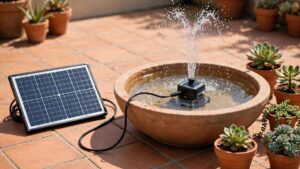
A garden fountain at the far end of a yard, a small cascade built into a rockery behind a shed, or a water feature tucked into a corner where the house wiring simply does not reach all share the same problem. There is water, there is a good spot, and there is no outlet anywhere near it. Running a buried cable across a lawn is a project in itself, and an extension cord left across paving all season is untidy and exposed to weather. That gap between the feature and the nearest mains socket is exactly where solar and battery kits earn their place, and it is the only kind of pump this guide covers.
Every kit below runs from a solar panel, and every kit as sold includes stored battery power as part of the package. That second point matters more than it first appears. A panel-only pump stops the moment a cloud crosses the sun, which makes a waterfall look broken rather than restful. A kit with a built-in battery or a battery pack in the box smooths those gaps out, keeps a cascade moving through passing shade, and in a few cases keeps water moving for a while after the light fades. When people search for the best garden waterfall pumps for garden fountains without outlets, that combination of panel plus included battery is the real requirement hiding behind the words.
There is a limit to be honest about from the start. These are small pumps. Their flow figures sit in the tens or low hundreds of gallons per hour, and their lift figures sit in feet, not in yards. They suit a short cascade over rocks, a spout feeding a tiered fountain, a bubbler in a basin, or a gentle stream run through short tubing. They do not suit a tall, wide fall that needs a strong sheet of water all day. Read the lift and flow figures for each kit closely, keep your planned rise well inside the listed maximum, and a no-outlet feature can run quietly all season with nothing plugged in at all.
Quick verdict
For a genuine waterfall or fountain away from any outlet, the Sunnydaze 132 GPH kit leads this list because it pairs the highest flow figure here with a separate battery pack, long cables, and a spray height that suits a small cascade or a tiered feature. The POPOSOAP 12W P112D follows closely, with the largest panel and the largest built-in battery in the group, plus tubing that makes a rock cascade or bamboo spout straightforward to build. The POPOSOAP 8W and the Biling 8W sit in the middle, both built around an 8W panel and a 3600mAh battery, one leaning toward spray variety and tubing work, the other toward quiet running in a small pond. The POPOSOAP 6.5W P1065D is the calmer, smaller option for a low dripper or a short, gentle run, and the maker is plain that it is not built for strong waterfalls. The SZMP 3.5W is the smallest kit here and the one aimed at evening display in a basin or tub, with lights and a modest spray rather than any real cascade work.
| Product | Key spec | Best for |
|---|---|---|
| Sunnydaze 132 GPH Solar Pump and Panel Kit with Battery Pack | 132 GPH flow, 5W panel, battery pack listed at up to 4 hours | Best for a small cascade or tiered fountain far from the house |
| POPOSOAP 12W Solar Fountain Pump P112D | 12W panel, 4200mAh built-in battery, 80 GPH, 5 ft lift | Best for the largest battery and panel in a single kit |
| POPOSOAP 8W Solar Fountain Pump | 8W panel, 3600mAh built-in battery, 65 in lift | Best for spray modes plus a short tubing-fed fall |
| Biling 8W Solar Fountain Pump | 8W panel, 3600mAh battery, 5 nozzles, dry-run protection | Best for quiet running in a small patio pond feature |
| POPOSOAP 6.5W Solar Fountain Pump P1065D | 6.5W panel, 3000mAh built-in battery, 80 GPH, 5.6 ft lift | Best for a low dripper or gentle short water run |
| SZMP 3.5W Solar Fountain | 3.5W glass panel, 2000mAh battery, 7 nozzles | Best for an evening-lit basin or container fountain |
How we chose
The first filter was power source, and it was strict. A kit only counted if the page for that exact kit states a solar panel and a battery that ships as part of that kit, either built into the panel or supplied as a battery pack in the box. A pump that can work with a separate battery bought later did not count, because a reader building a feature without an outlet needs the whole working system in one purchase, not a pump plus a shopping list. Kits with a panel and no battery at all were also left out, however strong their flow figures looked, because a waterfall that stops under every cloud does not do the job this keyword asks about.
The second filter was waterfall and fountain fit. A floating spray disk that can only sit in a basin and puff water upward is a different product from a pump that can push water through tubing to a higher outlet. So each kit here was read for the parts that decide that job: flow rate in gallons per hour, maximum lift, whether tubing is included or a spout can be fed, how long the cable between panel and pump runs, and whether the pump can sit submerged in a lower basin while the panel sits in sun somewhere else. A kit with a long cable and a separate panel scores well for real gardens, because the shady corner where a cascade looks best is rarely the sunny spot a panel needs.
The third filter was honesty about stored power. Battery capacity in milliamp hours, and any run time the maker lists, were taken only from the page opened for that kit. Where a maker states plainly that a model does not run at night, that limit is reported as a limit rather than smoothed over. Where a maker lists hours of run time on a full charge, that figure is reported as the maker's own figure. No kit here was credited with night running that its own page does not claim, and no flow or lift figure was rounded up, converted loosely, or borrowed from a different model in the same range.
Finally, the order reflects the job in the keyword. Flow and lift for a raised outlet come first, then battery size for steady running, then the extras such as lights, nozzle counts, and spray patterns. A pretty spray in a bird bath is a bonus here, not the main event. The main event is water arriving, steadily, at the top of a small fall or fountain in a part of the garden with no socket at all.
Sunnydaze 132 GPH Solar Pump and Panel Kit with Battery Pack and LED Light
- Solar panel: 5W, per the product page
- Maximum flow: 132 gallons per hour
- Spray height: up to 56 inches in a fountain, per the product page
- Battery: battery pack included in the kit, listed at up to 4 hours of operation on a full charge
- Cables: two 16 ft cables connecting pump, battery pack, and light
- Fountain heads: four different heads included
- Light: LED light ring included, fitted under the fountain head
- Panel size: 10 inches high by 7.5 inches wide, per the product page
- Kit weight: 4.6 pounds, per the product page
This is the kit that reads most like a small waterfall system rather than a basin ornament. The product page lists a flow of 132 gallons per hour, which is the highest flow figure among the battery kits in this guide, and a spray of up to 56 inches when the pump is used as a fountain. The same page describes a water display of about four and a half feet on a full battery charge. For a short cascade, that combination matters: flow is what makes a fall look like a fall instead of a trickle, and a separate battery pack is what keeps that flow going when the sun dips behind a fence or a tree for part of the afternoon.
The layout also suits a feature placed away from the house. Two 16 ft cables give real freedom to put the panel in the sunniest patch of the garden while the pump sits in a shaded basin at the foot of the rocks, and the battery pack sits between them as the store of power. The page notes that the battery unit carries a control panel with indicator lights, with options for a daily timer and for adjusting flow, which is useful when a fall should run at visiting hours rather than all day. The LED ring is a smaller point, but on a feature that can run into the evening on stored power, a light under the water outlet makes the moving water visible after dusk.
Pros: Highest flow figure of the battery kits here, a battery pack included in the box with up to four hours listed on a full charge, long 16 ft cables that separate the sunny panel spot from the shaded water spot, and flow and timer controls on the battery unit.
Cons: The panel is only 5W, so charging the pack in weak winter sun will be slow, the flow figure is still modest next to any mains pump, and the spray and display heights drop as the battery runs down rather than holding steady to the end.
POPOSOAP 12W Solar Fountain Pump P112D
- Solar panel: 12W, per the maker
- Pump power: 3W brushless pump, per the maker's manual details
- Built-in battery: 4200mAh, per the maker
- Maximum flow: 80 GPH, per the maker
- Maximum lift: 5 ft, per the maker
- Spray height: up to 6.8 ft, per the maker
- Power cord: 9.85 ft, per the maker
- Nozzles: 8 interchangeable nozzles, plus 5 ft of PVC tubing
- Protection: low-water dry-run protection, per the maker
If the Sunnydaze leads on flow, this kit leads on stored power and panel size. The maker lists a 12W panel, the largest single panel in this guide, paired with a built-in 4200mAh battery, the largest battery figure here. The maker states that the built-in battery allows the fountain to operate during cloudy periods, in low sunlight, and at night, and the maker's own guidance puts night running at one to eight hours on a partial charge and eight to twelve hours on a full charge. Those are the maker's figures, and real running will depend on how much sun the panel gathered that day, but no other kit in this list pairs this much panel with this much storage.
For waterfall work, the useful details are the tubing and the lift. The maker lists a maximum lift of 5 ft and includes 5 ft of PVC tubing alongside the eight nozzles, so the pump can sit in a lower basin and feed a bamboo spout, a small rock cascade, or a raised outlet instead of only spraying upward where it sits. The 9.85 ft cord lets the panel stand apart from the water, on its mounting bracket, in a brighter spot. A low-water sensor stops the pump when the level falls too low, which matters in a shallow basin on a hot day, when evaporation can drop the level faster than an owner expects. The maker also lists the working water depth for the pump as from 1.2 inches to 8 inches, so very deep or very shallow placements need a second thought.
Pros: Largest panel and largest built-in battery in this guide, tubing included for a spout or cascade, a listed lift of 5 ft, low-water protection, and maker-listed running through cloudy periods and into the night on stored power.
Cons: Flow is listed at 80 GPH, well below the Sunnydaze figure, so a wide fall will look thin, the panel needs a clear sunny mounting spot to fill a battery of this size, and this model includes no lights and no remote, per the maker.
POPOSOAP 8W Solar Fountain Pump with Built-in 3600mAh Battery
- Solar panel: 8W, per the product page
- Built-in battery: 3600mAh rechargeable, per the product page
- Maximum lift: 65 inches, per the product page
- Maximum spray height: 24 inches, per the product page
- Connection cord: 10 ft, per the product page
- Spray modes: 8 spray modes with a double-layer nozzle set
- Tubing: 5 ft of tubing included for water features
- Protection: dry-run shutoff and anti-clogging filter, per the product page
- Panel mounting: 180 degree adjustable bracket for ground or wall
This 8W kit sits a step below the 12W model in panel and battery size, and a step above it in one respect that fountain owners notice: spray variety. The product page lists eight spray modes from a double-layer nozzle set, a maximum lift of 65 inches, and a spray height of up to 24 inches. The lift figure is the one to plan a small fall around. Sixty-five inches of listed lift means a raised outlet a few feet above the pump is within the stated range, as long as the run of tubing is short and the rise is kept comfortably below that maximum rather than right at it.
The page is also plain about the battery's job. The built-in 3600mAh battery stores energy so the pump keeps running on cloudy days, and the page states directly that this solar fountain does not work at night. That honesty helps planning: this is a daytime feature with a buffer against passing cloud, not an evening feature. The 5 ft of included tubing is listed for creating small waterfalls, bubblers, and streams, and the pump can float on the included foam or sit submerged on suction cups, which gives two ways to place it in a basin. Dry-run protection shuts the pump off if the water runs out, and the bracket turns 180 degrees so the panel can be angled from a ground stake or a wall mount.
Pros: A listed lift of 65 inches for a raised outlet, eight spray modes, tubing included for a small fall or stream, dry-run protection, and flexible panel mounting on ground or wall.
Cons: The product page states that it does not work at night, spray height is listed at 24 inches, which is modest for a tall tiered fountain, and flow will still fade in long overcast spells once the stored charge is used.
Biling 8W Solar Fountain Pump with 3600mAh Battery
- Solar panel: 8W monocrystalline, glass-covered, per the product page
- Battery: 3600mAh, per the product page
- Nozzles: 5 included, per the product page
- Tubing: 5 ft included, per the product page
- Protection: dry-run protection with a water-shortage sensor, per the product page
- Motor: ceramic shaft, listed by the maker at about 30 dB running noise
- Fit: listed for patio ponds up to about 100 gallons
The Biling takes the same broad recipe as the POPOSOAP 8W, an 8W panel with a 3600mAh battery, and aims it at quiet, steady running in a small pond feature rather than at spray variety. The product page lists a glass-covered monocrystalline panel, five nozzles, and 5 ft of tubing, so it can float in shallow water with its floating sponges or feed a small spout at the edge of a pond. The maker lists a ceramic motor shaft rather than a stainless one, and puts running noise at about 30 dB, which is the sort of figure that matters when the feature sits near a bench or a patio door and the pump will be heard as much as seen.
On stored power, the page describes the battery keeping the pump going when a cloud passes and for a while after sunset, while also noting that it does not run through a dark night. Plan it as a long daytime feature with a soft landing in the evening, not as an all-night one. A water-shortage sensor shuts the pump off if the level falls, and a built-in debris filter is part of the design, which suits a pond setting where leaves and sediment reach a pump faster than they do in a clean basin. For a small cascade built into the edge of a patio pond, with the fall dropping back into the same water, this is a calm and well-matched set of parts.
Pros: Quiet running figure from the maker, a glass-covered panel, dry-run protection, a debris filter suited to pond water, and tubing for a small spout or edge cascade.
Cons: Only five nozzles, so fewer spray shapes than the POPOSOAP kits, no flow or lift figure as clear as the strongest kits here, and the page notes that it does not run through a dark night.
POPOSOAP 6.5W Solar Fountain Pump P1065D
- Solar panel: 6.5W, per the maker
- Pump power: 3W, per the maker's manual details
- Built-in battery: 3000mAh, on the back of the panel, per the maker
- Maximum flow: 80 GPH, per the maker
- Maximum lift: 5.6 ft, per the maker
- Spray height: 3.6 ft, per the maker
- Power cord: 9.85 ft, per the maker
- Kit: 8 spray modes and 5 ft of tubing included
- Best working range: DIY dripper height best under 1 to 2 ft, per the maker
This smaller POPOSOAP kit needs the clearest framing in the guide, because the maker is unusually direct about what it is not for. The maker lists a maximum lift of 5.6 ft and a flow of 80 GPH, which sound like waterfall figures, and then adds that the included tubing works best for a simple low-height dripper or small water feature, with the lift in that use kept under 1 to 2 ft, and that the kit is not recommended for strong waterfalls or large tiered fountains. Both parts belong in a buying decision. As a gentle, low fall, a dripper over stones, or a short stream in a container feature, it fits well. As the engine of a proud cascade, it does not, and the maker says so.
Within that honest range, the kit is well put together. The 3000mAh battery is built into the back of the panel and, per the maker, stores extra solar energy to keep daytime flow steadier when sunlight changes. The maker states plainly that it does not run at night; the battery is a daytime buffer, not an evening supply. The separate panel on a 9.85 ft cord can stand in sun while the pump works in a shaded bowl, the maker lists suitable bowls at about 12 to 24 inches wide with at least 1.2 inches of water depth, and the same kit can serve a small pond of roughly 40 to 160 gallons for light fountain movement. For a feature far from an outlet where the fall is low and the mood is gentle, that is a sensible, modest tool.
Pros: A separate panel on a long cord for shaded water and sunny placement, a built-in battery that steadies daytime flow, eight spray modes, and clear maker guidance on the sizes of feature it suits.
Cons: The maker states that it is not built for strong waterfalls or large tiered fountains, it does not run at night, and its best tubing work sits at a low height of under 1 to 2 ft.
SZMP 3.5W Solar Fountain with LED Lights and 2000mAh Battery
- Solar panel: 3.5W glass panel, per the product page
- Battery: 2000mAh, per the product page
- Nozzles: 7 nozzles plus 4 fixers, per the product page
- Spray height: 40 to 60 cm in sun, 10 to 20 cm when cloudy, per the product page
- Lights: 6 white LEDs, per the product page
- Evening running: pump and lights listed at roughly 3 to 4 hours after dark on stored power
- Extras: water-shortage probes and three spare filter sponges, per the product page
The SZMP is the outlier in this list, and it earns its place for a different kind of no-outlet feature. Its panel is the smallest here at 3.5W and its battery the smallest at 2000mAh, so it was never going to feed a real cascade, and its listed spray height, 40 to 60 cm in sun and only 10 to 20 cm under cloud, confirms that. What it does instead is run into the evening. The product page lists stored battery power running the pump and its six white LEDs for roughly three to four hours after dark. For a container fountain on a dark corner of a patio, a basin by a path, or a small feature near outdoor seating where there is no socket, a lit, moving fountain in the evening can be worth more than a taller spray at noon.
The glass panel is a practical point in its favour, since the page notes it is meant to resist the clouding that affects cheaper plastic panels over time, and the kit includes water-shortage probes and three spare filter sponges, which makes routine upkeep simple. The four fixers help hold the unit in place in a basin so the spray stays centred instead of drifting to an edge and splashing out. Treat it as a small evening fountain for a tub or basin, keep the feature compact, and its limits stop being a problem.
Pros: Listed evening running of the pump and lights for roughly three to four hours on stored power, a glass panel, spare filter sponges included, and fixers that keep the unit centred in a basin.
Cons: The lowest panel wattage and battery capacity in this guide, a spray that drops sharply under cloud, and no output suited to a raised waterfall or a tall fountain.
Buying guide
Start with the rise, not with the panel. Measure the vertical distance from the water surface where the pump will sit to the point where water should leave the tubing or spout. That distance, plus a margin, is the lift your kit must cover. A pump run close to its listed maximum lift delivers a weak flow at the top, so a fall planned at half to two thirds of the listed lift will look far better than one planned at the limit. If your measured rise is more than about five feet, none of the battery kits in this guide is the right tool, and a feature redesign with a lower fall will serve you better than a stronger hope.
Next, think about flow as the width of the fall. Flow in gallons per hour decides whether water arrives as a sheet, a stream, or a drip. A narrow spout or a short runnel over stones can look good on 80 GPH. A wider lip of rock needs the higher flow of a kit like the Sunnydaze 132 GPH, and even that will give a modest sheet rather than a broad curtain. Match the fall to the pump: build the outlet narrow, keep the tubing run short and smooth, and avoid sharp bends, since every bend and every extra foot of tubing takes flow away before the water reaches the top.
Panel placement is the third decision, and in a garden without an outlet it is often the deciding one. The panel needs direct sun for the best part of the day, while the water feature often sits in shade, which is better for the water and for the look of the planting around it. Separate-panel kits with long cords solve this. Look at the cord figures in this guide, from just under ten feet on the POPOSOAP kits to sixteen feet on the Sunnydaze cables, and plan the route before you buy. A panel that can only reach a shaded spot will charge a battery slowly all season, and no battery size makes up for a panel that never sees the sun.
Battery size then decides how forgiving the feature feels. A larger battery, such as the 4200mAh unit in the POPOSOAP 12W or the 3600mAh units in the 8W kits, smooths passing clouds and keeps a fall looking steady through a changeable afternoon. A smaller battery still helps, but the spray will rise and fall with the light more visibly. Be clear with yourself about evenings. Some kits here list running after dark on stored power, with the maker's own hours attached. Others state plainly that they stop at night, and their batteries exist only to steady the daytime flow. Neither is a fault. Buying the second kind while expecting the first is the fault, and it is an easy one to avoid by reading the maker's own wording.
Protection features are worth real weight in an outdoor feature that nobody watches all day. Dry-run or low-water protection shuts a pump off when evaporation or a small leak drops the level, instead of letting it run dry in an empty basin. Filters and spare sponges matter because a small pump drawing pond or basin water will gather debris, and a clogged intake is the most common reason a solar fountain fades. Plan a short weekly routine: lift the pump, rinse the intake and sponge, clear the nozzle, and top the water up. Ten minutes of that keeps any kit in this guide running close to its listed figures.
Finally, set the feature up in the right order. Place the pump fully submerged in the deepest part of the basin, run the tubing to the outlet with as gentle a rise as the design allows, fix the panel in its sunniest spot and angle it toward the midday sun, and only then judge the spray or the fall. Give a battery kit a full sunny day of charging before deciding that its evening running or its flow falls short. Solar kits are judged fairly on a charged battery and a clean filter, in the season they were built for, and most disappointments trace back to a shaded panel, a clogged intake, or a fall built taller than the lift figure on the page.
FAQ
Can a solar waterfall pump work where there is no outlet at all?
Yes, that is the exact use these kits are built for. The panel makes the power, the battery stored in the kit smooths the supply, and no mains wiring is involved at any point. The maker of the POPOSOAP 6.5W kit states directly that no outdoor power outlet or wiring is required for that model, and the same principle holds across this guide. The conditions are sun for the panel, water deep enough to keep the pump submerged, and a fall sized to the kit's listed lift and flow.
Will a battery solar pump keep a waterfall running all night?
Only some kits list any night running at all, and none should be expected to run a fall at full strength until morning. The POPOSOAP 12W maker lists one to eight hours at night on a partial charge and eight to twelve hours on a full charge. The Sunnydaze battery pack is listed at up to four hours, and the SZMP lists roughly three to four hours of pump and light running after dark. The POPOSOAP 8W and 6.5W pages state that those models do not work at night. Read the figure for the exact kit, and treat every one of them as the maker's best-case number on a well-charged battery.
How high can these pumps lift water for a waterfall?
The listed maximums in this guide run from the SZMP's short spray, measured in centimetres, up to 5 ft on the POPOSOAP 12W, 5.6 ft on the POPOSOAP 6.5W, and 65 inches on the POPOSOAP 8W. Those are maximums, not working recommendations. A fall built at half to two thirds of the listed lift will carry visibly more water at the top. If a design needs more rise than that, lower the fall or split it into two shorter drops with a small basin between them.
What happens to a solar fountain pump on a cloudy day?
Output falls, and the battery decides by how much the feature shows it. A kit with a larger built-in battery, such as the 4200mAh POPOSOAP 12W or the 3600mAh 8W kits, keeps water moving through cloud that would stop a panel-only pump outright. Spray height still drops in weak light; the SZMP page, for example, lists 40 to 60 cm of spray in sun against 10 to 20 cm when cloudy. A run of grey days will drain any of these batteries, and the feature will pause until the panel gathers a charge again.
Where should the solar panel go if the fountain sits in shade?
In the sunniest spot the cord can reach. That is why cord length is a working spec rather than a footnote: just under ten feet on the POPOSOAP kits, ten feet on the POPOSOAP 8W, and sixteen feet of cable on the Sunnydaze kit. Angle the panel toward the midday sun, keep it clear of overhanging leaves, and wipe dust and pollen off its face when you clean the pump filter. A panel in shade is the single most common reason a no-outlet feature underperforms.
How much upkeep does a solar waterfall pump need?
A little, done often. Rinse the pump intake, filter sponge, and nozzles when flow weakens, keep the water deep enough that the pump stays submerged, and let dry-run protection do its job rather than topping up late every time. The POPOSOAP 6.5W maker suggests a weekly check at first, which is a fair rhythm for any kit here. In autumn, falling leaves raise the cleaning frequency, and in freezing weather a small solar pump should be lifted out, cleaned, and stored rather than left in ice.
Conclusion
A fountain or a small waterfall does not need a socket. It needs a panel in real sun, a battery in the kit to smooth the supply, and a fall sized honestly to the lift and flow figures on the page. On those terms, the Sunnydaze 132 GPH kit is the strongest all-round choice here for a small cascade or tiered feature placed far from the house, thanks to its flow, its included battery pack, and its long cables. The POPOSOAP 12W P112D is the pick where stored power matters most, with the largest panel and battery in the guide and tubing ready for a spout or rock fall. The two 8W kits cover quiet pond features and spray-led fountains in the middle, the POPOSOAP 6.5W suits a low, gentle run and says so plainly, and the SZMP trades power for a lit evening display in a basin. Choose by your measured rise and your sunniest panel spot, keep the filter clean, and a corner of the garden with no outlet at all can carry the sound of moving water all season.

Write Your Review
No reviews yet. Be the first to share your experience!