
Key takeaways
- Five plastic rain barrels with maker-stated linking options for vegetable gardens, compared on capacity, spigots, overflow design, diverters and footprint.
What's inside
As an Amazon Associate I earn from qualifying purchases. This post may contain affiliate links at no extra cost to you.
One rain barrel is a gesture; two linked barrels are a water supply. A vegetable garden in a dry spell drinks far more than a single barrel holds — a modest bed can take a full barrel in two or three waterings — so the barrels that matter are the ones designed to grow: a second barrel joins the first, the pair fills and drains as one reservoir, and the downspout work is done once. The best plastic rain barrels with linked barrel connectors for vegetable garden watering are the models whose makers state the linking path on the product page itself — a connector kit, a link kit, an overflow connection — rather than leaving you to improvise with bulkhead fittings and hope.
That maker-stated gate is what this roundup enforced. Every pick below names its linking route in its own listing or retailer specification: a connector kit sold by the barrel's maker, a linking kit from the same brand, or a modular design the maker describes as linkable. Generic barrels that merely have an overflow port were not enough. Every barrel is plastic, as the keyword requires, and every specification — capacity, dimensions, weight, spigot material, screen and overflow design — comes from a page opened for this guide.
Linked systems also divide by how they link, and the difference matters in a vegetable garden. Bottom-spigot linking, the Good Ideas pattern, connects barrels at their spigots so both fill and drain together and either spigot draws from the combined store. Top-overflow linking fills the first barrel, then spills the surplus into the second. Modular panel and block designs link side by side or stack. The sections below state which pattern each barrel uses, because the right choice depends on whether you draw water by hose and gravity — the usual vegetable-garden case — and on how level your ground is.
Quick verdict
The Good Ideas Rain Wizard 50 is the default linked barrel: a plain, tough 50-gallon drum whose maker sells a connector kit that joins two barrels at their spigots so the levels equalise. The RTS Home Accents Flat Back 50 is the wall-hugger, with a brass spigot, a built-in overflow valve and a stated option to connect multiple barrels, in a shape that sits flush against the house. The Good Ideas Impressions Riverwalk 50 brings the same linking family in a slate-look barrel with a planter top and two metal spigots. The EMSCO Rescue Waterboy 42 is the modular one — the maker states it links horizontally or vertically with its linking kit, and it ships with a downspout diverter system included. The EMSCO Waterstones 40 pairs a stone-look finish with the same brand linking kit and an included diverter, for a run of smaller barrels along a bed.
| Product | Key spec | Best for |
|---|---|---|
| Good Ideas Rain Wizard 50 | 50 gal, connector kit links at spigots | The standard two-barrel bank |
| RTS Home Accents Flat Back 50 | 50 gal, brass spigot, overflow valve | Flush against a wall or fence |
| Good Ideas Impressions Riverwalk 50 | 50 gal, dual metal spigots, planter top | Looks plus linking |
| EMSCO Rescue Waterboy 42 | 42 gal, links horizontally or vertically | Growing a modular bank |
| EMSCO Waterstones 40 | 40 gal, linking kit, diverter included | A run of smaller barrels |
How we chose
The first filter was the linking claim, stated by the maker. Each pick's own product page or brand retailer page had to name the route to a second barrel: a connector kit, a linking kit, or a modular link design. That single rule removed most of the rain barrel market, including several good barrels whose pages never mention expansion at all.
The second filter was vegetable-garden practicality. A barrel feeding beds needs a spigot that accepts a hose or fills a can cleanly, an overflow that routes surplus water away from the foundation and the barrel's own base, and a screen that keeps debris and insects out of water that will sit between rains. Capacity had to be realistic for expansion — 40 gallons and up — and the footprint had to suit the spaces gardens actually have: against a wall, beside a shed, at the end of a bed.
Construction was the third filter: UV-stabilized plastic that will not go brittle in a few summers, stated on the page. Finally, the set was kept to barrels whose linking hardware comes from the same maker as the barrel. A maker's own kit is designed around that barrel's spigot threads and wall thickness; a universal kit is a compromise you discover at the first heavy rain.
Good Ideas Rain Wizard 50
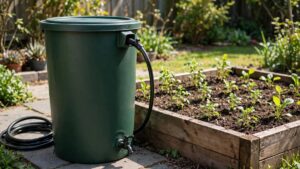
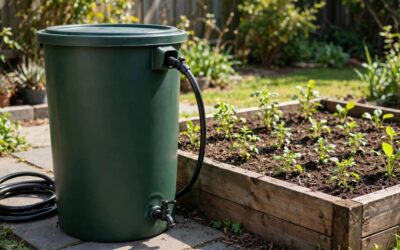
The Rain Wizard is the barrel the linked-barrel idea is built around in the US market: a simple 50-gallon plastic drum, and a maker — Good Ideas — that sells the Rain Wizard Connector Kit to join two of them. The barrel's own listing states the arrangement: the drum connects to other Good Ideas rain barrels, with the connection kit sold separately. The kit links the pair through their bottom spigots, so both barrels fill together, drain together, and hold one shared water level.
- Capacity: 50 gallons
- Dimensions: 23 in long by 22 in wide by 30 in high
- Weight: 19 lb empty
- Material: durable plastic, weather and UV resistant
- Spigot: metal spigot for hose connection or overflow use
- Screen: plastic mesh screen at the inlet
- Overflow: front-facing overflow outlet
- Linking: connects to other Good Ideas rain barrels; Rain Wizard Connector Kit sold separately
For vegetable watering, the shared-level behaviour is the point. A soaker hose or a watering can draws from whichever spigot is nearer the bed, and the bank behaves like one 100-gallon tank with two taps. The mesh screen keeps the stored water clean enough for beds, and the front overflow keeps surplus away from the wall behind. The design is deliberately plain — a drum, not a piece of garden furniture — and the drum shape needs a flat, level base, because a linked pair connected at the spigots must sit at the same height for the levels to equalise as designed.
Pros:
- Maker's own connector kit links two barrels at the spigots
- Shared water level across the pair — draw from either spigot
- Metal spigot and mesh inlet screen
- Light at 19 lb empty, easy to position before filling
Cons:
- Connector kit is a separate purchase
- Plain drum styling; no planter top or texture
RTS Home Accents 50-Gallon Flat Back Rain Barrel with Brass Spigot
The RTS barrel solves the placement problem first: its back is flat, so the barrel sits tight against a wall or fence instead of leaving the crescent of wasted space a round drum creates. The listing states a built-in overflow valve for managing excess water and the option to connect multiple barrels for increased storage, which is the linking claim that earns its place here.
- Capacity: 50 gallons
- Dimensions: about 21 in wide by 19 in deep by 34 in high
- Weight: about 18 lb empty
- Material: UV-resistant polyethylene
- Spigot: brass spigot with shut-off, hose hook-up
- Overflow: built-in overflow valve; option to connect multiple barrels
- Shape: flat back for placement against walls and fences
- Top: closed top with debris and insect screen
- Origin: made in the USA
A brass spigot is the right detail on a barrel that will work for its living: it takes a hose, a shut-off and years of can-filling without the thread wear plastic spigots suffer. The flat-back shape matters doubly for a linked pair, because two flat backs line up along a wall in a tidy run with the connection run short and straight. The maker's own link kit for this barrel family uses a short clear linking tube with clamps, and the barrels need to sit close — within about a foot of each other — on a flat surface. Plan the base first: a level run of pavers along the wall is the whole foundation job, and it decides whether the linking works as intended.
Pros:
- Flat back sits flush to the wall — the neatest linked run here
- Brass spigot with shut-off and hose hook-up
- Overflow valve and stated multi-barrel connection option
- UV-resistant polyethylene, made in the USA
Cons:
- Linked barrels must sit close together on level ground
- Link kit is a separate purchase
Good Ideas Impressions Riverwalk 50
The Riverwalk takes the Rain Wizard's linking family and dresses it for the front of the house: a faux slate-rock texture, an integrated planter top, and two metal spigots. The maker's product description states the drum can be connected to other Good Ideas rain barrels to build a larger collection system, and the dual spigot layout is what makes that practical — one spigot works the garden hose, the other serves the overflow or the link.
- Capacity: 50 gallons
- Dimensions: 23 in diameter by 38 in high
- Weight: 24 lb empty
- Material: plastic with faux slate-rock texture
- Top: integrated planter top
- Screen: meshed screen at the inlet
- Spigots: dual metal spigots, two spigot locations
- Overflow: routed overflow channel directs excess water away from the foundation
- Linking: connectable to other Good Ideas rain barrels, per the maker's description
At 38 inches tall, the Riverwalk stands higher than the other barrels here, which buys gravity pressure at the spigot — a small but real advantage when a soaker hose runs to a bed a few feet away. The planter top is more than decoration on a working barrel: a shallow tray of herbs or flowers hides the inlet screen and puts the barrel's footprint to double use beside a vegetable bed. The honest costs are size and price class — it is the bulkiest pick here, and the texture and planter put it at the decorative end of the market. As the second barrel in a linked pair behind a plain Rain Wizard, it also mixes happily, since the linking family is shared across the maker's range.
Pros:
- Tall body gives the best gravity head at the spigot here
- Dual metal spigots split hose and link duties cleanly
- Planter top and slate texture suit visible placements
- Links within the Good Ideas barrel family
Cons:
- Largest and heaviest barrel in this roundup
- Decorative pricing class
EMSCO Rescue Waterboy 42
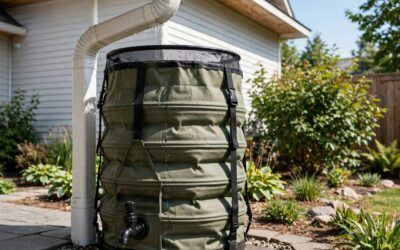
The Waterboy is the modular thinker of the group. EMSCO describes the design in one word — modular — and states that Waterboy barrels can be linked together in groups of two or more, horizontally or vertically, with the linking kit sold separately. Vertical linking is unique here: a stacked pair doubles storage on a single 22-inch square of ground, which is exactly the constraint in a small urban vegetable plot.
- Capacity: 42 gallons
- Dimensions: 22 in by 22 in by 23 in
- Weight: 14.5 lb empty
- Material: polyethylene with UV inhibitors
- Linking: modular design links horizontally or vertically; linking kit sold separately
- Diverter: diverter system included — 36 in tube and 48 in main hose, fits 2 in by 3 in and 3 in by 4 in downspouts
- Finish: wicker texture, brown
- Warranty: 1-year limited warranty
The included diverter system is the other half of the value: most barrels in this class make the diverter a second purchase, and the Waterboy arrives with the downspout connection in the box, sized for both common downspout profiles. For a vegetable garden, the square footprint and the stacking option make layout easy — a pair side by side along a shed wall, or a stacked pair in the corner by the gate. The capacity per barrel is the smallest-but-one here, so a Waterboy bank reaches a given storage target with more units; the modular design is plainly built for exactly that. Level ground matters even more for the vertical arrangement, and the maker's instructions should be followed on stacking heights.
Pros:
- Links horizontally or vertically — the only stackable option here
- Diverter system included in the box
- Compact square footprint suits small plots
- Lightest barrel in the roundup at 14.5 lb
Cons:
- 42-gallon capacity means more units for the same storage
- Linking kit is a separate purchase
EMSCO Waterstones 40
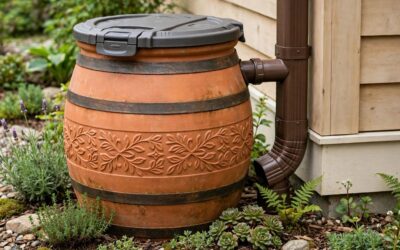
The Waterstones is EMSCO's stone-look barrel, and its retailer specification states the linking route directly: the maker's rain barrel linking kit connects multiple Waterstones together, doubling storage with each added barrel. It ships with a downspout diverter included, like its Waterboy sibling, which makes a run of Waterstones the simplest expansion path in this roundup to start — the first barrel arrives complete.
- Capacity: 40 gallons
- Material: polyethylene
- Linking: EMSCO rain barrel linking kit connects multiple Waterstones; kit sold separately
- Diverter: downspout diverter included
- Finish: stone-look texture
The case for the Waterstones is incremental growth. Start with one barrel at the corner of the greenhouse or shed; add a second and a third along the wall as the garden's thirst proves itself, each joined by the same linking kit. At 40 gallons a unit, it is the smallest barrel here, which cuts both ways: individual barrels are easy to handle, place and clean, but a serious vegetable garden will want three or four of them where two 50-gallon drums would do. The stone finish earns its place where the barrels sit in view of the house rather than hidden behind the shed. As with every linked system here, the run must sit level, and the linking kit belongs in the first order even if the second barrel comes later — fitting it from the start is far easier than draining a full barrel to add it.
Pros:
- Maker's linking kit stated for multi-barrel runs
- Diverter included — the first barrel is a complete system
- Small units are easy to place, move and clean
- Stone-look finish suits visible spots
Cons:
- Smallest capacity here at 40 gallons
- A useful bank needs three or more units
Buying guide
Decide how the pair will link before you buy the first barrel. Bottom-spigot linking, the Good Ideas pattern, shares one water level across the bank and lets any spigot draw from the whole store — the most flexible arrangement for watering cans and soaker hoses. Overflow linking fills barrels in sequence and is simpler to plumb but leaves the second barrel as a reserve rather than a shared tank. Modular systems like the Waterboy add stacking, which trades footprint for height. The pattern is set by the barrel family, so choose the family, not just the barrel.
Level ground is not optional. Linked barrels share water by gravity, and gravity reads small slopes as instructions. A pair sitting at different heights will not equalise as designed, and a stacked pair on a slope is a hazard. A run of pavers or a gravel pad levelled with a straight edge is the foundation every system in this roundup assumes.
Count the whole system cost. In four of the five picks, the linking hardware is a separate purchase, and in three, so is nothing else — but diverters, stands and extra hose all live in the same accessories aisle. The Waterboy and Waterstones include the diverter; the Good Ideas and RTS barrels ask you to add the connection kit. None of that changes which barrel is right, but the first order should contain everything the install needs, because a half-built system in a storm is just a barrel.
Match spigot material to how you water. A brass or metal spigot tolerates a hose hanging off it season after season and gives a clean shut-off for filling cans. Plastic spigots are fine for can-only use. If a soaker hose will live on the barrel, metal is the right call, and a second spigot location — the Riverwalk's layout — lets the link and the hose each have their own port.
Overflow is a foundation feature, not a detail. A linked bank at capacity in a storm moves a lot of water. The overflow must route away from the house and from the barrels' own base, or the pad erodes and the level goes with it. Front-facing outlets and routed channels, both present in this roundup, exist to aim that water at a bed or a gravel strip instead.
Screens and stored-water hygiene. Vegetable gardens get the water, so keep the store clean: a mesh screen at the inlet, a closed top, and an occasional rinse keep sediment and insects out. Dark, UV-stabilized plastic slows algae. If the water will sit for weeks between rains, a barrel that drains fully through its spigot — all five here do — is easier to keep sweet than one with a dead pocket below the outlet.
FAQ
How many barrels does a vegetable garden need?
Work backwards from a dry week. A single barrel of 40 to 50 gallons covers a few beds for two or three waterings. Most keen vegetable growers land on two linked barrels — roughly 100 gallons of shared storage — and modular systems like the Waterboy exist for gardens that outgrow that. The advantage of every system here is that the second barrel is an addition, not a replacement.
Do linked barrels have to be the same model?
Within a maker's family, models often share spigot threads and linking kits — the Good Ideas barrels here link across the range. Across brands, assume they do not: spigot thread sizes, heights and wall fittings differ, and a link that almost fits will leak at the worst moment. Buy the second barrel from the same family as the first.
Where should the overflow go?
Away from the foundation and away from the barrels' own base — onto a bed, a gravel strip or a drain. A linked bank overflows as one system, so one well-aimed overflow outlet serves the bank, but it must be the highest barrel's outlet and it must never be the one used for the link hose.
Can I run a soaker hose from a rain barrel?
Yes, with modest expectations. Gravity from a barrel gives low pressure, so soaker hoses run slowly and best over short lengths on level beds. Taller barrels — the Riverwalk stands highest here — and a barrel raised on blocks both add head and improve flow. Keep the hose run short and the bed level, and a linked bank will water it steadily.
What stops mosquitoes breeding in stored rainwater?
A closed top and a fine mesh screen at the inlet, both standard on the barrels here, keep insects out of the store. Water that moves regularly — a working vegetable garden in summer — rarely sits long enough to be a problem. Check the screen each spring; a torn screen is the usual failure.
Does the linking kit come with the barrel?
In this roundup, no — each maker sells its connector or linking kit separately, while EMSCO includes the downspout diverter with the Waterboy and Waterstones. Order the kit with the first barrel even if the second barrel waits a season; retrofitting a link to a barrel that has sat full all summer is a wetter job than fitting it dry.
Conclusion
Linked storage is what turns a rain barrel into a vegetable garden's water supply, and the linking claim is where the makers separate. The Good Ideas Rain Wizard 50 and its connector kit are the standard bank; the RTS Flat Back adds a brass spigot and the tidiest wall run; the Impressions Riverwalk brings height, twin spigots and looks to the same family; and EMSCO's Waterboy and Waterstones make expansion itself the design — horizontal, vertical or one small barrel at a time. Pick the family whose linking pattern matches how you water, level the pad, and order the kit with the first barrel.

Write Your Review
No reviews yet. Be the first to share your experience!