
Key takeaways
- Five plastic rain barrels shaped for small urban patios, with flat backs, diverter kits and planter tops, from 45 to 65 gallons, compared on footprint first.
As an Amazon Associate I earn from qualifying purchases. This post may contain affiliate links at no extra cost to you.
A small urban patio gives a rain barrel very little room to be wrong. The barrel has to sit against a wall or fence, stay out of the walking path, and still hold enough water to be worth plumbing into a downspout. The best plastic rain barrels for small urban patios are the ones designed around that footprint problem first and capacity second: flat backs that hug the wall, diverter kits that keep overflow inside the downspout instead of across the paving, and lids that double as planters so the barrel earns its square footage twice.
All five picks here are plastic — polyethylene or resin — because plastic is what makes these shapes possible at weights a patio owner can move. Capacities run from 45 to 65 gallons, and every barrel below was verified on an opened maker or retailer page, with dimensions taken from those pages. This set is deliberately different from the decorative rain barrels covered elsewhere in the program: the Good Ideas urn and faux-oak styles and the RTS 50-gallon flat back are set aside here in favor of working patio shapes, including a recycled-plastic 55, a diverter-fed 45 with a planter lid, and a tall 65 that trades floor space for height.
One planning note before the picks: a full 50-gallon barrel weighs well over 400 pounds. On a small patio, the barrel's home is chosen once, on a level, solid base, and it stays there for the season. The buying guide returns to base prep, because it decides more patio installations than any fitting does.
Quick verdict
The RTS Home Accents Premium 55-Gallon Eco is the default patio pick: flat back, 100 percent recycled plastic, a removable lid, and a footprint just over 21 inches deep. The FCMP Outdoor Raincatcher 4000 is the kit pick, arriving with its screen, hoses, shut-off valve, and linking tube in the box. The Algreen EcoCascata 65 stores the most water by growing up instead of out, at 24 inches wide and 47 inches tall. The EarthMinded RainStation 45 is the smallest footprint and the neatest install, feeding through a downspout diverter with a reversible planter lid. The Emsco Group Flatback Stoneware Urn pairs a flat back with an integrated planter top and its own diverter system.
Comparison table
| Product | Key spec | Best for |
|---|---|---|
| RTS Home Accents Premium 55-Gallon Eco | 55 gal, flat back, 33.5 x 21.25 x 33.5 in | The standard patio corner |
| FCMP Outdoor Raincatcher 4000 (RC4000-BRN) | 50 gal, flat back, full hose and valve kit included | Buyers who want every fitting in the box |
| Algreen EcoCascata 65 (81305) | 65 gal, 24 in wide x 47 in high, brass spigot | Maximum storage on a small footprint |
| EarthMinded RainStation 45 (RS45-TC) | 45 gal, FlexiFit diverter kit, reversible planter lid | The tightest patios and tidiest installs |
| Emsco Group Flatback Stoneware Urn (2233-1) | 50 gal, flat back, integrated planter, diverter included | A barrel that reads as patio furniture |
How we chose
Footprint came before capacity. Each candidate's depth from the wall was the first figure compared, because on a patio the inches between the barrel and the chair legs are the inches that matter. Flat-back designs dominate this list for that reason: a flat back against the wall turns a round tank's wasted crescent of floor into usable space.
The second filter was overflow behavior. On a paved patio, an overflowing barrel sends water across the surface and toward the house. Barrels that route overflow back into the downspout through a diverter, or through a proper overflow port that can be hosed away from the foundation, scored ahead of barrels that simply spill from the top.
The third filter was completeness. A patio install usually happens in one afternoon, so barrels that include their diverter, hoses, and screens — or are part of a system whose parts are easy to find — ranked above barrels that assume a shelf of fittings already in the garage. Every specification below comes from a page opened during research, and dimensions are the makers' or retailers' listed figures.
RTS Home Accents Premium 55-Gallon Eco Rain Barrel
- Capacity: 55 gal
- Material: polyethylene, 100 percent recycled plastic as listed
- Dimensions: 33.5 L x 21.25 W x 33.5 H in as listed
- Weight: 28 lb empty
- Features: flat back, removable lid, screened inlet, integrated overflow, plastic spigot with shut-off valve and hose thread
- Model: 551400300A8081
The Premium Eco is the barrel this category revolves around: a flat-backed 55-gallon tank that takes up about 21 inches of depth against a wall and disappears into a patio corner. The maker builds it from 100 percent recycled plastic with a UV-resistant resin, and the removable lid makes the two jobs patio owners actually do — scooping a watering can and scrubbing the barrel out at season's end — straightforward rather than awkward.
The screened inlet keeps leaves and insects out of the stored water, and the integrated overflow redirects excess water once the barrel is full. The spigot is plastic with a shut-off valve and a standard hose thread, so a short hose or soaker line connects without adapters. A matching stand is sold separately for owners who want the spigot higher above a watering can. For most small patios, this is the barrel to measure the others against.
Pros:
- Flat back keeps depth to about 21 inches
- Removable lid for dipping and cleaning
- Recycled plastic build with UV-resistant resin
Cons:
- Stand for easier can filling is a separate purchase
- Plastic spigot where some rivals fit brass
FCMP Outdoor Raincatcher 4000 (RC4000-BRN)
- Capacity: 50 gal (189 L)
- Material: polyethylene, BPA-free and UV-inhibited as listed
- Dimensions: 24 x 24 x 32 in
- Weight: about 20 to 21 lb empty
- Included: aluminum mesh debris screen, 40 in garden hose, shut-off valve, 66 in overflow tube, 16 in linking tube
- Warranty: 1 year limited as listed by the retailer
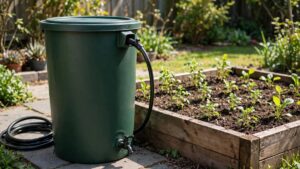
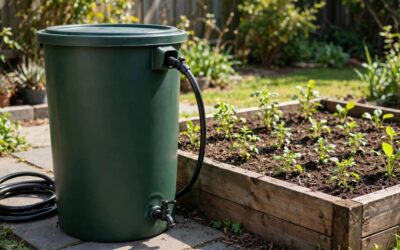
The Raincatcher 4000 is the complete-kit answer. Where most barrels assume the buyer will hunt down hoses and tubes, this one lists them in the box: a debris screen for the wide top opening, a 40-inch garden hose with a shut-off valve for drawing water off, an overflow tube for full-barrel weather, and a linking tube so a second barrel can join the first when the patio allows. The flat back lets the 24-inch-square footprint sit against the house wall under the downspout.
The wide top opening is the install detail to appreciate on a patio: the downspout ends above the barrel rather than being replumbed into it, which keeps the job reversible — a real consideration for renters and for owners who winterize by removing the barrel entirely. Side spigots support the linking arrangement. At 50 gallons it gives up a little storage to the 55s here, and buys it back in fittings and simplicity.
Pros:
- Hoses, valve, screen, and linking tube all included
- Wide opening makes downspout placement simple and reversible
- Flat back suits wall-side patio placement
Cons:
- 50 gal is mid-pack for capacity
- Round-front profile uses more depth than the slimmest flat backs
Algreen EcoCascata 65 (81305)
- Capacity: 65 gal
- Material: roto-molded resin, recyclable and BPA free as listed
- Dimensions: 24 in wide x 47 in high
- Fittings: brass spigot in a reinforced threaded fitting with sealing gasket, lower drain fitting
- Features: corrosion-proof screen guard, dual rear overflow ports that also serve for linking
- Warranty: 2 year manufacturer warranty as listed
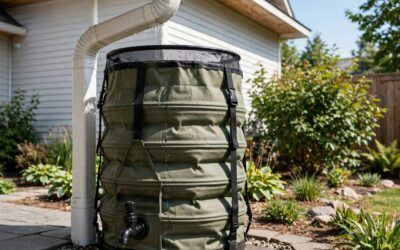
The EcoCascata solves the patio problem vertically. Its footprint is a 24-inch width — no wider than the Raincatcher — but it stands 47 inches tall and holds 65 gallons, the most water in this group. On a patio where floor space is the scarce resource and a tall corner stands empty, that trade is exactly right. The charcoal-stone finish reads as a garden ornament rather than a tank, which matters when the barrel sits in the middle of the view.
The fittings are a step up in material: a brass spigot set into a reinforced threaded fitting with an integrated gasket, plus a lower drain fitting for emptying or for a hose connection. The dual rear overflow ports route excess water away or link a second barrel behind the first. The listing notes the barrel is part of Algreen's Rainwatr system, so diverter kits and expansion parts from the same line fit it. Two years of manufacturer warranty is the longest cover listed in this group.
Pros:
- Most capacity here on a 24 in footprint
- Brass spigot with gasketed, reinforced fitting
- Dual overflow ports double as linking ports
Cons:
- 47 in height needs a stable, level base and care when full
- Taller profile is more visible than low barrels
EarthMinded RainStation 45 (RS45-TC)
- Capacity: 45 gal
- Material: recycled plastic, food-grade HDPE as described by retailers
- Dimensions: 35.5 x 23.5 x 23.5 in as listed
- Kit: patented FlexiFit diverter included, fits 2 x 3 and 3 x 4 in downspouts
- Lid: reversible, flat cover on one side and planter on the other
- Inlet: fine mesh screen over the top opening
The RainStation is the tidy install. Instead of sitting open under a cut downspout, it connects through the FlexiFit diverter, which taps the downspout and sends water to the barrel through a hose; when the barrel fills, the diverter simply returns the flow to the downspout. On a paved patio that means no overflow sheeting across the stones in a storm, and no shortened downspout to restore later. The barrel itself is flat-backed and compact at 45 gallons — the smallest here, and the right size for a genuinely tight patio.
The reversible lid is the patio-friendly detail: one side is a flat cover, the other is a planter for annuals or herbs, so the barrel's top works as growing space in a garden that has none to spare. Retailers describe the resin as food-grade HDPE, a comfort for gardeners watering edibles. The kit includes the diverter fittings and hole saw the install needs, which keeps the afternoon-project promise the design makes.
Pros:
- Diverter feed keeps overflow inside the downspout
- Reversible planter lid turns the top into growing space
- Smallest, lightest install in this group
Cons:
- 45 gal fills fast in a heavy storm season
- Barrel must sit within hose reach of the downspout
Emsco Group Flatback Stoneware Urn (2233-1)
- Capacity: 50 gal
- Material: polyethylene with UV inhibitors as listed
- Dimensions: 20.0 x 24.5 x 37.25 in as listed
- Weight: 15 lb empty
- Features: flat back, integrated top planter with built-in weep hole, included diverter system with 36 in tube and 48 in main hose
- Warranty: 1 year limited as listed
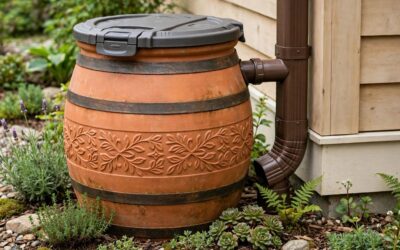
The Emsco urn is designed to work as patio furniture. The stoneware-look body stands on a flat back against the wall, and the top is an integrated planter with a built-in weep hole that drains excess water away from roots. Planted up, it reads as a tall planter that happens to hold 50 gallons of rainwater underneath — a genuine advantage on a patio where every object is on display.
Like the RainStation, it feeds through a diverter rather than an open top: the included system brings a 36-inch tube, a 48-inch main hose, gaskets, and a ball cock with on-and-off control, and it fits standard 2 x 3 and 3 x 4 inch downspouts. When the barrel is full, the diverter sends excess water back down the downspout instead of over the patio. At 15 pounds empty it is the lightest barrel here, which makes seasonal moving and cleaning noticeably easier. The retailer listing credits it with UV inhibitors in the polyethylene, suiting it to a sunny, exposed patio corner.
Pros:
- Integrated planter hides the barrel in plain sight
- Diverter system and hoses included
- Lightest empty weight in this group
Cons:
- Planter top needs its own watering attention in dry spells
- Stoneware styling will not suit every patio
Buying guide
Measure the patio before the barrel. The figure that decides fit is depth from the wall: on a small patio, the difference between a 21-inch flat back and a 24-inch round front is the difference between a barrel that tucks away and one that narrows the walkway all season. Measure the downspout position too, since the barrel must stand within reach of it — directly beneath for open-top and flat-back designs, or within the hose run for diverter-fed models like the RainStation and the Emsco.
Choose the overflow route on purpose. Paved patios punish casual overflow: water sheets toward the house, stains stones, and stands in corners. Diverter-fed barrels return excess water to the downspout automatically. Open-top barrels need their overflow port hosed to a drain or a planted bed, never left to spill beside the foundation. Whichever style you choose, decide where a full barrel's extra water goes before the first storm decides for you.
Prepare the base like it matters, because it does. Fifty gallons of water weighs about 415 pounds, plus the barrel. On pavers, that load belongs on a level, compacted base or a proper stand; on a deck, check the structure before placing a full barrel near a railing edge. A slight tilt that looks harmless empty becomes a lean and a stressed seam at half a ton. Several of these barrels offer matching stands, which also raise the spigot high enough to fill a watering can without tipping it sideways.
Check the rules of the building and the city before the barrel goes in. Most cities encourage rain barrels and some subsidize them, but a few homeowners associations regulate anything visible from the street, and a tall or brightly finished barrel on a front-facing patio can draw a letter. The muted finishes in this group — charcoal stone, sandstone, black, terracotta — exist partly for that reason. Renters should confirm the downspout plan with the landlord; diverter-fed models score here again, because the downspout is drilled once with a small hole rather than cut and shortened, and the barrel leaves with the tenant.
Think about how the water will be used. A spigot at the base fills cans slowly by gravity; a shut-off valve and hose thread, as on the RTS and FCMP, let a short hose or soaker line do the carrying. Planter-top barrels give back growing space but ask for the planter to be watered like any other container. And plan the winter move at purchase time: in freezing climates the barrel must be drained and the diverter set to bypass, so a model that disconnects cleanly earns its keep every autumn.
FAQ
How much space does a patio rain barrel actually need?
Less than most people fear. The flat-back models here project about 21 to 24 inches from the wall and stand roughly 33 to 47 inches tall. Allow a little working room in front for a watering can under the spigot, or choose a stand that raises the spigot so the can slides straight in. The barrel also needs to sit within reach of a downspout.
Is 45 gallons enough for a patio garden?
For containers, herbs, and a few raised beds, yes. Patio plantings are thirsty but small in area, and a 45-gallon barrel refills with every moderate rain. Gardeners running soaker lines across many containers will drain any single barrel quickly in a dry week; that is the case for a linking tube and a second barrel, which several models here support.
Can a rain barrel sit on a deck or balcony?
A small one, with caution, and a balcony is usually beyond the safe limit. Fifty gallons of water weighs over 400 pounds concentrated on a few square feet. A ground-level patio slab takes that easily; a deck needs its structure checked and the barrel placed over a support line. However tempting, a full-size barrel does not belong on an upper balcony.
Why choose a diverter-fed barrel over an open-top one?
The diverter keeps the system closed: water enters through a hose, and overflow returns to the downspout instead of spilling. On a paved patio that means no storm-day sheeting toward the house and no cut downspout to repair later. Open-top barrels are simpler and fill faster in light rain, but they ask the owner to manage the overflow path deliberately.
Does stored rainwater attract mosquitoes?
It can if the water is open and still. Every barrel here closes the loop somehow — a screened inlet, a lid, or a sealed diverter feed — and those barriers are what keep insects from reaching the water. Keep screens intact and lids seated, and empty and scrub the barrel if it will sit unused through a warm month.
How are these barrels handled in winter?
In freezing climates, drain the barrel fully, leave the spigot open, and set any diverter to bypass so the downspout runs free. Flat-back plastic barrels can stay in place empty, though storing them upside down or under cover extends their life. Ice expanding inside a full barrel is the one reliably fatal event in a rain barrel's life, and it is entirely avoidable.
Conclusion
Small patios reward barrels that were designed for the wall they will stand against. The RTS Premium 55 Eco is the balanced default, flat-backed and simple. The FCMP Raincatcher 4000 brings its whole fitting kit in the box. The Algreen EcoCascata 65 trades height for the most storage on the smallest floor plan. The EarthMinded RainStation 45 and the Emsco Flatback Urn feed through diverters and give their tops back as planters, which on a small patio is space returned, not spent. Measure the depth, plan the overflow, set a level base, and any of the five will turn a downspout into the patio's quiet water supply.

Write Your Review
No reviews yet. Be the first to share your experience!