
Key takeaways
- Compare compact rain barrels sized for community garden plots, with footprints, capacities, spigots and overflow fittings that suit shared plots and sheds.
What's inside
As an Amazon Associate I earn from qualifying purchases. This post may contain affiliate links at no extra cost to you.
Community garden plots run on shared everything: shared paths, shared sheds, shared water. A rain barrel that works at a house, parked under its own downspout in a wide side yard, can fail completely in a shared garden where the only roof is the tool shed, the paths are narrow, and three plot holders need to fill cans from the same barrel without stepping on anyone's beds. The best compact rain barrels for community garden plots are the ones that respect that squeeze: modest footprints, flat backs that sit against a shed wall or fence, capacities in the 45 to 50 gallon range that a small group can actually use up between rains, and fittings that let several people draw water without a queue turning into an argument.
Size is the first filter. A compact barrel for a shared plot should stand no wider than about two feet in any direction, so it can live on the shed's drip line, at the end of a raised bed, or along the fence without eating planting space. Height matters too, because a barrel on a low stand fills a watering can faster and clears the spigot above can height. Every model in this guide lists its dimensions on the page read for it, and the footprints below are those listed figures, not estimates.
The second filter is how the barrel behaves in a shared space. A closed lid and a debris screen keep leaves, roof grit, and insects out of water that many hands will use. An overflow that can be aimed away from paths keeps the shed corner from turning to mud. Side spigots or a linking kit let a garden add a second barrel when the group grows, and a spigot that accepts a short hose helps plot holders reach the far beds without carrying every drop.
Quick verdict
The FCMP Outdoor RC45 Rain Catcher is the natural lead pick for a shared plot: 45 gallons, a flat back, a shallow depth, and a full kit of hose, valve, screen, and overflow parts in the box. Its bigger sibling, the Rain Catcher 4000, adds capacity and a second spigot for gardens that link barrels along a shed wall. The two RTS Home Accents barrels are the simple, light options, one in fully recycled plastic and one with a brass spigot for groups that value a metal fitting. EarthMinded's RainStation RS50 brings a removable lid and a planter top option for a visible corner, Algreen's Agua adds a ceramic look with a brass spigot, and the Good Ideas Impressions Nantucket finishes the list with a planter top that turns the barrel into part of the garden's display.
| Product | Key spec | Best for |
|---|---|---|
| FCMP Outdoor RC45 Rain Catcher | 45 gal, 20 x 22 x 32 in, flat back | Small shared plots by a shed wall |
| FCMP Outdoor Rain Catcher 4000 | 50 gal, 24 x 24 x 32 in, two spigots | Linking barrels along a fence or shed |
| RTS Home Accents ECO Rain Barrel | 50 gal, 24 x 19 x 34 in, recycled plastic | Light barrel a group can move easily |
| RTS Home Accents Rain Barrel with Brass Spigot | 50 gal, 21 x 19 x 34 in, brass spigot | Groups that want a metal spigot |
| EarthMinded RainStation RS50 | 50 gal, 23.5 in diameter, removable lid | Plots that dip-fill cans from the top |
| Algreen Agua 50 Gallon Rain Barrel | 50 gal, 23 x 23 x 33 in, brass spigot | A decorative corner by the gate |
| Good Ideas Impressions Nantucket 50 | 50 gal, 23.2 x 23.2 x 32 in, planter top | Display barrels with flowers on top |
How we chose
Compact came first, and it was measured, not assumed. Each pick lists dimensions on its maker or retailer page, and each one fits within roughly a two-foot square footprint, the size that tucks beside a community shed or at a plot corner without shading a bed. Capacity was capped at the 45 to 50 gallon band: smaller barrels empty too fast for shared use, and larger ones stop being compact and become hard for a volunteer crew to shift at season's end.
Fittings were read page by page. The spec lines below only claim what the page states: spigot count and material, whether an overflow is included or built in, whether a debris screen and hose are in the box, and whether the barrel can link to a second one. Where a page did not state a detail, the line says see product page rather than borrowing the detail from a sibling model, because these barrel families reuse names across different builds.
Shared-garden realities shaped the order. Closed lids and screens scored well because open water in a public space collects debris and insects. Flat backs scored well because shed walls and fences are where shared barrels actually live. Light empty weight mattered more than it would at a house, since community barrels get moved for cleaning, repair, and winter storage by whoever is on duty that week. No prices or ratings are used in this guide; the sources file holds the pages behind every figure.
FCMP Outdoor RC45 Rain Catcher
- Capacity: 45 gallons
- Dimensions: 20 x 22 x 32 inches assembled
- Shape: flat back, wood-look barrel styling
- Material: recycled, UV-inhibited, BPA-free polyethylene
- Included: debris screen, garden hose, shut-off thumb valve, hanging hose clip, overflow hose, linking kit
- Lid: fixed lid with safety rib
- Empty weight: about 20 pounds
The RC45 is the smallest footprint in this guide with a full parts kit, and that combination is why it leads. The flat back and shallow depth let it sit tight against a shed wall under the drip edge or a short downspout elbow, and the fixed lid's safety rib is a thoughtful detail for a garden where children visit with their families. The included 3.5 foot hose with a shut-off thumb valve fills a watering can without holding a spigot handle, and the overflow connection at the back sends storm excess down behind the barrel instead of across the path. Side spigots let the garden link a second barrel in series when the group grows into its water use. The maker is plain that the barrel is not for freezing weather: it must be drained and flipped for winter, which fits the rhythm of most community gardens anyway.
Pros: smallest listed footprint here with a full kit included; flat back suits shed walls; linking spigots for expansion; closed fixed lid
Cons: 45 gallons is the least storage in this group; must be drained and stored out of freezing weather
FCMP Outdoor Rain Catcher 4000
- Capacity: 50 gallons
- Dimensions: 24 x 24 x 32 inches
- Shape: flat back
- Material: BPA-free, UV-inhibited polyethylene
- Spigots: two side spigots
- Included: debris screen, overflow tube, 40 inch hose, linking kit
The Rain Catcher 4000 is the RC45's bigger sibling, trading a wider body for five more gallons and a second spigot. In a shared garden, that second spigot earns its keep: one side can carry the short filling hose while the other links to the next barrel, or two plot holders can draw at once during the evening rush. The flat back still parks it against a wall, and the included overflow tube and linking kit mean the garden buys one box and has the whole run working. At 24 inches wide it needs a slightly bigger patch of ground than the RC45, so measure the shed corner before choosing between the siblings: if the spot is tight, the smaller barrel plus a linked second one later is the more flexible plan. The debris screen under the lid keeps roof grit out of the stored water, which matters when the shed roof is old.
Pros: 50 gallons with two spigots; linking kit and overflow included; flat back; screen keeps stored water cleaner
Cons: widest footprint in this guide; fixed lid means no dip-filling from the top
RTS Home Accents ECO Rain Barrel

- Capacity: 50 gallons
- Dimensions: 24 x 19 x 34 inches
- Material: 100 percent recycled plastic, UV-resistant
- Shape: flat back
- Fittings: plastic spigot, built-in overflow valve
- Empty weight: 18 pounds
- Linking: can connect to additional barrels
The ECO barrel is the light, simple workhorse of the list. At 18 pounds empty, one volunteer can carry it to wherever the garden decides the water point should live this season, and the 19 inch depth is the shallowest listed here, so it hugs a fence line without leaning into the path. The body is made from fully recycled plastic, a point a community garden can feel good about when it writes its grant report or its sign board copy. The overflow valve is built in rather than a loose tube, which is one less part for a shared parts bin to lose. The spigot is plastic, and the retailer summaries for this model carry owner notes about spigot care, so the garden's setup crew should seat the seal carefully at install and keep a spare washer in the shed. For a first shared barrel on a small budget of effort, this is the easy one to say yes to.
Pros: lightest barrel here; shallowest depth for fence lines; fully recycled body; built-in overflow valve
Cons: plastic spigot needs careful seating; taller body wants a level, firm pad
RTS Home Accents Rain Barrel with Brass Spigot
- Capacity: 50 gallons
- Dimensions: 21 x 19 x 34 inches
- Material: UV-resistant polyethylene
- Shape: flat back
- Spigot: brass
- Fittings: overflow valve, linking option
- Empty weight: 18 pounds
This RTS model keeps the same light, flat-back idea as its ECO sibling and changes the one part shared gardens argue about: the spigot is brass. A metal spigot shrugs off the bumps of a busy water point, threads a hose on and off all season without complaint, and gives a firm shut-off feel that plastic taps sometimes lack. The footprint is slightly narrower than the ECO at 21 inches wide, still with the same 19 inch depth, so the two are interchangeable in most shed corners. The overflow valve can route excess to a second barrel through the linking option, which makes this a sensible first barrel for a garden that expects to add storage next year. Everything else follows the family pattern: UV-resistant polyethylene body, 18 pounds empty, and a shape that sits flat against a wall rather than rolling into the path.
Pros: brass spigot for a busy shared water point; narrow footprint; linking option for a second barrel; light to move
Cons: same winter drain-down duty as the other plastic barrels; single spigot position limits hose routing
EarthMinded RainStation RS50
- Capacity: 50 gallons
- Diameter: 23.5 inches at the bumper
- Height: 39 inches with domed planter lid
- Empty weight: 17 pounds dry
- Material: 85 percent recycled in the black version
- Lid: removable, for dip-filling
- Downspouts: works with standard 2 x 3 and 3 x 4 inch rectangular downspouts
- Outlets: threaded outlets for hose connection
The RainStation takes a different approach to the shared water point: its removable lid lets a gardener dunk a watering can straight into the barrel, which is faster than any spigot when six people are waiting with cans in the evening. EarthMinded's sell sheet lists a 50 gallon capacity, a 23.5 inch diameter, and a dry weight of just 17 pounds, the lightest here alongside its height, the tallest in the group at 39 inches with the domed lid. That lid doubles as a planter, so the barrel can hold flowers at a visible corner instead of hiding by the shed. The sheet notes the diverter works with both common rectangular downspout sizes, which suits the mixed guttering on older community sheds. Threaded outlets take a hose for the beds farther from the water point. Because the lid lifts off, the garden should agree a simple rule that the lid goes back on after every fill, keeping debris and insects out of the shared supply.
Pros: removable lid allows fast dip-filling; planter lid option; very light; fits both downspout sizes
Cons: tallest barrel here, so check clearance under the shed eave; open-top design depends on users replacing the lid
Algreen Agua 50 Gallon Rain Barrel
- Capacity: 50 gallons
- Dimensions: 23 x 23 x 33 inches
- Material: roto-molded plastic, BPA-free
- Spigot: corrosion-proof brass
- Included: 4 foot garden hose with shut-off, screen guard
- Top: doubles as a planter
- Overflow: dual overflow design on the retailer listing
- Empty weight: about 13 pounds on the retailer page
The Agua is the decorative pick that still works like a tool. Its roto-molded body imitates a ceramic barrel, so a community garden can put the water point by the front gate where visitors see it, and the planter top finishes the look with flowers or herbs. Under the styling, the retailer page lists a corrosion-proof brass spigot, a four foot hose with a shut-off nozzle that hangs on an attached hook, and a screen guard at the inlet. At about 13 pounds it is the lightest barrel in this guide, which the setup crew will appreciate when it is carried across the site. The 23 inch square footprint is mid-pack: not the slimmest for a fence line, but reasonable for a corner placement. Dual overflows on the listing give the installer a choice of direction for storm excess, useful when one side faces a path and the other a bed.
Pros: lightest here; brass spigot; planter top suits a visible gate corner; hose and screen included
Cons: square footprint is wider than the flat-back models; decorative finish shows scratches more than plain barrels
Good Ideas Impressions Nantucket 50 Gallon Rain Barrel

- Capacity: 50 gallons
- Dimensions: 23.2 x 23.2 x 32 inches
- Top: integrated planter, holds up to 4 inches of soil
- Spigots: dual spigot locations on the family design
- Material: see product page
- Finish: textured barrel styling
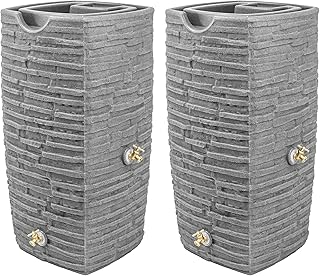
The Nantucket rounds out the list with the deepest planter top here: the retailer page states the top holds up to four inches of soil, enough for a real display of annuals rather than a token tuft of greenery. For a community garden, that display value is practical, not vanity: a barrel that looks like a planter gets adopted, labelled, and looked after, while a plain drum in the corner gets forgotten until it clogs. The 50 gallon body and roughly 23 inch square footprint match the Agua's class, and the dual spigot locations in this barrel family let the installer pick the side that faces the path. The page read for this guide was lighter on construction detail than the others, so the garden's buyer should confirm the material and the included fittings on the current product page before ordering. As a second barrel paired with a plainer workhorse, it earns its place at the public-facing end of the shed.
Pros: deep planter top for a real flower display; 50 gallon capacity; spigot placement choice
Cons: fewer construction details on the page read; square footprint needs a corner rather than a fence line
Buying guide
Place the barrel before you buy it. In a community garden the water almost always comes off one roof: the shed, the pavilion, or a greenhouse. Measure that wall: its length decides how many barrels can line up, the eave height decides whether a tall model like the RainStation fits under the drip, and the downspout size decides which diverters connect cleanly. Then measure the ground patch. A flat-back barrel needs about 19 to 24 inches of depth against the wall; a round or square model needs its full footprint plus room to stand with a can. Keep the spot off the main path if you can, because a popular water point wears a mud patch into any route it sits on.
Think about how the group will actually draw water. Spigot-only barrels are tidy and keep the water covered, but the spigot sits low, so a stand or a row of blocks under the barrel is almost mandatory for can filling; budget the stand as part of the install. Removable-lid barrels skip the stand and fill cans fast by dipping, at the cost of discipline about replacing the lid. Hose users should check the spigot threading and the included hose length: a four foot hose reaches the nearest beds, and everything beyond that is carrying, which is fine if the group agrees the barrel serves the plots near the shed.
Plan for overflow on day one, not after the first storm. A full 50 gallon barrel in a heavy rain passes every extra gallon somewhere, and in a shared garden that somewhere should be a gravel patch, a rain garden corner, or a linked second barrel, never the path or a neighbour's plot. Models with an overflow tube or valve make this easy; aim the outlet when you install, and write the direction on the garden's setup notes so a spring reinstall by different volunteers repeats it.
Shared spaces reward simple rules more than fancy fittings. Agree who cleans the screen each month, because a clogged screen silently sends the whole roof's water down the overflow. Agree the winter plan: every plastic barrel here needs draining before freezing weather, and most makers say to flip or store the barrel so ice cannot split it. Put one name on the task. Finally, think about growth. Barrels with linking spigots or a linking kit let the garden start with one unit at the shed and add a second along the wall next season without replumbing the downspout, which is exactly how community gardens actually expand: one grant, one barrel, one year at a time.
Capacity maths helps set expectations. Fifty gallons sounds like a lot until six plots water on the same hot evening; a full barrel is roughly twenty-five watering cans. That is a supplement to the mains tap, not a replacement, and it is best spent on seedlings, transplants, and the beds nearest the shed, where rain water's lack of chlorine is most appreciated and the carrying is shortest. Two linked barrels double the buffer and are still compact in a line along a wall. If the garden has a long dry spell pattern, link early rather than after the first summer of queues.
FAQ
Where should a community garden put a shared rain barrel?
Under the shed or pavilion downspout, on a level pad against the wall, close to the plots it will serve most. Keep it off the main path, leave standing room for a person with a watering can, and aim the overflow at gravel or a planted corner rather than at a walkway or a neighbouring plot.
How many barrels does a community garden need?
Start with one 50 gallon barrel per downspout and watch how fast it empties in a hot week. Most gardens find one barrel serves the beds near the shed, and a second linked barrel is the right first expansion. Linking kits and side spigots on several models here make that second barrel a small job rather than a new install.
Do rain barrels need a stand?
Spigot models work far better raised on blocks or a stand, because the spigot sits near the base and a watering can must fit under it. Extra height also adds a little gravity pressure for a short hose. Lid-dipping models like the RainStation can sit on the ground, since cans fill from the top.
How does the garden keep shared barrel water clean?
Keep the lid on, keep the inlet screen in place, and clean the screen monthly in season. Draw water from the spigot rather than dipping dirty cans into a lidded barrel. At season's end, scrub the inside before storage. Stored rain water is for soil and roots; the group should not use it on salad leaves close to harvest.
What happens to the barrels in winter?
Every plastic barrel in this guide must be drained before freezing weather, and makers direct owners to flip or store the barrel so ice cannot form and split the walls. Community gardens should assign the drain-down to a named volunteer in autumn and add it to the same workday as the shed cleanout.
Can a rain barrel feed a drip line or soaker hose?
Yes, slowly. Gravity from a raised barrel gives gentle flow that suits soaker hoses and some drip layouts on flat ground, though output is far weaker than a tap. Keep runs short, raise the barrel as high as is practical and safe, and expect to refill more often; for most shared plots, cans and short hoses remain the main tools.
Conclusion
A compact rain barrel earns its place in a community garden by fitting the shared spaces: against the shed wall, at the end of a fence, beside the gate. The FCMP Outdoor RC45 leads this group with the smallest full-kit footprint, its Rain Catcher 4000 sibling adds a second spigot and linking for growing gardens, and the two RTS barrels keep things light and simple, with a brass spigot option for busy water points. The EarthMinded RainStation suits groups that fill by dipping, while the Algreen Agua and the Good Ideas Nantucket turn the water point into part of the garden's welcome. Measure the shed wall, agree the group's rules for lids, screens, and winter drain-down, and any of these seven will turn the shed roof into a steady, shared supply.
Related guides
More from Amazon
Programs that pair well with the guide above. Offers and eligibility are set by Amazon and may change.
Collect the home and kitchen items you want in one registry that guests can shop from.
Create a wedding registrySet up recurring deliveries of everyday items on eligible products. Terms and savings are set by Amazon.
Explore Subscribe & SaveFree shipping on eligible items, Prime Video and more. Eligible new members can start with a free trial.
Start a Prime free trialAudiobooks and podcasts to listen to on the go. Eligible new members can start with a free trial.
Try Audible freeAs an Amazon Associate we earn from qualifying purchases.
More ways to save on your garden
Programs that pair well with the guide above. Offers and eligibility are set by Amazon and may change.
Fast, free shipping on eligible items, plus Prime Video and more. Eligible new members can start with a free trial.
Start a Prime free trialSet up recurring deliveries of everyday items on eligible products. Terms and savings are set by Amazon.
Explore Subscribe & SaveRead from a huge library of eBooks, including how-to guides and cookbooks. Eligible new members can start with a free trial.
Try Kindle UnlimitedAudiobooks and podcasts for the commute, the garage or the kitchen. Eligible new members can start with a free trial.
Try Audible freeAs an Amazon Associate we earn from qualifying purchases. Using these links costs you nothing extra.


Write Your Review
No reviews yet. Be the first to share your experience!