
Key takeaways
- Five compact rain barrels with linking ports for small backyard gardens, compared on capacity, footprint, spigots, diverters and how each chain grows over time.
What's inside
As an Amazon Associate I earn from qualifying purchases. This post may contain affiliate links at no extra cost to you.
A small backyard garden asks a rain barrel to do three things at once: hold a useful amount of water, stand in the little space beside a downspout without crowding paths or beds, and grow when one barrel proves not enough. That third job is where linked connectors change the math. Instead of replacing a small barrel with a bigger tank, you join a second and third barrel through their overflow ports, and the chain stores two or three times the water on the same narrow strip of ground. This guide compares the best compact rain barrels with linked barrel connectors for small backyard gardens, five models in the 50 to 60 gallon class whose makers design them to link, nest or stack their way to more capacity.
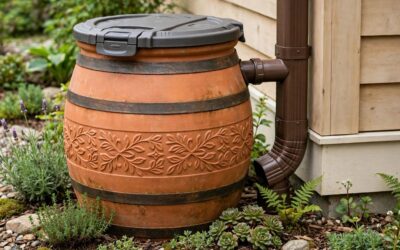
The five take different routes to compact. The Great American Rain Barrel and the EarthMinded RainStation RS50 are round drums with small footprints and linking built into their overflow fittings. The Ivy Rain Barrel tapers so empty barrels nest inside each other for storage. The Suncast RB50D uses a square profile that sits flat against a wall. The RainReserve Build-A-Barrel goes furthest, building capacity from interlocking panels that expand sideways or upward. All five are sized for a single downspout corner in a small garden, and all five can be joined to a twin when the garden's thirst outgrows one barrel.
Quick verdict
The Great American Rain Barrel is the most straightforward chain starter: a 60 gallon drum with two overflow valves fitted for linking from the start, so a second barrel joins with a short hose and no drilling. The EarthMinded RainStation RS50 is the neatest single-barrel package, with a diverter that fits both common downspout sizes and a planter lid that earns its footprint back. The Ivy Rain Barrel suits gardeners who store barrels over winter, since empties nest. The Suncast RB50D fits the tightest wall spaces with its square profile, and the RainReserve Build-A-Barrel is the choice when the plan is to keep expanding, because its panels add capacity horizontally or vertically on the same small base.
| Product | Key spec | Best for |
|---|---|---|
| Great American Rain Barrel 60 Gallon | Two 3/4 in overflow valves fitted for linking | Starting a barrel chain with no drilling |
| EarthMinded RainStation RS50 | FlexiFit diverter for 2×3 and 3×4 in downspouts | One tidy barrel with a planter lid |
| Ivy Rain Barrel 50 Gallon | Tapered body; empty barrels nest for storage | Seasonal gardens that store barrels in winter |
| Suncast RB50D | Square resin profile; leader hose with shut-off valve | Flat placement against a wall or fence |
| RainReserve Build-A-Barrel Tank | Modular interlocking panels; expands sideways or up | Gardens planning to grow capacity over time |
How we chose
Linking had to be a designed feature, not a hope. Every barrel here has maker-described overflow ports, linking valves or a dedicated linking kit, because a chain is only as good as its connections: when the first barrel fills, water must pass to the second through a proper port rather than spilling from the lid. Barrels that merely sit near each other, or that need a hole drilled in exactly the wrong place, were left out.
Compactness was judged on footprint and storage, not just capacity. A 50 to 60 gallon barrel on a roughly two-foot circle or square is the class a small garden can absorb; slimmer profiles, flat-to-wall shapes and nesting or panel designs scored extra credit because small gardens feel every inch. Practical details were compared from the makers' own pages and listings: spigot type and placement, overflow handling, whether a diverter is included or the barrel needs a separate kit, lid style, and how the barrel behaves in winter. Models already featured in this site's other rain barrel roundups were set aside so this list brings a fresh set to the small-garden problem.
Great American Rain Barrel 60 Gallon
- Capacity: 60 gallons
- Dimensions: 39 in tall x 24 in diameter
- Weight: 20 lb empty
- Material: food-grade UV polyethylene, 3/16 in wall, from repurposed drums
- Linking: two 3/4 in overflow valves, fitted for overflow and future linking
- Spigot: threaded plastic spigot with two port locations
- Lid: screw-on lid with a mosquito screen
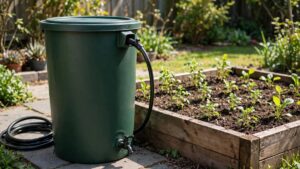
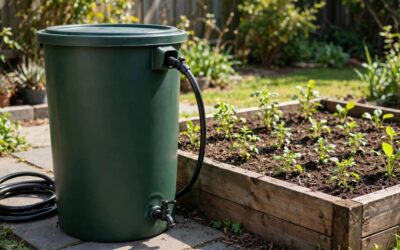
This is the barrel the maker designs around the chain. Two overflow valves are molded into the setup, one to carry overflow away and one ready to link a second barrel, and the maker's own description talks in chain numbers: link barrels together to store 120 gallons, 180 gallons and more. For a small garden, that means the first barrel is not a dead end; it is the head of a system that grows along a fence line one drum at a time.
The barrel itself is a repurposed food-grade drum with a 3/16 inch polyethylene wall, which makes it sturdier than the thin blow-molded barrels that oil-can in summer heat. The screw-on lid keeps the top sealed, a screen guards the inlet, and the threaded spigot can be placed at one of two port locations, handy when the watering can needs to fit underneath or a hose runs to a nearby bed. At 24 inches across it takes a standard downspout corner, and the color choices, Forest Green, Earth Brown and Nantucket Gray, sit quietly against planting. A one-year warranty is listed by the retailer.
Pros:
- Linking valves fitted from the factory, no drilling to start a chain
- Thick repurposed drum wall feels sturdier than thin molded barrels
- Two spigot port locations for flexible placement
Cons:
- Round drum profile uses its full 24 in circle against a wall
- Diverter is not the centerpiece of the package, so check what your downspout needs
EarthMinded RainStation RS50
- Capacity: 50 gallons
- Dimensions: 39 in tall; 23.5 in bumper diameter
- Weight: 17 lb dry
- Material: drum-grade HDPE with 10-year UV resistance
- Diverter: FlexiFit, works on 2×3 in and 3×4 in downspouts
- Lid: reversible planter lid
- Outlets: hose-threaded spigot plus drain outlets; barrels nest
The RainStation RS50 is the most complete single-barrel kit in this guide. Its FlexiFit diverter is the detail small gardens appreciate, because it works on both common downspout sizes, the 2×3 inch and the 3×4 inch, so the barrel fits the house you have rather than the house the barrel designer imagined. The maker's sell sheet lists drum-grade HDPE with ten-year UV resistance, a dry weight of just 17 lb, and a reversible lid with a planter on one side, which returns the barrel's footprint to the garden as growing space for herbs or flowers.
Linking is handled through the barrel's outlets and overflow arrangement, and empty RainStations nest, so a chain of two or three stores in the floor space of one over winter. The hose-threaded spigot accepts a standard garden hose for watering beds directly, and separate drain outlets make the end-of-season emptying less of a wrestle. At 23.5 inches at its widest bumper ring, it is marginally slimmer than the Great American drum while giving up ten gallons to get there.
Pros:
- Diverter fits both standard downspout sizes
- Planter lid gives the footprint back to the garden
- Light, nesting barrels store compactly between seasons
Cons:
- 50 gallon capacity fills fast on a large roof section
- Chain building relies on the standard outlet layout rather than dedicated linking valves
Ivy Rain Barrel 50 Gallon
- Capacity: 50 gallons
- Dimensions: 42.5 in tall; 22.5 in top diameter, 18 in bottom diameter
- Weight: 16 lb empty; about 424 lb full
- Material: 100 percent recycled HDPE
- Linking: two overflow ports with linking capability
- Included: 6 ft overflow hose; 3/4 in valve
- Lid: locking lid secured with zip ties; barrels nest
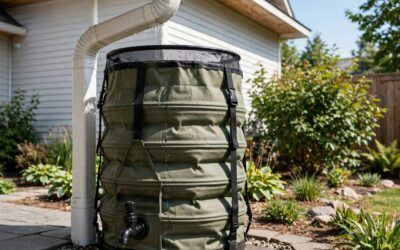
The Ivy is the tall, tapered option. Rain Water Solutions builds it from fully recycled HDPE with a top diameter of 22.5 inches narrowing to 18 inches at the base, and that taper does double duty: the barrel presents a slimmer face to a small garden, and empty barrels nest inside one another, so a chain of three stores in one barrel's floor space when the season ends. At 42.5 inches tall it is the tallest pick here, which also gives its valve a little more head pressure than shorter barrels manage.
Two overflow ports give the chain its path: one port can carry the linking hose to the next barrel while the other handles true overflow, and a 6 ft overflow hose is included in the box rather than sold as an accessory. The maker lists a 3/4 inch valve for drawing water and a locking lid held with zip ties, a simple arrangement that keeps the top closed to debris and curious wildlife. Full, the barrel weighs about 424 lb, a number worth respecting when choosing its stand: linked or not, every barrel in this guide wants a level, solid base.
Pros:
- Nesting taper makes multi-barrel storage genuinely compact
- Two overflow ports and an included 6 ft hose ease chain setup
- Tall profile adds a little gravity pressure at the valve
Cons:
- Zip-tie lid closure is basic next to screw-on or locking lids
- Tall, narrow shape wants a secure, level base in windy spots
Suncast RB50D
- Capacity: 50 gallons
- Material: resin construction
- Profile: square body for flat placement against a wall
- Outlet: leader hose with a shut-off valve instead of a spigot
- Lid: screened locking lid
- Linking: linkable with other units; linking kit sold separately
The RB50D is the wall-hugger of the group. Its square resin profile sits flat against siding or a fence where a round drum wastes the corners of its circle, and in a narrow side yard that flat back can be the difference between a barrel that fits the passage and one that blocks it. Suncast lists the barrel as linkable with other units, so a second RB50D can join the first along the same wall, though the linking kit is a separate purchase rather than a fitting in the box.
Instead of a spigot, the RB50D draws water through a leader hose with a shut-off valve. That arrangement fills watering cans less gracefully than a raised spigot, but it drains the barrel lower and routes water along the ground to a nearby bed without lifting cans onto a stand. The screened locking lid keeps the top closed, and the resin body shrugs off the dents and rust that metal drums collect. Gardeners who want the barrel to disappear against the house will find this the least obtrusive shape here.
Pros:
- Square profile sits flat to walls and fences in narrow yards
- Leader hose draws water low without a tall stand
- Resin body will not rust or dent
Cons:
- Linking kit is sold separately
- Hose outlet is slower for filling cans than a spigot
RainReserve Build-A-Barrel Tank
- Capacity: 50 gallons per tank
- Dimensions: 19 x 19 x 38 in
- Material: food-grade, BPA-free, UV-inhibited panels
- Design: modular interlocking panels, expandable horizontally and vertically
- Linking: Daisy Chain Kit links three or more barrels from the top ports
- Fittings: high-flow spigot and diverter
The Build-A-Barrel rethinks what a barrel is. Instead of a molded drum, RainReserve builds the tank from interlocking panels, 19 by 19 inches at the base and 38 inches tall, and the system expands by adding tanks side by side or stacking the arrangement upward. The maker's Daisy Chain Kit links three or more barrels from their top ports, which keeps the linking run short and level along a wall or fence.
For a small backyard garden, the 19 inch square footprint is the smallest in this guide, closer to a large planter than a drum, and the panel construction means a damaged section is a part, not a whole new barrel. The maker lists food-grade, BPA-free, UV-inhibited material, a high-flow spigot and a diverter in the system. The trade-off for all this flexibility is assembly: panels must be built and sealed by the owner, where the molded drums in this guide arrive ready to fill.
Pros:
- Smallest footprint here at 19 in square
- Capacity grows horizontally or vertically from the same base size
- Daisy Chain Kit is made to link three or more tanks
Cons:
- Panel assembly takes time the molded barrels do not
- More seams and parts than a one-piece drum
Buying guide
Plan the chain before the first barrel. Linked barrels fill in sequence and drain from the last spigot you open, so decide where the chain starts at the downspout, where it runs, usually along a fence or the house wall, and where you will draw water. Every barrel in the chain must sit at the same base height on a level, solid pad: a full 50 gallon barrel weighs over 400 lb, and a chain of three is well over half a ton pressing on whatever they stand on. Pavers or a gravel pad over compacted soil suit most small gardens; a wobbly stand under one barrel twists the linking hoses for all of them.
Check how each model links before buying two. Factory linking valves, like the Great American's pair of overflow valves, join with a short hose and no tools. Port-based systems, like the Ivy's twin overflow ports, need the right hose and a few minutes. Kit-based systems, the RainReserve Daisy Chain or Suncast's separate linking kit, add a purchase to the second barrel, so price the chain, not the single barrel. Linking from the top ports keeps barrels at equal level and lets any barrel in the chain be drawn down; whatever the route, keep the linking run short, level and free of sags that trap water and freeze in winter.
Fit the barrel to the downspout as carefully as to the garden. A diverter that matches your downspout size, as the RainStation's FlexiFit does for both common sizes, saves a return trip. Overflow routing matters in a small garden: the overflow hose should lead water away from foundations and paths, ideally to a bed that appreciates the extra drink. Screens and closed lids keep the stored water clean and keep insects from breeding in it, and a planter lid, where offered, returns the barrel's footprint to growing duty.
Finally, think about the off-season. In freezing climates barrels are drained and often stored; nesting designs like the Ivy and RainStation shrink a chain into one barrel's space, while panel systems break down flat. A barrel that stores easily is a barrel that survives to link again next spring.
FAQ
How does linking rain barrels actually work?
The barrels join through their overflow ports or dedicated linking valves with a short hose. Rain fills the first barrel; once it is full, water passes through the linking hose into the second, and so on down the chain. The Great American Rain Barrel fits two overflow valves for exactly this, and RainReserve sells a Daisy Chain Kit that links three or more of its tanks from the top ports.
Do linked barrels all need to be the same model?
Staying with one model is simplest, because port heights and fitting sizes match. The Suncast RB50D is listed as linkable with other units of its kind, and panel systems like the Build-A-Barrel are made to join their own tanks. Mixing brands can work when port heights align, but the makers design their chains around their own barrels.
How much space does a two-barrel chain take in a small garden?
Roughly two footprints in a line. Two round drums of about 24 inches sit in a strip about four feet long and two feet deep along a wall. The RainReserve tanks shrink that to a 19 inch square each, and the square Suncast profile wastes no corner space against the wall, which is why profile matters as much as capacity in a small yard.
Can I drink from a watering can easily with a linked chain?
Draw from any barrel's spigot; the chain equalizes as you draw. Barrels with a raised threaded spigot, like the Great American and the RainStation, fill a can directly. The Suncast's leader hose draws lower and slower, better for running water along the ground to a bed than for quick can fills.
What happens to a linked chain in winter?
Drain it. Open the spigots and drain outlets, disconnect the linking hoses, and store the barrels dry. Nesting models stack into one footprint, panel tanks break down, and molded drums simply stand empty. Water left in linking hoses and valves is what freezes and splits fittings, so the hoses matter as much as the barrels.
Is a diverter necessary, or can the barrel sit under the downspout?
A barrel can catch a shortened downspout directly, but a diverter is tidier: it feeds the barrel, sends overflow back down the drain line when the barrel is full, and keeps the system closed to debris. The RainStation includes its FlexiFit diverter in the system, sized for both 2×3 and 3×4 inch downspouts.
Conclusion
For small backyard gardens, the best rain barrel is the one that fits the corner today and accepts a partner tomorrow. The Great American Rain Barrel starts a chain with the least fuss, its factory linking valves ready from day one. The EarthMinded RainStation RS50 is the polished all-in-one, diverter and planter lid included. The Ivy Rain Barrel stores its chain in a single footprint over winter, the Suncast RB50D hugs a wall where round drums cannot, and the RainReserve Build-A-Barrel grows by panels in whichever direction the garden allows. Pick the profile your space can spare, plan the chain before the first purchase, and a modest downspout corner becomes the garden's reservoir.

Write Your Review
No reviews yet. Be the first to share your experience!