
Key takeaways
- Wooden herb planters for patios with full sun: seven cedar, fir and pine planters compared on size, soil depth, drainage, height, sunlight and herb-growing fit.
What's inside
As an Amazon Associate I earn from qualifying purchases. This post may contain affiliate links at no extra cost to you.
Herbs are sun plants. Basil, rosemary, thyme and oregano all do their best work in full sun, and a patio that bakes all afternoon is the right place for them, provided the planter can handle the heat. A wooden planter handles it better than most materials: wood insulates the roots from the worst of the sun, it breathes where plastic sweats, and it looks like it belongs on a patio rather than like a piece of garden equipment that wandered in from the shed. The catch is that wood in full sun and daily watering needs to be the right wood, with drainage that works and a depth that suits herb roots.
This guide covers best wooden herb planters for patios with full sun, and every planter in it is a wooden raised bed or planter box with drainage listed on the page opened for it. The seven planters below are made from cedar, fir or pine, and they range from a compact two-pack of small boxes to a 73 inch raised bed on legs. Soil depth, drainage holes, height and weight capacity are compared in the table, and the buying guide explains how to match each one to the herbs it will hold.
Herbs are mostly shallow-rooted, which is good news: a planter does not need to be deep to grow them well, but it does need to drain freely, hold enough soil to stay damp between waterings, and stand at a height that makes picking easy. The planters in this guide all meet those tests in different ways, from a waist-high cedar bed to a three-tier rolling planter that can be moved into the sun or out of it.
Quick verdict
The VegTrug Raised Bed Cedar Wood Garden Planter Small is the safest first choice: cedar resists rot in sun and rain, the waist-high bed makes picking easy, and the liner and bottom shelf are practical details that cheaper beds skip. Gardeners who want the most growing space should look at the Costway 73 inch bed on legs, with eight drainage holes and a 330 pound capacity, while the Best Choice Products 72 inch bed is the pick for a long sunny wall at a similar size. The Sunnydaze three-tier rolling planter is the best choice for a small patio, because it holds three herbs in a small footprint and rolls into the sun or into shade.
| Product | Key spec | Best for |
|---|---|---|
| VegTrug Raised Bed Cedar Wood Garden Planter Small | Cedar, 31.5 in high, liner, bottom shelf | A waist-high cedar bed for easy herb picking |
| Best Choice Products Raised Garden Bed 72 by 24 by 30 Inch | Chinese fir, 72x24x30 in, 8.4 cu ft, 6 drainage holes, 300 lb | A long bed along a sunny patio wall |
| Costway Outdoor Raised Garden Bed with Legs 73 by 23 by 30 Inch | Fir, 73x23x30 in, 8 drainage holes, 330 lb capacity | The largest soil volume with the highest capacity |
| VegTrug Wallhugger Raised Garden Bed Planter Small | Fir, 40x18x31 in, 6 cu ft, liner included | A narrow bed flat against a sunny wall |
| YIORTWO Wooden Raised Garden Bed with Trellis | Fir, 36x14x59 in, interior 33.5×12.5×8 in, 88 lb capacity | Climbing herbs and a trellis on a sunny patio |
| SPORFIT Wooden Raised Garden Bed 28 by 10 by 10 Inch Set of 2 | Pine, 28x10x10 in, set of 2, interior 26×7.5×8.5 in, 88 lb | Two small beds for herbs that need separating |
| Sunnydaze 3-Tier Wooden Rolling Planter DSL-947 | Fir, 3 tiers, 1/1.4/1.8 gal, 39.25 in high, 2 iron wheels | Three herbs in a small footprint that rolls |
How we chose
Wood came first: each planter had to be made from real wood, cedar, fir or pine, because the keyword asks for a wooden herb planter and a resin or plastic planter, however good, is not the same thing. Drainage came second, because a wooden planter in full sun will be watered daily, and a planter that cannot drain will rot from the inside and drown the herbs. Every planter here lists drainage holes, a liner or a drainage design on the page opened for it, and the soil depth was read against herb roots: most herbs need 6 to 8 inches of soil, while rosemary and other woody herbs want more.
Size and height were judged against a patio, not a garden: a planter must fit the space, leave room to walk past it, and stand at a height that makes picking easy without bending. Weight capacity was noted where listed, because a wooden bed full of wet soil is heavy, and a bed on legs must hold that weight safely. Full sun was taken seriously: the guide notes where the maker lists UV resistance or a liner, and it favours cedar and fir, which handle sun and rain better than untreated softwood. No planter here was chosen on a rating or a review score.
VegTrug Raised Bed Cedar Wood Garden Planter Small
- Height: 31.5 in
- Material: cedar wood
- Included: liner
- Storage: bottom shelf
- Use: raised bed garden planter
The VegTrug Small is the classic cedar raised bed, and it earns the lead because it gets the three things that matter for herbs on a sunny patio right at once: the wood, the height and the liner. Cedar is the best common wood for outdoor planters, because it resists rot and insects without chemical treatment, and it weathers to a soft grey that suits a patio rather than looking tired. At 31.5 inches high the bed stands at waist height, so basil, parsley and chives can be picked without bending, and the liner holds the soil in while letting water drain, which protects the cedar from constant wetting. The bottom shelf is a practical detail: it holds pots, tools and a watering can within reach, and it stiffens the frame.
A small VegTrug suits a patio herb garden of five or six plants: basil and parsley at the front where they are picked often, rosemary at the back where it can grow tall, and thyme and oregano along the edges where they can trail. Cedar in full sun will warm the soil, which herbs like, and the wood insulates the roots from the worst of the afternoon heat far better than a thin plastic pot. The trade is size: this is a small bed, so a gardener who wants a large herb harvest will need more than one, or a longer bed from elsewhere in this guide. For a first wooden herb planter on a sunny patio, it is the one to buy.
Pros: Cedar resists rot without treatment; waist height for easy picking; liner included; bottom shelf for tools.
Cons: Small size suits a few herbs, not a large harvest; no drainage hole count listed on the page opened.
Best Choice Products Raised Garden Bed 72 by 24 by 30 Inch
- Size: 72 x 24 x 30 in
- Soil volume: 8.4 cu ft
- Material: Chinese fir
- Drainage: 6 drainage holes
- Capacity: 300 lb
The Best Choice Products bed is the long bed in this guide: 72 inches long, 24 inches wide and 30 inches high, with 8.4 cubic feet of soil and a 300 pound capacity. That length suits a sunny patio wall, where it can hold a full herb collection in a single row: rosemary and sage at the back, basil and parsley in the middle, and thyme, oregano and chives along the front edge. Chinese fir is a light, straight-grained wood that is easy to work and holds up well outdoors, and the six drainage holes are spaced to let water out evenly along the whole bed, which matters in a long bed where the middle can stay wet while the ends dry out. The 30 inch height is waist-high for most gardeners, so picking and weeding are done standing up.
A bed this size needs planning before it is filled: 8.4 cubic feet of soil is a lot to move, and the bed should be sited where it will stay, because a full bed cannot be shifted. The 300 pound capacity covers the soil, the plants and a season of watering, and the legs hold the bed clear of the patio so water can drain away rather than pooling underneath. The trade is that fir needs more care than cedar over the years: a liner, which is not listed for this model, will protect the wood, and the bed should be checked each spring for soft spots. For a gardener with a long sunny wall and a serious herb habit, this is the bed that fits.
Pros: Long bed holds a full herb collection; six drainage holes; 8.4 cubic feet of soil; 300 pound capacity.
Cons: Needs a liner for long wood life; a full bed cannot be moved once sited.
Costway Outdoor Raised Garden Bed with Legs 73 by 23 by 30 Inch
- Size: 73 x 23 x 30 in
- Material: fir
- Drainage: 8 drainage holes
- Capacity: 330 lb
- Features: divider panel
The Costway bed is the twin of the Best Choice Products bed in size and the leader on capacity: 73 inches long, 23 inches wide and 30 inches high, with eight drainage holes and a 330 pound capacity. The extra drainage holes are the detail that matters: eight holes along a 73 inch bed drain more evenly than six, so the middle of the bed does not stay wet while the ends dry, and herbs that hate wet feet, like rosemary and lavender, will be happier for it. The divider panel is a useful extra: it splits the bed into sections, so a thug like mint can be kept in its own compartment instead of taking over the whole bed, and different herbs can have different soil mixes on either side of the divider. Fir is the wood, light and straight-grained, and the 30 inch height keeps the work at waist level.
A bed of this size is a piece of patio furniture as much as a planter, and it should be treated as one: site it where it will stay, level the legs, fill it with a free-draining mix, and plant it as a single design rather than as a row of afterthoughts. The 330 pound capacity is the highest in this guide, which gives a comfortable margin for wet soil, and the legs hold the bed clear of the patio so the drainage holes can work. The trade is the same as for any large wooden bed: fir will last longer with a liner and with an annual check for soft spots. For the largest herb garden on a sunny patio, this is the bed to buy.
Pros: Eight drainage holes for even drainage; divider panel tames mint; 330 pound capacity; waist-high working height.
Cons: A full bed cannot be moved; fir benefits from a liner for long life.
VegTrug Wallhugger Raised Garden Bed Planter Small
- Size: 40 x 18 x 31 in
- Soil volume: 6 cu ft
- Material: fir
- Included: liner
- Use: wall-hugging raised bed planter
The VegTrug Wallhugger is the narrow bed in this guide, and its shape is the reason to buy it: 40 inches long and only 18 inches deep, it sits flat against a sunny wall and uses a strip of patio that a deeper bed would waste. Six cubic feet of soil is enough for a generous herb collection, and the 31 inch height keeps the work at waist level. Fir is the wood, and a liner is included, which protects the timber from constant wetting and holds the soil in place. Against a wall, the bed catches the heat the wall gives off in the evening, which herbs love, and the wall shelters the plants from wind while the sun does its work.
A wall-hugging bed suits a patio where space is tight and the sunny wall is the best growing position. Plant tall herbs like rosemary and bay at the back against the wall, where they can lean on it, and low herbs like thyme and oregano at the front where they can trail over the edge. The narrow depth means the soil will dry faster than a deep bed, so watering needs to be regular in hot weather, and a mulch of gravel or bark will help hold the moisture. The trade is depth: 18 inches is plenty for herbs, but it will not suit deep-rooted vegetables, so this bed should be kept for herbs and salads. For a sunny wall on a small patio, it is the best fit in this guide.
Pros: Narrow shape fits a wall strip; liner included; 6 cubic feet of soil; wall warmth suits herbs.
Cons: Narrow bed dries faster in hot weather; depth suits herbs, not deep-rooted crops.
YIORTWO Wooden Raised Garden Bed with Trellis
- Size: 36 x 14 x 59 in
- Interior: 33.5 x 12.5 x 8 in
- Material: fir
- Capacity: 88 lb
- Feature: trellis
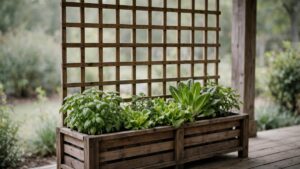
The YIORTWO bed is the only planter in this guide with a trellis, and that trellis is the reason to buy it. At 36 inches long, 14 inches deep and 59 inches high overall, it is a compact bed with a tall back, and the trellis gives climbing herbs and small vines something to hold on to. The interior of the bed is 33.5 by 12.5 by 8 inches, which is the right depth for herbs: 8 inches of soil suits basil, parsley, chives and thyme, and the trellis can carry a climbing bean, a small cucumber or a trailing herb like nasturtium above them. Fir is the wood, and the 88 pound capacity covers the soil and the plants with margin. On a sunny patio the trellis also does a second job: it breaks the wind and gives a little afternoon shade to the herbs at its foot.
A bed with a trellis needs to be sited with the sun in mind: put the trellis on the north side of the bed so it does not shade the herbs, and let the climbers use the sun while the herbs use the soil. The narrow 14 inch depth means the bed will dry quickly in full sun, so regular watering and a mulch will help, and the trellis should be checked each season for loose joints. The trade is size: this is a small bed for a few herbs and a climber, not a production bed. For a sunny patio where a trellis adds height and interest, it is the most charming planter here.
Pros: Trellis suits climbing herbs and vines; 8 inch soil depth suits herb roots; compact footprint for a small patio.
Cons: Small soil volume dries fast in full sun; 88 pound capacity limits heavy planting.
SPORFIT Wooden Raised Garden Bed 28 by 10 by 10 Inch Set of 2
- Size: 28 x 10 x 10 in each, set of 2
- Interior: 26 x 7.5 x 8.5 in
- Material: pine
- Capacity: 88 lb
- Use: raised garden bed, two-pack
The SPORFIT set is the smallest planter in this guide and the most flexible: two pine boxes, each 28 by 10 by 10 inches, with an interior of 26 by 7.5 by 8.5 inches. Two boxes mean two soils, two waterings and two positions: mint in one box where it cannot escape, and basil and parsley in the other where they can be picked daily. Pine is a light, affordable wood, and the 8.5 inch interior depth suits herb roots well, while the 88 pound capacity covers the soil and the plants. The boxes sit on the patio or on a bench, and they can be moved with the sun through the seasons, which is a real advantage on a patio where the sunny spot moves.
Small boxes dry fast in full sun, so they need the most regular watering in this guide, and a mulch will help more here than in any other planter. The trade is capacity: two small boxes will not feed a large household, but they will keep a cook in fresh herbs all summer, and they are the easiest planters here to replace or to move. For a gardener who wants to try a wooden herb planter without committing to a large bed, or for a cook who wants mint kept strictly apart from everything else, this two-pack is the sensible first buy.
Pros: Two boxes keep mint separate; movable with the sun; 8.5 inch depth suits herb roots; low cost for a first try.
Cons: Small boxes dry fast in full sun; pine needs care to last several seasons.
Sunnydaze 3-Tier Wooden Rolling Planter DSL-947
- Model: DSL-947
- Material: fir wood
- Tiers: 3, capacities 1, 1.4 and 1.8 gal
- Height: 39.25 in
- Wheels: 2 iron wheels, 9.5 in
- Warranty: 1-year warranty
The Sunnydaze DSL-947 is the only tiered planter in this guide, and it is the best answer for a small patio: three tiers in a single footprint, holding 1, 1.4 and 1.8 gallons of soil, standing 39.25 inches high on two 9.5 inch iron wheels. The tiers step back as they rise, so each level gets its own sun, and the wheels let the whole planter roll into the sun in the morning and into a sheltered corner in a storm. Fir is the wood, and the one year warranty covers the first season. Three tiers mean three herbs with different needs: a thirsty basil on the bottom tier where it can be watered most, a rosemary on the top where it drains fastest, and a thyme in the middle where it can trail.
A tiered planter needs a watering routine that respects the tiers: water the top first and let the excess drain down, and check the bottom tier, which will stay wettest. The small tier volumes dry fast in full sun, so daily watering is the norm in summer, and the wheels should be checked for rust at the end of the season. The trade is soil volume: no tier holds enough for a large plant, so this planter suits herbs and small salads rather than vegetables. For a small sunny patio where floor space is precious and the sun moves during the day, it is the cleverest planter here.
Pros: Three tiers in a small footprint; rolls into the sun; each tier gets its own light; waist-high picking.
Cons: Small tier volumes dry fast; wheels need care; one year warranty only.
Buying guide
Wood type and rot resistance
Cedar is the best wood for a herb planter in full sun and rain, because it resists rot and insects without chemical treatment, and it weathers gracefully. Fir is a good second choice: light, straight-grained and durable with a liner, but it needs more care than cedar over the years. Pine is the most affordable and the lightest, but it is also the softest, so it needs a liner and a dry position to last several seasons. Whatever the wood, a liner is worth having: it holds the soil, lets water drain, and keeps the timber from sitting wet, which is what rots a planter from the inside.
Soil depth for herb roots
Most herbs are shallow-rooted and do well in 6 to 8 inches of soil, which is the depth of the planters in this guide. Basil, parsley, chives, thyme and oregano all thrive at that depth, while woody herbs like rosemary and sage want a little more room and will be happier in the deeper beds. A planter shallower than 6 inches will dry out too fast in full sun and will not hold enough soil to feed the plants through the season. When in doubt, choose the deeper bed: extra soil is a water reserve that keeps herbs alive through a hot afternoon.
Drainage and watering in full sun
A wooden planter in full sun will be watered daily, so drainage must work every time. Look for drainage holes spaced along the whole bed, not just at the ends, and check that the bed stands clear of the patio so water can escape underneath. Water in the morning so the leaves dry before the heat of the day, and water the soil, not the foliage. A mulch of gravel or bark on the surface slows evaporation and keeps the soil damp between waterings, which matters more in a wooden planter than in a plastic one because wood itself drinks a little water.
Height, reach and picking
A herb planter should stand at a height that makes picking easy without bending, which for most gardeners is 28 to 32 inches. A waist-high bed is used more often than a ground-level one, because the herbs are at hand when cooking and the gardener can see at a glance what needs picking. A bed on legs should be checked for stability before it is filled: a full bed is heavy, and legs that splay or sink will tilt the bed and spill soil. A planter that can be moved, like the rolling tiered model here, is worth considering where the sunny spot moves through the day.
Sun, heat and placement
Full sun means six or more hours of direct sun a day, and on a patio that sun is often reflected off walls and paving, which makes it hotter still. Site the planter where it gets morning sun and a little afternoon shade if possible, or where a wall gives warmth without trapping heat. Wood insulates roots better than thin plastic, but a small wooden box in full sun will still dry fast, so small planters need the most frequent watering. Turn a movable planter through the season so all sides get sun, and leave a gap behind a wall-hugging bed so air can move and the wood can dry.
FAQ
Which wood lasts longest for a herb planter in full sun?
Cedar lasts longest, because it resists rot and insects without chemical treatment, and it weathers to a soft grey rather than looking tired. Fir is a good second choice with a liner and an annual check, while pine is the most affordable but needs the most care. Whatever the wood, a liner, free drainage and a position where the wood can dry between waterings will add years to the planter.
How deep should a wooden herb planter be?
Six to eight inches of soil suits most herbs, including basil, parsley, chives, thyme and oregano. Woody herbs like rosemary and sage want a little more depth, and a bed of 8 inches or more will suit them. A planter shallower than 6 inches dries too fast in full sun and will not hold enough soil to feed the plants through the season, so choose the deeper bed when in doubt.
Do wooden herb planters need drainage holes?
Yes, and the holes should be spaced along the whole bed so water drains evenly. A wooden planter without drainage will hold water at the bottom, rot the wood and drown the herbs. Check that the bed stands clear of the patio so water can escape underneath, and use a free-draining soil mix rather than heavy garden soil, which holds water and compacts.
How often will I water wooden planters in full sun?
Daily in summer, and twice daily for small boxes in a heatwave. Wooden planters in full sun dry from the top and from the sides, and small boxes dry fastest of all. Water in the morning so the leaves dry before the heat of the day, check the soil with a finger before watering, and mulch the surface with gravel or bark to slow evaporation. A deep bed on legs will need less frequent watering than a small box on a bench.
Can wooden herb planters stay outside in winter?
Yes, if they are drained and the soil is not left waterlogged. Empty annual herbs at the end of the season, cut back perennials, and make sure the drainage holes are clear so winter rain can escape. A liner helps the wood survive the wet winter, and a planter on legs should be checked for stability before the frosts. Wood that stays wet all winter will rot faster than wood that dries between rains.
What herbs grow best in a sunny wooden planter?
Basil, rosemary, thyme, oregano, sage, parsley and chives all do well in full sun in a wooden planter. Keep mint in its own box or behind a divider, because it will take over a shared bed. Plant tall herbs at the back and trailing herbs at the front edge, and pick little and often, which keeps the plants bushy and productive all summer.
Conclusion
The right wooden herb planter for a sunny patio is the one that fits the space, drains freely and stands at a height that makes picking a pleasure. The VegTrug cedar bed is the safest first buy, the Costway and Best Choice Products beds suit a long sunny wall, the Wallhugger fits a narrow strip, and the Sunnydaze tiered planter makes the most of a small patio. Choose cedar where the budget allows, fit a liner, use a free-draining mix, and water in the morning. Herbs in full sun reward that care with a summer of fresh picking, and a wooden planter will look better for it every year.




Write Your Review
No reviews yet. Be the first to share your experience!