
Key takeaways
- Compare electric irrigation pumps with automatic priming for watering large vegetable plots, with flow, pressure, lift, voltage, and port sizes for each model.
As an Amazon Associate I earn from qualifying purchases. This post may contain affiliate links at no extra cost to you.
Our top picks at a glance
4 products from this guide, in the order reviewed below.



As an Amazon Associate we earn from qualifying purchases. Prices and availability can change.
A large vegetable plot drinks on a schedule the weather does not negotiate, and the pump feeding it often sits above its water: a well head, a cistern, a pond bank, or a storage tank. That layout is why priming matters. A self-priming pump, filled once at installation, pulls air from the suction line and restarts on water day after day, instead of demanding a manual prime every time the system sits idle. This guide compares best electric irrigation pumps with automatic priming for watering large vegetable plots from opened maker and retailer pages.
The field below is the class of electric sprinkler and irrigation pumps whose makers describe self-priming or one-time priming operation: cast iron Red Lion models in three sizes, corrosion-resistant Flotec thermoplastic models in three sizes, and one portable Wayne pump for plots watered from stored water. Flow at working pressure, priming lift, voltage, and port sizes are listed for each, because those four numbers decide whether a pump fits a plot far better than a horsepower badge does.
Quick verdict
For most large vegetable plots, the Red Lion RL-SPRK150 is the center of this group: strong flow at working pressure, cast iron build, and priming to 25 ft after one initial fill. Bigger plots and long main lines point to the RL-SPRK200, smaller ones to the RL-SPRK100. Where the pump site is damp or corrosive, the Flotec thermoplastic models trade a little pressure for a housing that does not rust, and the Wayne PLS100 covers portable watering from tanks and ponds at a smaller scale.
| Product | Key spec | Best for |
|---|---|---|
| Red Lion RL-SPRK150 Sprinkler Pump | 1.5 HP, up to 71 GPM, self-priming to 25 ft | Best for large plots needing high flow at moderate pressure |
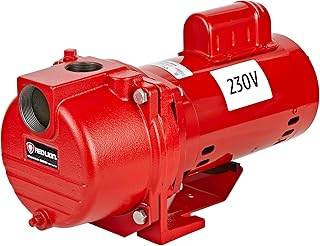
| Red Lion RL-SPRK200 Sprinkler Pump | 2 HP, up to 76 GPM, 230 V | Best for the largest plots and long main lines |
| Red Lion RL-SPRK100 Sprinkler Pump | 1 HP, up to 63 GPM, self-priming to 25 ft | Best for mid-size plots on a 115 V supply |
| Pentair Flotec FP5162 Thermoplastic Sprinkler Pump | 1 HP, 55 GPM, self-priming after initial fill | Best for corrosion resistance near damp pump sites |
| Flotec FP5172 Thermoplastic Sprinkler Pump | 1.5 HP, 67 GPM, self-priming after initial fill | Best for larger sprinkler zones on a corrosion-proof body |
| Flotec FP5182 Thermoplastic Sprinkler Pump | 2 HP, 69 GPM, 2 in ports | Best for high volume transfer and big zone work |
| Wayne PLS100 Portable Lawn Sprinkling Pump | 1 HP, 720 GPH, self-priming, 20 ft suction lift | Best for portable watering from ponds and tanks |
How we chose
The gate for this keyword was priming behavior stated on an opened page. Each model below is described by its maker or retailer as self-priming, easy to prime with no additional priming after the initial fill, or self-priming after the housing is initially filled. That is the working meaning of automatic priming in this pump class: fill the case once, fit the check or foot valve the maker requires, and the pump re-establishes prime on its own at each start. Pumps whose pages described manual priming before every use were excluded.
Models were then compared on the figures a vegetable plot actually loads: flow at 30 psi rather than the open-discharge maximum, since sprinklers and drip mains work under pressure; priming lift, since wells and tanks sit below the pump; voltage, since a barn supply and a house outlet offer different options; and port size, since an undersized intake starves any pump. All figures come from the opened pages, and series data is identified as such where a maker publishes one table for a family.
Red Lion RL-SPRK150 Sprinkler Pump
- Horsepower: 1.5 HP
- Maximum flow: 71 GPM
- Priming: easy to prime up to 25 ft, no added priming after initial fill
- Voltage: 115/230 V dual voltage
- Ports: 2 in FNPT intake, 1.5 in FNPT discharge
- Maximum pressure: 44 psi
- Housing: cast iron casing and base
- Flow at 30 psi and 5 ft lift: 44 GPM as listed
The RL-SPRK150 is the anchor pick for a large vegetable plot fed from a well, pond, or tank. The maker lists a cast iron casing, a 1.5 HP dual-voltage motor, and flow up to 71 GPM, holding 44 GPM at 30 psi with a 5 ft lift, which is the working zone for running several sprinkler lines or a wide drip main across beds. Priming is listed as easy up to 25 ft with no additional priming after the initial fill, so a pump that sits above its water source restarts cleanly between watering days instead of asking for a bucket and a wrench each time.
Pros: High flow at working pressure for multi-line plots; Self-priming to 25 ft after the initial fill; Dual voltage suits barn or house supply.
Cons: Cast iron body is heavy to move; Needs a check or foot valve setup done properly.
Red Lion RL-SPRK200 Sprinkler Pump
- Horsepower: 2 HP
- Maximum flow: 76 GPM as listed
- Maximum pressure: 49 psi as listed
- Priming: easy to prime up to 25 ft after initial fill
- Voltage: 230 V
- Ports: 2 in FNPT intake, 1.5 in FNPT discharge
- Housing: cast iron casing and base
- Flow at 30 psi and 5 ft lift: 65 GPM as listed
Where a vegetable plot grows into small-scale production, the RL-SPRK200 adds headroom. The maker's table lists 2 HP, up to 76 GPM, and 65 GPM at 30 psi with a 5 ft lift, numbers that keep pressure steadier when several zones run or when the main line runs long to the far beds. It shares the family traits that matter here: cast iron casing, priming up to 25 ft with no re-priming after the initial fill, and 2 in intake plumbing that does not starve the pump. It runs on 230 V only, so the supply at the pump site decides whether this model is even an option.
Pros: Highest flow in this group at working pressure; Steady pressure for long main lines; Same 25 ft priming lift as the family.
Cons: 230 V only, so site wiring must suit it; Oversized for modest plots.
Red Lion RL-SPRK100 Sprinkler Pump
- Horsepower: 1 HP
- Maximum flow: 63 GPM as listed
- Maximum pressure: 45 psi as listed
- Priming: easy to prime up to 25 ft after initial fill
- Voltage: 115/230 V dual voltage
- Ports: 2 in FNPT intake, 1.5 in FNPT discharge
- Housing: cast iron casing and base
- Flow at 30 psi and 5 ft lift: 38 GPM as listed
The RL-SPRK100 brings the same cast iron, self-priming design down to 1 HP for plots that do not need the bigger models' flow. The maker lists up to 63 GPM, 38 GPM at 30 psi with a 5 ft lift, and dual 115/230 V operation, so it can start life on a standard outlet near the house and move to a wired 230 V supply later. For a large home vegetable plot running one or two sprinkler zones at a time, that is a sensible ceiling: enough flow for real coverage, with the 25 ft priming lift shared across the family for wells, cisterns, and tanks.
Pros: Dual voltage flexibility at 1 HP; Same priming lift as the larger models; Cast iron build in a smaller frame.
Cons: Runs one or two zones, not a whole plot at once; Still a fixed installation, not a portable pump.
Pentair Flotec FP5162 Thermoplastic Sprinkler Pump
- Horsepower: 1 HP
- Maximum capacity: 55 GPM
- Priming: self-priming after the housing is initially filled
- Housing: fiberglass-reinforced thermoplastic
- Maximum pressure: 42 psi
- Max lift: 25 ft as listed
- Ports: 1.5 in NPT suction and discharge
- Voltage: 115/230 V, preset at 230 V
- Heads: capable of operating up to 30 sprinkler heads as listed
The Flotec FP5162 answers a different worry: rust. Pentair lists a fiberglass-reinforced thermoplastic housing for corrosion resistance, which suits a pump that lives in a damp pit, a greenhouse corner, or a coastal plot where cast iron ages fast. Performance is listed at 55 GPM maximum, 28 GPM at a 10 ft lift and 30 psi, and up to 30 sprinkler heads, with self-priming after the housing is initially filled and a check or foot valve required. Dual voltage is preset at 230 V and can be set for 115 V, and the maker lists a 1-year limited warranty.
Pros: Thermoplastic housing resists corrosion; Solid flow for sprinkler zones and transfer; Dual voltage with clear breaker guidance.
Cons: Lower pressure ceiling than the cast iron models; Foot valve or check valve required, sold separately.
Flotec FP5172 Thermoplastic Sprinkler Pump
- Horsepower: 1.5 HP
- Maximum flow: 67 GPM as listed in the series data
- Priming: self-priming after the housing is initially filled
- Housing: fiberglass-reinforced thermoplastic
- Voltage: 115/230 V dual voltage, preset at 230 V
- Ports: 1.5 in suction and discharge as listed for the series
- Performance: listed for depths to water of 20 ft or less
The FP5172 is the 1.5 HP step in the same Flotec thermoplastic family, listed at 67 GPM for larger sprinkler zones or water transfer across a big plot. It keeps the traits that make the series fit this keyword: self-priming after the housing is initially filled, a corrosion-resistant fiberglass-reinforced thermoplastic housing, and a heavy-duty dual-voltage motor preset at 230 V. The series data frames performance at depths to water of 20 ft or less, so it suits wells, tanks, and cisterns where the lift is moderate and the demand is volume for beds, rows, and overhead sprinklers.
Pros: More flow than the 1 HP Flotec; Corrosion-resistant housing for damp sites; Dual voltage motor.
Cons: Best at moderate lifts, per the series data; Check valve or foot valve required.
Flotec FP5182 Thermoplastic Sprinkler Pump
- Horsepower: 2 HP
- Maximum flow: 69 GPM as listed in the series data
- Priming: self-priming after the housing is initially filled
- Housing: fiberglass-reinforced thermoplastic
- Voltage: 115/230 V dual voltage
- Ports: 2 in suction and 2 in discharge as listed for this model
- Performance at 5 ft lift: 69 GPM at 10 psi down to 14 GPM at 50 psi as listed
At the top of the Flotec thermoplastic line, the FP5182 pairs a 2 HP motor with 2 in suction and discharge ports, the widest plumbing in this group. The series data lists 69 GPM at a 5 ft lift and 10 psi, easing to 14 GPM at 50 psi, a curve that favors moving a lot of water at the moderate pressures vegetable irrigation uses. Self-priming after the initial fill and a corrosion-resistant housing carry over from the family. For a large plot filling tanks, running wide sprinkler zones, or pushing water down long rows, that volume is the argument for this model.
Pros: Widest ports in this group at 2 in; High volume at moderate pressure; Corrosion-resistant housing.
Cons: 2 HP draw needs a suitable circuit; Volume is wasted on small plots.
Wayne PLS100 Portable Lawn Sprinkling Pump
- Horsepower: 1 HP
- Maximum flow: 720 gallons per hour as listed
- Priming: self-priming as listed by the retailer
- Suction lift: up to 20 ft
- Housing: stainless steel pump housing
- Ports: 1 in NPT suction and discharge, with garden hose adapter listed
- Voltage: 115 V
- Weight class: portable with a carrying handle, about 20.6 lb as listed
The Wayne PLS100 plays a different role from the fixed pumps here: it is a portable 1 HP stainless steel pump that can be carried to a pond, tank, or rain barrel and moved between plots. The retailer lists self-priming operation, suction lift up to 20 ft, and up to 720 gallons per hour, with 1 in NPT ports and a garden hose adapter for simple hookups. That flow is a fraction of the big cast iron models, so this is a one-sprinkler or drip-zone pump, but for a vegetable plot watered section by section from stored water, portability can beat raw capacity.
Pros: Portable enough to move between water sources; Stainless housing and garden hose adapter; Self-priming with 20 ft suction lift.
Cons: Low flow beside the fixed pumps here; 115 V only and corded, so power must reach the water.
Buying guide
Read flow at pressure, not the headline flow. A pump listed at 70 GPM may deliver that only into an open pipe; at the 30 psi a sprinkler zone wants, the same pump may give two-thirds as much, and the makers here publish those working figures, so use them. Add up the demand of the zones you plan to run together, then choose a pump whose flow at your working pressure covers that demand with a little room to spare. Running zones in sequence is normal on a vegetable plot and keeps the pump size, and the power bill, sane.
Respect the priming lift. These pumps prime to lifts around 20 to 25 ft, measured vertically from the water surface to the pump, and performance falls as lift grows. Keep the pump as low and as close to the source as the site allows, keep the suction line airtight, and fit the check valve or foot valve the maker specifies; most priming complaints trace back to a suction leak, not a weak pump. A pump that loses prime between waterings is telling you air is getting in somewhere on the intake side.
Match the housing to the site. Cast iron is strong, steady, and heavy, and it suits a permanent pad under cover. Fiberglass-reinforced thermoplastic gives up a little pressure ceiling in exchange for shrugging off damp, fertilizer splash, and coastal air that age iron. Stainless portable pumps serve a third pattern: carried to the water, used, and stored dry. Decide where the pump will honestly live for the next five summers, including winter storage, and let that answer pick the material.
Plan the electrics before the plumbing. Dual-voltage motors ship preset one way, often 230 V, and must be set to match the supply; the Flotec page even lists breaker sizes for each voltage. A 2 HP pump on a long barn run needs a circuit that can carry it without voltage sag, which shows up as weak pressure at the far beds. Put the pump on a timer or pump start relay if it feeds an irrigation controller, and keep connections in a weatherproof box, since this equipment lives where water and power meet.
Size the plumbing to the ports. A 2 in intake on the larger models is there to feed them; choking it down to a small line invites cavitation noise and lost flow. Discharge lines can step down for drip mains, but do it after the pump, not before. Add a pressure gauge port reading to your spring routine: a falling pressure trend across a season points to a clogging intake screen or a tired foot valve long before the plot shows stress, and catching it early is the cheapest irrigation repair there is.
Filtration protects everything downstream of the pump. Pond and well water carry sand and organic grit that a sprinkler nozzle or drip emitter cannot pass, so a strainer on the intake and a filter on the discharge side are part of the pump installation, not accessories for later. Check the intake screen whenever flow drops, and size the filter for cleaning without tools, because a filter that is awkward to service gets serviced rarely and then blamed for pressure loss that was really neglect.
Winter and downtime care decide how long these pumps serve. In freezing climates, drain the pump case and lines or move a portable unit indoors, since trapped water expands and cracks housings of any material. During the season, run the pump weekly even in rainy spells so seals stay wet and the motor turns, and listen for changes: a new rattle, a longer prime, or a hotter motor case are early warnings that cost little to answer and much to ignore through a dry month.
Keep a short log at the pump: the date it was installed, the voltage setting chosen, the breaker size, and the pressure reading at a standard zone each month. That one page of notes turns troubleshooting from guesswork into comparison when output changes, and it tells the next person who services the system exactly how it was set up. Note also which valve holds the prime and when the intake screen was last cleaned, because those two items explain most of the slow declines a hardworking irrigation pump shows across its seasons.
Zone design and pump choice should be settled together. Lay out the plot so that high-demand sprinkler zones and low-demand drip zones do not need to run at the same moment, since a pump sized for the sprinkler peak will short-cycle or overpressure a small drip zone unless a regulator handles the difference. Many growers put drip zones on their own regulated branch and run them longer at low flow, while sprinkler zones run shorter at full flow, and the pump figures in this guide, read at working pressure, tell you honestly which of those patterns a given model can carry alone and which need the next size up.
FAQ
What does automatic priming mean on these pumps?
In this pump class it means the pump is filled once at installation and then re-establishes prime by itself at each start, pulling air out of the suction line as it comes up to speed. Makers phrase it as self-priming after the initial fill, or no additional priming after the first fill. It is not magic: a check valve or foot valve must hold water in the suction line, and the line must be airtight, or any pump will lose prime and run dry.
How much flow does a large vegetable plot need?
It depends on how much runs at once. A single sprinkler zone or a drip main for several beds may draw 10 to 30 GPM, while two sprinkler zones together can pass 40 GPM. The practical method is to total the emitters or heads in the largest zone you will run simultaneously, then pick a pump whose flow at your working pressure, often around 30 psi, covers that total. The working-pressure figures in this guide matter more than maximum flow for that calculation.
Can these pumps draw from a pond or tank?
Yes, that is the classic use for a self-priming sprinkler pump: the pump sits on the bank or beside the tank, above the water, and lifts through a suction line fitted with a foot valve and a strainer. Keep the lift within the listed priming range, screen out debris that would clog emitters downstream, and check local rules about drawing from shared water. For stored water in tanks, the portable Wayne PLS100 is built for exactly that pattern at a smaller scale.
Cast iron or thermoplastic housing?
Cast iron offers strength and steadiness and suits a covered, permanent installation. Thermoplastic housings resist corrosion, which suits damp pits, greenhouse corners, fertilizer splash zones, and coastal air. The pressure ceilings of the thermoplastic models here are a little lower, so the choice is partly hydraulic and partly environmental. Either material lasts when it is drained or protected for winter in freezing climates and kept on a firm, level base while running.
Why does a self-priming pump still lose prime?
Almost always because air enters the suction side: a loose fitting, a cracked intake line, a foot valve that leaks back, or a water level that fell below the intake. The pump can only prime against a sealed line that holds water. Work through the intake fittings with fresh thread seal, confirm the foot valve holds a column of water overnight, and keep the intake submerged with margin for the draw-down that happens while the pump runs.
Conclusion
For a large vegetable plot, the right pump is the one whose working flow covers your biggest zone, whose priming lift covers your water source, and whose housing suits the corner it will live in. The Red Lion cast iron line anchors that brief in three sizes, the Flotec thermoplastic line answers damp and corrosive sites, and the Wayne PLS100 keeps a portable option open for tank-fed watering. Fit the valves the maker specifies, keep the suction line airtight, and a self-priming pump turns watering day into a switch, not a ceremony.
Related guides
More from Amazon
Programs that pair well with the guide above. Offers and eligibility are set by Amazon and may change.
Collect the home and kitchen items you want in one registry that guests can shop from.
Create a wedding registrySet up recurring deliveries of everyday items on eligible products. Terms and savings are set by Amazon.
Explore Subscribe & SaveFree shipping on eligible items, Prime Video and more. Eligible new members can start with a free trial.
Start a Prime free trialAudiobooks and podcasts to listen to on the go. Eligible new members can start with a free trial.
Try Audible freeAs an Amazon Associate we earn from qualifying purchases.
More ways to save on your garden
Programs that pair well with the guide above. Offers and eligibility are set by Amazon and may change.
Fast, free shipping on eligible items, plus Prime Video and more. Eligible new members can start with a free trial.
Start a Prime free trialSet up recurring deliveries of everyday items on eligible products. Terms and savings are set by Amazon.
Explore Subscribe & SaveRead from a huge library of eBooks, including how-to guides and cookbooks. Eligible new members can start with a free trial.
Try Kindle UnlimitedAudiobooks and podcasts for the commute, the garage or the kitchen. Eligible new members can start with a free trial.
Try Audible freeAs an Amazon Associate we earn from qualifying purchases. Using these links costs you nothing extra.


Write Your Review
No reviews yet. Be the first to share your experience!