
Key takeaways
- Seven brick look garden edging products for curved flower beds, compared on section length, height, spikes, material, and how well each design handles bends.
What's inside
As an Amazon Associate I earn from qualifying purchases. This post may contain affiliate links at no extra cost to you.
A curved flower bed is where edging earns its keep or shows its limits. A straight run forgives almost any product, but a sweeping bend asks each section to turn a few degrees without opening gaps, lifting at the joints, or forcing the curve into a series of visible chords. Brick-look edging answers with short sections, interlocking joints, and flexible strips that trade the weight and permanence of real masonry for a border that can be laid in an afternoon and reshaped next season. The shortlist for the best brick look garden edging for curved flower beds compares seven resin, plastic, and polypropylene products on the figures their pages state: section length, height, width, spike counts, and how the pieces connect. For curves specifically, short sections and pivoting joints matter more than any other spec, and the entries below say plainly which designs turn well and which merely tolerate a gentle arc.
Two formats dominate. Linked block sections, like the Beuta ranges and the ARGEE kit, imitate a row of individual bricks and turn a curve one small angle at a time, which reads naturally from a distance. Continuous or long-panel stone-look strips, like the EasyFlex and JYINCPED kits, flex along their length and suit broad, gentle sweeps with fewer joints to align. The Pure Garden and Liramera kits sit between the two, with interlocking pieces long enough to cover ground and short enough to angle around a bed. Every spec is taken from a product page, a retailer listing, or a comparison page that reproduced the maker's figures, and gaps are marked rather than filled in.
Quick verdict
The Beuta Polyrock Blocks lead for curved beds that need presence: six-block resin sections, 6.5 inches tall, that join and spike down and flex into curved layouts per the listing. The Beuta Polyrock Bricks are the lower, mow-friendly version of the same system. The ARGEE Lets Edge It kit is the renter-friendly pick, with individual bricks that snap together and press into the ground with no digging. The Pure Garden Faux Brick Edging is the modular tan brick format with interlocking pieces made to angle around curves. The Liramera kit covers short feature beds, the EasyFlex No-Dig Stone-Look gives a continuous 15 foot flexing run, and the JYINCPED faux stone kit covers 17 feet in one box for long, gentle sweeps.
| Product | Key spec | Best for |
|---|---|---|
| Beuta Polyrock Blocks | 48 in sections of 6 blocks, 6.5 in high, 8 spikes | Tall brick-look borders on curved beds |
| Beuta Polyrock Bricks | 48 in sections of 6 bricks, 2.25 in high, 12 spikes | Low borders the mower can cross |
| ARGEE Lets Edge It Brick Edging | 25 ft kit, 35 bricks, snap together, no digging | Renters and no-dig installations |
| Pure Garden Faux Brick Landscape Edging | 4 pieces, 8 ft total, 7.87 in high, 5 stakes | Small curved beds with a tall brick face |
| Liramera Landscape Edging | 3 interlocking pieces, 3.8 ft total, 2 in high | Short feature beds and tree surrounds |
| EasyFlex No-Dig Landscape Edging, Stone-Look | 15 ft kit, 2.7 in tall, anchoring spikes | Long gentle curves in one continuous run |
| JYINCPED Faux Stone Edging | 17 ft kit, 17 in sections, no-dig | Long borders on a budget of effort |
How we chose
The keyword asks for three things at once: a brick look, garden edging as the product type, and suitability for curved beds. Each product here is a named model sold for landscape edging with a brick or stone-block appearance, and each has a stated mechanism for handling curves — linked sections that pivot, short interlocking pieces that angle, or a flexible strip. Real clay bricks were excluded because they are a masonry material, not an edging product with listed specs, and plain steel or aluminum edging was excluded because it does not carry the brick look, however well it curves.
Specs were taken from the pages opened for this batch: section dimensions, heights, spike counts, materials, and kit contents as listed. Heights in this category range from 2 inches to nearly 8 inches, and that spread is the main functional divide — tall faces hold back mulch and soil on a raised bed edge, while low faces mostly mark a line and let the mower pass. Spike counts are stated where the page states them, because anchoring is what keeps a curved run honest through frost and foot traffic. Where a page did not give a figure, the entry marks it as not stated rather than borrowing a number from a similar product.
Beuta Polyrock Blocks
- Sections: 4 sections per pack, each with 6 blocks
- Section size: 48 in long x 4 in wide x 6.5 in high
- Spikes: 8 included
- Material: resin
- Color: cobblestone
- Connection: patent-pending connection system per the listing
The Polyrock Blocks are the heavyweight look of this list: resin sections that read as a course of stone blocks, standing 6.5 inches high, which is tall enough to hold a real mulch layer back from the lawn and to give a curved bed a finished, built appearance. The listing describes a flexible design that allows different landscaping layouts, with sections joined by a connection system and hammered spikes to anchor the run. On a curve, the 48 inch sections turn in segments — each joint takes a small angle — and the block molding disguises those angles better than a smooth strip would, because the eye expects individual blocks to step around a bend.
Owner feedback quoted in roundups praises the realistic look and easy curved installs, and the resin is described as resisting rust, fading, and corrosion and standing up to routine edge trimming without scratching. The compromises are anchoring and scale. Eight spikes across four 48 inch sections is a modest count for a long curved run, and owners planning a big sweep should expect to add spikes at the joints, where curves try to straighten themselves over time. The height that makes the border handsome also makes it a feature that must be wanted; on a low cottage bed it can look heavier than the planting behind it.
Pros:
- 6.5 in height holds mulch and reads as real masonry
- Flexible linked sections follow curved layouts per the listing
- Resin resists rust, fading, and trimming damage per the listing
- Four 48 in sections cover 16 ft per pack
Cons:
- Only 8 spikes included for anchoring long runs
- Tall profile can overpower low plantings
- Hammered install is more work than push-in designs
Beuta Polyrock Bricks
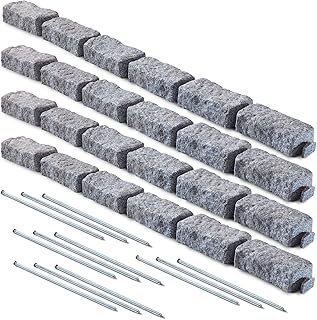
- Sections: 4 sections per pack, each with 6 bricks
- Section size: 48 in long x 4 in wide x 2.25 in high
- Spikes: 12 included
- Material: resin
- Color: sandstone
- Weight: 5.6 kg per the listing
The Polyrock Bricks are the same system at lawn level: six resin bricks linked into each 48 inch section, standing just 2.25 inches high, with twelve spikes in the pack — the most generous anchoring count relative to size on this list. Roundup coverage describes owners mowing straight over this edging, which is the practical point of the low profile: the border marks the bed, holds the mulch line, and never asks the mower to slow down. On curves, the linked sections flex around flower beds, and the low height means the stepping effect of segmented curves is barely visible at grass level.
The resin construction carries the same listed resistance to trimming damage as the Blocks, and the sections are described as staying securely in place once spiked. What the low profile gives up is retention and presence: 2.25 inches will not hold back a deep mulch layer on a slope, and the border is a line, not a wall, so beds that need a visible built edge should take the Blocks instead. The maker's guidance, quoted in listings, also advises against installing this edging where it faces extreme weather or heavy foot traffic, a caution worth honoring on a front path edge.
Pros:
- Low 2.25 in profile the mower can cross
- 12 spikes included, the strongest anchoring in this group
- Flexible sections curve around beds per the listings
- Resin build resists trimming damage
Cons:
- Too low to retain deep mulch or soil on a slope
- Maker guidance warns against heavy foot traffic areas
- Border reads as a line rather than a built edge
ARGEE Lets Edge It Brick Edging

- Kit length: 25 ft
- Contents: 35 bricks, 35 connectors, 2 end caps per the roundup listing
- Material: plastic
- Installation: snaps together and presses into the ground, no digging
- Layout: curves or straight runs per the listing
The ARGEE kit is built from individual plastic bricks joined by connectors, and that granularity is exactly what a tight curve wants: each brick turns a few degrees against its neighbor, so the border can follow a bed edge down to a fairly small radius without fighting the material. The roundup listing gives a 25 foot kit with 35 bricks, 35 connectors, and 2 end caps, and describes an install that presses into the ground with no digging and no mortar — the reason it is the standard recommendation for renters and for anyone whose landlord, HOA, or own indecision rules out a dug trench.
The same lightness that makes install easy sets the durability expectation. Owner feedback collected in roundups is mixed on lifespan, with the plastic bricks described as good value and easy to work with but not a multi-decade fixture. A pressed-in border can also ride up in freeze-thaw cycles and need reseating in spring, a five-minute job that should be planned rather than resented. For a curved bed that may be reshaped, a seasonal display border, or a first attempt at edging before committing to a heavier system, this kit's flexibility — in both senses — is the point.
Pros:
- Individual bricks turn tight curves smoothly
- No digging; presses into the ground
- 25 ft of edging in one kit
- Easy to reshape or remove entirely
Cons:
- Owner feedback on long-term durability is mixed
- Pressed-in fit can lift in freeze-thaw cycles
- Lightweight plastic look is less masonry-like up close
Pure Garden Faux Brick Landscape Edging
- Pieces: 4 interlocking pieces
- Piece size: 25.91 in long x 2.17 in wide x 7.87 in high
- Total length: 8 ft assembled
- Stakes: 5 ground stakes included
- Material: polypropylene
- Model: 50-EDG-BRCK-T
- Color: tan
The Pure Garden set is the tall, narrow format: four interlocking pieces, each just under 26 inches long and standing 7.87 inches high — the tallest face on this list — assembling into 8 feet of brick-textured border. The retailer listing describes a flexible modular design that allows straight lines and creative curves, with the interlocking pieces angled to create bends for rounded areas, and five ground stakes to anchor the result. The polypropylene body is described as resisting fading, rust, and corrosion, and the tan color aims at a weathered brick tone rather than a stone gray.
Height is this set's argument and its limit. Nearly 8 inches of face will hold back a raised bed's soil and mulch convincingly and give a curved bed a real sense of enclosure, but 8 feet per set means a long curved border takes several sets, and the joints between sets need the same care as the joints within one. The narrow 2.17 inch width also means the pieces rely on their stakes and the soil behind them for stability more than the wide Beuta sections do. For a single curved bed, a tree surround with a raised mulch cone, or a short feature border, the proportions are right; for a whole garden's worth of edging, the per-foot effort adds up.
Pros:
- Tallest face here at 7.87 in, holds back soil and mulch
- Interlocking pieces angle to form curves per the listing
- Polypropylene resists fading and rust per the listing
- Stakes included for anchoring
Cons:
- Only 8 ft per set; long borders need multiple sets
- Narrow width leans on stakes for stability
- Tall face can dominate small plantings
Liramera Landscape Edging
- Pieces: 3 interlocking pieces
- Piece size: 16.3 in long x 3.5 in wide x 2 in high
- Total length: 3.8 ft (46.65 in)
- Material: plastic
- Style: faux stone texture per the listing
The Liramera kit is the small-job entry: three interlocking faux stone pieces totaling 3.8 feet, each piece 16.3 inches long and 2 inches high. Short pieces are the easiest of all to walk around a curve — three pieces can suggest a bend around a small bed, a mailbox planting, or the front of a tree surround without any cutting or forcing — and the listing describes a textured surface intended to resemble natural stone in a light plastic body that needs no heavy lifting.
Everything about this kit is scaled to a feature, not a perimeter. The listing does not state an included spike count or a specific anchoring system, so owners should plan on the pieces being seated carefully and check them after the first heavy rain. At 2 inches high it marks a line rather than retaining soil, like the Beuta Bricks but over a much shorter run. Judged as a compact kit for a small curved accent — finishing the edge of a corner bed, ringing a small shrub — it does its job at the lowest commitment on this list. Judged as garden-wide edging, it was never meant to be that, and the per-foot count of kits would grow quickly.
Pros:
- Short pieces angle easily around small curves
- Light plastic is simple to place and adjust
- Faux stone texture suits naturalistic beds
- Lowest-commitment kit here for a small feature
Cons:
- Only 3.8 ft per kit
- Spike count and anchoring system not stated on the listing
- 2 in height marks a line but retains little
EasyFlex No-Dig Landscape Edging, Stone-Look
- Kit length: 15 ft
- Height: 2.7 in tall
- Finish: decorative stone look, slate gray
- Installation: anchoring spikes, no digging
- Brand line: EasyFlex by Dimex
The EasyFlex stone-look kit takes the opposite approach to curves from the brick kits: instead of segments, a continuous flexible strip 15 feet long and 2.7 inches tall that bends along its length, anchored with spikes and installed without digging. For a long, gentle sweep — the classic curved bed that arcs across a front lawn — a continuous strip gives the smoothest line of any product here, with no joints to step or gap. The stone-look molding keeps it inside this article's brief, giving the strip a textured, block-patterned face rather than a plain plastic wall.
The trade is radius. A continuous strip flexes gracefully through broad curves and resists tight ones, where segmented bricks keep turning happily; a bed with a tight corner or a small circle will fight this material. The 2.7 inch height is a marking and light-retention height, similar to the Beuta Bricks, and the no-dig spike system shares the pressed anchoring caveat in freeze-thaw ground. Within its design envelope — long, flowing curves at lawn level — it is the least labor per foot on this list, and the slate gray finish suits modern plantings where a tan brick tone would clash.
Pros:
- Continuous strip gives the smoothest long curves
- 15 ft per kit with no-dig spike install
- Stone-look face with a slate gray finish
- Low profile suits mower-adjacent edges
Cons:
- Resists tight curves and small circles
- 2.7 in height retains little mulch on slopes
- Spike anchoring can shift in freeze-thaw cycles
JYINCPED Faux Stone Edging
- Kit length: 17 ft per the roundup listing
- Section size: 17 in long x 2.7 in wide per the listing table
- Material: plastic
- Installation: no-dig per the roundup description
- Height: see product page
The JYINCPED kit is the long-run value format: 17 feet of faux stone edging in one kit, built from 17 inch sections. Section length sits in the useful middle for curves — short enough that each joint can take an angle, long enough that a sweeping bed does not become a hundred-piece project. Roundup coverage groups it with the no-dig stone-look borders, and the plastic construction keeps the whole kit light enough to carry around a garden in one hand.
The listing information available for this model is thinner than for the branded kits above: the comparison table gives section length and width and the kit's total coverage, while height and spike counts were not stated on the pages opened, so they are marked as see product page rather than guessed. That thinness is itself a buying fact — a maker that publishes full dimensions and anchoring details is easier to plan around. For a long, low-stakes border where the owner is happy to confirm the remaining figures on the product page before ordering, the coverage per kit is the attraction.
Pros:
- 17 ft of edging in a single kit
- 17 in sections balance curve ability and install speed
- Light plastic sections are easy to handle
- Suits long, gentle bed edges
Cons:
- Height and spike count not stated on the pages opened
- Thinner published detail than the branded kits
- Plastic look is decorative rather than masonry-like
Buying guide
Section length is the curve spec
Forget marketing language about flexibility and read the section length. As a working rule from the products here: individual bricks and pieces under about 18 inches turn down to small radii happily; 48 inch linked sections turn well through garden-scale curves because each block in the molding steps the angle; continuous strips give the smoothest line of all but only through broad sweeps. Walk the bed's tightest bend before ordering, and choose the format whose sections can take that bend without being forced. Forcing a too-long section into a tight curve stores energy in the run, and the border will spend the season trying to straighten itself.
Height decides the job the edge can do
A face around 2 to 2.7 inches marks a line, keeps a thin mulch layer honest, and lets the mower cross. A face around 6.5 to 7.87 inches retains a real mulch depth, holds soil on a slightly raised bed, and reads as a built structure from the street. Neither is better; they are different tools. Curved beds that are raised or heavily mulched need the tall formats — Beuta Blocks or the Pure Garden set — while flat lawn-level curves are better served by the low profiles that maintenance can roll over.
Anchoring is what keeps a curve a curve
Every curved run wants to straighten, and spikes are the argument against it. Note the counts in the entries: twelve spikes in the Beuta Bricks pack against eight in the Blocks pack, five stakes in the Pure Garden set, and unstated anchoring for the Liramera and JYINCPED kits. Whatever the kit includes, place anchors at the joints and at the apex of each bend, where the straightening force concentrates, and add spikes beyond the kit count on long runs. In freeze-thaw climates, expect any spike or press-in system to need a spring reseating pass; building that five minutes into the spring routine keeps the line crisp for years.
Laying out a curve that looks intentional
Mark the curve before any edging goes down — a garden hose laid along the bed edge is the classic tool, adjusted until the line looks right from the house and from the street. Cut or settle the bed edge along that line, then install the edging to the line rather than asking the edging to invent the curve as it goes. Work from one fixed end, seat each section fully before connecting the next, and sight down the run every few sections. Small corrections made early stay small; a drift discovered at the far end means relaying half the border.
Material expectations for resin and plastic
None of these products is masonry, and none should be bought expecting masonry's lifespan or weight. What the listings claim — and what owners should hold them to — is resistance to rust, corrosion, and fading, easy handling, and a convincing look at garden viewing distance. Resin sections like the Beuta ranges feel denser and read more like stone up close; thin plastic kits trade that realism for price and flexibility. All of them can be lifted and relaid when a bed is redesigned, which for many gardeners is not a compromise but the reason for choosing this category over real brick in the first place.
FAQ
How tight a curve can brick-look edging follow?
It depends on the format. Individual-brick kits like the ARGEE, with a joint every few inches, can work down to a radius of a couple of feet. Linked 48 inch sections like the Beuta ranges handle typical garden curves — think the sweep of a corner bed — by stepping the angle at each block. Continuous strips like the EasyFlex are happiest at large radii and will kink or resist on tight circles. Measure the tightest bend in the bed and match the format to it, rather than buying for the average curve.
Will brick-look edging stay in place through winter?
Spiked and pressed-in systems commonly shift a little through freeze-thaw cycles, because the ground itself moves. The fix is routine rather than dramatic: walk the border in spring, press or hammer sections back to level, and add a spike at any joint that lifted. Taller, heavier sections like the Beuta Blocks move least; light press-in kits like the ARGEE move most and are also the fastest to reseat. A border installed into a shallow, well-defined trench edge moves less than one laid on a rough surface.
Can these products hold back mulch on a raised curved bed?
The tall formats can: the Beuta Blocks at 6.5 inches and the Pure Garden pieces at 7.87 inches present enough face to retain a normal mulch layer on a modestly raised bed. The low formats — Beuta Bricks, EasyFlex, Liramera — mark edges and stop mulch creep at lawn level but will not retain a deep layer against a slope. Match the face height to the depth that needs holding, and remember that soil pressure on a curve pushes outward at the apex, which is where extra anchoring belongs.
How much edging do I need for a curved bed?
Measure the curve itself, not the straight-line distance: run a rope or hose along the bed edge and measure that. Then divide by the kit coverage — 16 ft for a Beuta four-pack of 48 inch sections, 25 ft for the ARGEE kit, 15 ft for the EasyFlex, 8 ft for the Pure Garden set, 17 ft for the JYINCPED, 3.8 ft for the Liramera — and round up to whole kits, because curves consume a little extra at the joints and ends. Having one section left over is a spare for repairs; running one section short stops the job.
Does brick-look edging look convincing?
At garden viewing distance — a few feet and beyond — the molded block patterns, matte finishes, and stepped joints of the better resin sections read convincingly as masonry, and roundup owner feedback on the Beuta ranges says as much. Up close, the weight gives the material away: these sections are light, and a hand on them knows they are not stone. Most owners judge the trade worthwhile, since a border is looked at far more often than it is touched, and the look from the path and the street is what the product is for.
Can I mix straight and curved runs with one product?
Yes; every format here handles straight runs as the easy case of a curve with no angle at the joints. Linked sections and bricks simply continue straight, and continuous strips lay flat along a line. Where a bed mixes both, install the curved portion first while the layout is being sighted, then run the straights to meet it — curves are where the measuring and adjustment live, and straights forgive being cut or extended to fit. End caps, where a kit includes them like the ARGEE set, finish the exposed ends cleanly.
Conclusion
Curved beds reward edging that turns in small increments and anchors at the joints, and the seven products here cover that ground at every height. The Beuta Polyrock Blocks bring a tall, masonry-like face to curved beds that need mulch retention, and their Polyrock Bricks sibling keeps the same system at mower height. The ARGEE kit's individual bricks take the tightest curves with no digging at all, the Pure Garden set offers the tallest face in a modular tan brick, the Liramera kit finishes small features, and the EasyFlex and JYINCPED strips cover long, gentle sweeps with the fewest joints. Measure the tightest bend, match the face height to the mulch depth, anchor the apex of every curve, and a brick-look border will hold the line of a curved bed season after season.
Related guides
More from Amazon
Programs that pair well with the guide above. Offers and eligibility are set by Amazon and may change.
Collect the home and kitchen items you want in one registry that guests can shop from.
Create a wedding registrySet up recurring deliveries of everyday items on eligible products. Terms and savings are set by Amazon.
Explore Subscribe & SaveFree shipping on eligible items, Prime Video and more. Eligible new members can start with a free trial.
Start a Prime free trialAudiobooks and podcasts to listen to on the go. Eligible new members can start with a free trial.
Try Audible freeAs an Amazon Associate we earn from qualifying purchases.
More ways to save on your garden
Programs that pair well with the guide above. Offers and eligibility are set by Amazon and may change.
Fast, free shipping on eligible items, plus Prime Video and more. Eligible new members can start with a free trial.
Start a Prime free trialSet up recurring deliveries of everyday items on eligible products. Terms and savings are set by Amazon.
Explore Subscribe & SaveRead from a huge library of eBooks, including how-to guides and cookbooks. Eligible new members can start with a free trial.
Try Kindle UnlimitedAudiobooks and podcasts for the commute, the garage or the kitchen. Eligible new members can start with a free trial.
Try Audible freeAs an Amazon Associate we earn from qualifying purchases. Using these links costs you nothing extra.







Write Your Review
No reviews yet. Be the first to share your experience!