
Key takeaways
- Five plastic rain barrels with an overflow connection, compared for raised bed watering: diverters, overflow hoses, and channels that route excess water away.
As an Amazon Associate I earn from qualifying purchases. This post may contain affiliate links at no extra cost to you.
A rain barrel earns its place next to a raised bed only if two things work well: the spigot has to deliver stored water at a pace a soaker hose or watering can can use, and the overflow has to go somewhere deliberate when a storm fills the barrel faster than the beds can drink. Barrels that simply spill over the rim dump that water against the house wall or into the path beside the beds. The best plastic rain barrels with an overflow connection for raised bed watering solve the second problem with hardware: a diverter that hands excess water back to the downspout, an overflow port with a hose that can be aimed or linked to a second barrel, or a molded channel that routes the surplus to the front of the barrel and away from the foundation.
All five picks below are plastic, polyethylene or HDPE, and every one has its overflow connection stated on a product page or maker document opened during research. They range from a 45-gallon diverter kit that arrives with its own hole saw, to a 55-gallon commercial-style barrel whose overflow hose links barrel to barrel. Capacities, dimensions, and overflow designs are taken only from those opened pages.
Quick verdict
The EarthMinded RainStation 45 is the easiest complete start: the FlexiFit diverter is in the box, overflow returns to the downspout automatically, and the lid flips into a planter. The Ivy Rain Barrel is the pick for linking, with two overflow ports and a six-foot overflow hose included. The Good Ideas Impressions Stone 50 hides its overflow in a routed front channel and looks like masonry rather than plastic. The Bushman Spruce Creek 54 pairs a recessed channel with a proper back-mounted overflow hose on a large 1.25-inch port. The ORBIS SYSTERN 55 is the plain, sturdy option whose overflow hose can chain to a second SYSTERN or be aimed away from the house.
Comparison table
| Product | Key spec | Best for |
|---|---|---|
| EarthMinded RainStation 45 | 45 gal HDPE, FlexiFit diverter returns overflow to downspout | First barrel, complete kit in the box |
| Ivy Rain Barrel 50 | 50 gal recycled HDPE, 2 overflow ports, 6 ft overflow hose | Linking barrels in a row |
| Good Ideas Impressions Stone 50 | 50 gal polyethylene, integrated front overflow channel | Gardeners who want the barrel to look like stone |
| Bushman Spruce Creek 54 | 54 gal polyethylene, overflow channel + 1.25 in overflow hose | Large overflow volume near beds |
| ORBIS SYSTERN 55 | 55 gal, overflow hose links or aims away, mosquito mesh | Simple, commercial-grade durability |
How we chose
The gate for this keyword had two parts, and both had to be verified on an opened page. First, the barrel had to be plastic, stated as polyethylene, HDPE, or resin by its maker. Second, the overflow had to be a connection or a designed route, not a hope: a diverter that returns water to the downspout, a threaded overflow port that accepts a hose, an included overflow hose, or an integrated channel molded into the barrel that carries excess water to a chosen outlet. Barrels whose pages said nothing about overflow, or that relied on water simply cascading over the lid, were excluded.
Fit for raised bed watering shaped the rest of the selection. Raised beds drink slowly and often, usually through a soaker hose, a drip line, or a can, so a hose-threaded spigot near the base matters more than decorative styling. Barrel height matters too, because gravity is the only pump: a taller barrel gives a little more head pressure at the spigot. Linking earned extra weight, since one barrel beside a downspout rarely holds enough for a row of beds through a dry week, and overflow ports are the usual linking path. Capacities and dimensions below come from the opened pages only, and where a maker and a retailer listed different figures, the maker's document governs.
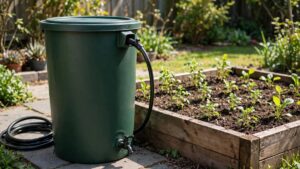
EarthMinded RainStation 45 Gallon Rain Barrel
- Capacity: 45 gal
- Material: HDPE plastic
- Overflow design: FlexiFit diverter returns overflow to the downspout when the barrel is full
- Lid: reversible planter top
- Extra overflow route: integrated channel in the rim diverts surplus to the front
- UV package: barrel and lid carry a 10-year UV protection package
- Included: all parts and a hole saw for installation
The RainStation is sold as a system rather than a bare barrel. Its FlexiFit diverter cuts into a standard rectangular downspout and feeds the barrel from the side; when the barrel reaches full, the diverter sends the rest of the roof water back down the downspout, which is the overflow connection doing its work without any hose to aim. EarthMinded also molds an overflow channel into the rim, so surplus arriving at the top is carried to the front of the barrel instead of down its back against the wall.
For raised beds, the appeal is the completeness of the kit. The box includes the parts and the hole saw for the downspout cut, and the spigot sits low for a hose or can. The reversible lid flips into a shallow planter, which softens the look of a barrel parked beside beds. At 45 gallons it is the smallest barrel here, so a long row of beds in a dry spell will drain it quickly; the diverter design, however, makes adding the maker's larger sibling later a familiar job.
Pros:
- Diverter included, overflow returns to the downspout automatically
- Hole saw and all parts in the box
- Planter top lid softens the look beside beds
- Rim channel gives a second, passive overflow route
Cons:
- Smallest capacity in this roundup at 45 gal
- Diverter requires cutting into the downspout
- Gravity flow only, like every barrel here
Ivy Rain Barrel 50 Gallon (Rain Water Solutions)
- Capacity: 50 gal
- Material: 100% recycled HDPE, BPA free
- Overflow design: 2 overflow ports, 6 ft overflow hose included
- Linking: multiple barrels link using the overflow hose
- Dimensions: 42.5 in high, 22.5 in top diameter
- Weight: 16 lb empty
- Lid: locking lid with screen
The Ivy is built around its overflow plumbing. Rain Water Solutions fits two overflow ports and includes a six-foot overflow hose, and the maker states plainly that multiple Ivy barrels link together using that hose: fill the first barrel, and the surplus travels through the overflow connection into the next. For a gardener watering several raised beds, that turns one downspout into a small reservoir row without pumps or extra fittings.
The barrel itself is tall and narrow, which helps twice over. The height adds a little head pressure at the valve for soaker runs, and the slim footprint tucks between a downspout and a bed where a wide barrel would block the path. The maker lists the body as fully recycled HDPE and made in the USA, with a locking lid and a screen to keep debris and insects out of the stored water. An overflow cap is included for the port that is not in use.
Pros:
- Two overflow ports and an included 6 ft overflow hose
- Designed to link barrel to barrel in series
- Tall profile adds head pressure and saves floor space
- Recycled HDPE body, made in the USA
Cons:
- Plain utility styling next to decorative barrels
- Linking beyond the first barrel needs the run planned level
- Lid uses releasable ties rather than a latch
Good Ideas Impressions Stone 50 Gallon Rain Saver
- Capacity: 50 gal
- Material: polyethylene
- Overflow design: integrated channel diverts overflow to the front of the barrel
- Dimensions: 20.5 x 20.5 x 42 in
- Weight: 19 lb
- Inlet: large opening for 2×3 or 3×4 downspouts, fine mesh screen
- Warranty: 1-year limited
The Impressions Stone takes the overflow problem and hides it in the styling. Good Ideas routes a channel through the top of the barrel that automatically carries overflow to the front, so excess water leaves on the garden side rather than against the foundation. There is no hose to coil and no port to cap; the connection is the molded channel itself, which suits a barrel placed where a dangling overflow hose would cross a path or a bed edge.
The faux-stone finish is the other half of the appeal. Beside raised beds in a front or side garden, a barrel that reads as a stone urn draws less attention than a utility drum. The large top opening accepts standard downspout sizes and is covered by a fine mesh screen, and the barrel stands 42 inches tall, which helps gravity flow at the spigot. The trade-off for the clean look is flexibility: the channel sends overflow to the front only, so placement has to suit that direction, and there is no port for linking a second barrel.
Pros:
- Overflow handled by a built-in channel, nothing to attach
- Stone-look finish suits visible garden spots
- Tall body helps gravity pressure at the spigot
- Mesh screen keeps debris out of stored water
Cons:
- Overflow direction is fixed to the front
- No linking port for a second barrel
- Decorative finish costs more than utility barrels of the same size
Bushman Spruce Creek 54 Gallon Rain Saver
- Capacity: 54 gal
- Material: rotationally molded, UV-protected polyethylene
- Overflow design: recessed overflow channel plus included back-mounted overflow hose
- Overflow port: 1.25 in diameter, hose 6 ft long
- Water access: dual spigot ports, metal spigot, drainage plug
- Intake: screened, closed one-piece top
- Weight: 18 lb
The Spruce Creek is the barrel here for gardeners who have watched a smaller overflow fitting fail to keep up with a hard storm. Bushman fits a 1.25-inch overflow port at the back of the barrel, larger than the fittings on most residential barrels, and includes a six-foot flexible overflow hose to carry the surplus away. A recessed channel in the top handles the first excess quietly, and the hose takes over for the heavy flow. The same overflow connection accepts the maker's T-Connector, so a second Spruce Creek can be chained in when the beds demand more storage.
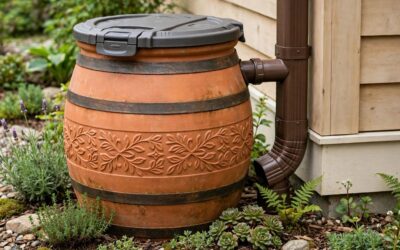
The body is cast from a real oak barrel mold, so it carries wood grain detail in antique brown while staying one-piece polyethylene. Dual spigot ports give a choice of filling a can at one and leaving a soaker hose attached at the other, and a drainage plug at the base makes the end-of-season emptying simple. At 54 gallons it is near the top of this group for capacity, which matters when raised beds need watering every day of a dry week.
Pros:
- Large 1.25 in overflow port with included 6 ft hose
- Overflow connection doubles as the linking point
- Dual spigot ports for can and hose at once
- One-piece molded body with a drainage plug
Cons:
- Rustic oak look will not suit every garden style
- Linking kit parts are separate purchases
- Big footprint beside narrow bed paths
ORBIS SYSTERN Rain Barrel 55 Gallon
- Capacity: 55 gal
- Material: recycled-content plastic, BPA free
- Overflow design: overflow hose can link to another SYSTERN or be directed away from the house
- Dimensions: 26 x 26 x 34 in
- Weight: 16 lb
- Inlet: mosquito mesh screen
- Spigot: contoured spigot, accommodates existing downspouts
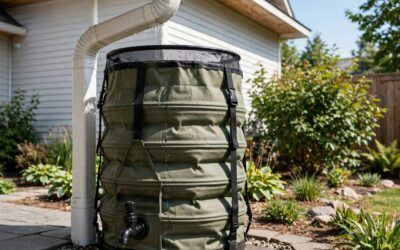
The SYSTERN comes from ORBIS, a maker of commercial material-handling products, and it reads like it: plain, thick-walled, and specified on a one-page spec sheet. Its overflow arrangement is the flexible kind. The overflow hose either links across to a second SYSTERN to build capacity, or is directed away from the house to a bed, a swale, or a drain. That choice makes it easy to park the barrel at a downspout and send storm surplus straight to the raised beds' end of the garden.
At 55 gallons it is the largest barrel in this roundup, and at 16 pounds empty it is also one of the lightest to move into place. The maker lists a UV stabilizer in the material and recycled content in the body, with a mosquito mesh over the inlet and a contoured spigot sized for a hose or a can. There is no decorative finish and no planter lid; the SYSTERN is for gardeners who want capacity and a proper overflow hose and do not mind a utility look behind the beds.
Pros:
- Largest capacity here at 55 gal
- Overflow hose links a second barrel or aims away from the house
- Light to position at 16 lb empty
- Commercial spec sheet with full dimensions published
Cons:
- Utility styling, no decorative finish
- No planter top or styling options
- Sold through fewer garden retailers than the big consumer brands
Buying guide
Begin with the overflow, because it is the feature in the keyword and the one most often faked by vague product copy. A genuine overflow connection takes one of three forms. A diverter, like the RainStation's FlexiFit, intercepts the downspout and hands surplus water back to it, which is the tidiest solution and needs no drainage plan at all. An overflow port with a hose, like the Ivy's twin ports or the Spruce Creek's 1.25-inch back port, lets you aim surplus at a bed, a swale, or a second barrel. A molded channel, like the Impressions Stone's, routes overflow to a fixed outlet, usually the front, which is simple but fixes the direction in advance. Choose the form that matches where the water can safely go at your house.
Then size the storage to the beds. A single 4×8 raised bed in hot weather can take several gallons a day at the roots, and a barrel empties faster than most new owners expect. One 50-gallon barrel per downspout is a starting point; gardeners with three or more beds should favor barrels whose overflow ports double as linking points, so capacity grows by adding a barrel rather than replacing one. Remember that linked barrels must sit level with each other for the overflow chain to fill them evenly.
Height and placement come next. Gravity is the only pressure a rain barrel has, so a taller barrel or a barrel raised on blocks delivers a noticeably stronger flow to a soaker hose. Set the barrel on a flat, solid base, full barrels weigh several hundred pounds, and keep the spigot high enough to fit a watering can under it. If the beds sit uphill from the downspout, no barrel here will push water up to them; plan to carry cans or move the beds' watering to a barrel placed on the high side.
Finally, check the details that decide daily convenience: a screen fine enough to keep mosquitoes from breeding in the stored water, a lid that closes against debris, a spigot threaded for a standard hose, and a drain or plug for winter emptying in cold climates. Plastic bodies shrug off freezing better than most materials, but the makers still advise draining fittings before hard frost. A barrel that is easy to empty, clean, and reconnect each spring is the one that stays in service for years.
FAQ
How does an overflow connection protect the house and the beds?
When a barrel fills during a storm, incoming roof water has to leave at the same rate it arrives. An overflow connection gives that water a planned path: back into the downspout through a diverter, out through a hose aimed at a drain or bed, or along a molded channel to the front of the barrel. Without it, water sheets over the rim and down the barrel's back, soaking the soil against the foundation and flooding whatever sits beside the barrel.
Can one barrel keep up with several raised beds?
For a few days of watering, yes; for a dry week, usually not. Beds in full sun drink steadily, and a 50-gallon barrel can be gone in two or three rounds of deep watering. That is why linking matters: barrels with overflow ports, like the Ivy and the SYSTERN, chain together so the overflow of the first becomes the fill line of the second, doubling or tripling storage at one downspout.
Will a rain barrel run a soaker hose in a raised bed?
Generally yes, slowly. Gravity flow from a barrel is gentle, which suits soaker hoses and drip lines laid on level beds. Flow improves when the barrel is tall or raised on blocks and when the hose run is short. Long runs, uphill beds, and pressure-compensating drip emitters designed for household water pressure are poor matches for barrel pressure, so keep the layout simple and level.
Does the overflow hose have to go to a drain?
No. The hose can be aimed anywhere the surplus is welcome: a thirsty bed away from the house, a swale, a gravel area, or a second barrel. The two cautions are direction and distance. Keep the outlet away from the foundation and from paths that turn muddy, and keep the run short and downhill, since a long or rising hose slows the overflow exactly when a storm needs it fast.
How should a plastic rain barrel be wintered?
The makers' common advice is to drain the barrel before hard freezes, disconnect or bypass the diverter so roof water runs straight down the downspout, and leave the spigot open so trapped water can escape. Plastic bodies tolerate cold well, but ice expanding inside fittings and hoses is what cracks parts. Barrels that nest or store upside down in a shed ask even less of the fittings.
Conclusion
For raised bed watering, the overflow connection is not an accessory; it is the difference between a barrel that manages storm water and one that merely delays a spill. The EarthMinded RainStation 45 hands the problem back to the downspout with its diverter kit. The Ivy 50 and the ORBIS SYSTERN 55 turn their overflow ports into linking points for real storage capacity. The Good Ideas Impressions Stone 50 hides its overflow in a front channel behind a masonry look, and the Bushman Spruce Creek 54 brings the largest overflow port and hose of the group. Pick the overflow style that fits your downspout and drainage, size the storage to the beds, and the barrel will keep both the garden and the foundation dry where each needs to be.

Write Your Review
No reviews yet. Be the first to share your experience!