
Key takeaways
- Six collapsible rain barrels for drought-prone neighborhoods compared on capacity, fabric, spigots and storage, with every figure taken from the product page.
What's inside
As an Amazon Associate I earn from qualifying purchases. This post may contain affiliate links at no extra cost to you.
In a drought-prone neighborhood, rain arrives the way the bills do — rarely, and all at once. A collapsible rain barrel is built for exactly that pattern. It stands open under a downspout through the wet weeks, banking every gallon the roof can give, and then folds flat against a garage wall for the long dry stretch when a rigid barrel would sit empty, baking and taking up space. The best collapsible rain barrels for drought prone neighborhoods add a second virtue: capacity. When the next rain may be months away, the difference between a 50-gallon barrel and a 132-gallon barrel is the difference between watering the tomatoes twice and keeping the whole bed alive until the weather turns.
The six models below are all collapsible barrels sold on Amazon US, spanning 50 to 132 gallons, and every figure in this article — capacity, fabric, fittings, dimensions — comes from the product page for that model. Fabric barrels live or die by their seams, spigot seals and support frames, so those details get as much attention here as the gallon count.
Quick verdict
If you have the downspout space, the ANTSKU 132 Gallon is the drought pick: the largest capacity in the group, two spigots and an overflow kit, on a PVC frame with 500D fabric. For a single downspout on a smaller home, the Curifurn 100 Gal brings the heaviest fabric specification here — a 1000-denier Oxford cloth with a three-layer PVC coating — and a stated operating range that covers hard winters. The Karelwui 100 Gallon and the Hikarinowa 100 Gallon cover the same capacity class at lower page prices at the time of reading, while the two 50-gallon models, from Trygoal and Vasitelan, suit a single bed, a balcony-adjacent downspout, or a linked pair — the Vasitelan page even lists an outflow valve for connecting a second barrel.
| Product | Key spec | Best for |
|---|---|---|
| ANTSKU 132 Gallon Collapsible Rain Barrel | 132 gal class, PVC frame, 500D fabric, two spigots | Maximum storage at one downspout |
| Curifurn 100 Gal Collapsible Rain Barrel | 1000-denier Oxford, three-layer PVC coating, 5 support legs | Harsh sun and cold climates |
| Karelwui 100 Gallon Rain Barrel | 3-layer PVC, two spigots, rod holders | Two watering points from one barrel |
| Hikarinowa 100 Gallon Portable Rain Barrel | 27.56 in diameter, 8.16 lb, filter top | Lightweight barrel that one person can place |
| Trygoal Collapsible Rain Barrel 50 Gallon | Three-layer PVC, dual rubber rings | A single downspout and a small garden |
| Vasitelan 50 Gallon Folding Rain Barrel | PVC frame and mesh fabric, linking outflow valve | Starting small, with a second barrel planned |
How we chose
Only genuinely collapsible designs were considered: fabric or flexible barrels that fold down for storage, with a frame or support structure to hold their shape when full. Rigid barrels, however good, do not answer this keyword, because the folding storage is the point for households whose rain is seasonal. Each model had to be a named product sold on Amazon US with its capacity, material and fittings stated on its own product page, and those page figures are the only ones used here.
Capacity was weighted heavily — in a drought-prone area, stored water is the product — but not at the expense of the fittings. A barrel that leaks at the spigot all summer is a 132-gallon claim and a 90-gallon reality, so pages that describe their seals, rubber rings or washers in detail scored over pages that say nothing. Mesh tops or filter covers also mattered, because a barrel that fills with leaves and mosquito larvae in the first storm is a maintenance burden for the rest of the season. Brand overlap with other roundups in this program was avoided where the market allowed, which is why this set is built from makers not featured in the sibling rain barrel articles.
ANTSKU 132 Gallon Collapsible Rain Barrel
- Capacity: 132 gallon class; the maker's copy puts usable storage at about 123 gallons
- Frame and fabric: PVC frame with 500D fabric, listed as corrosion resistant and crack-proof in cold weather
- Fittings: two spigots and an overflow kit
- Seals: pre-installed double-layer rubber washers on the outlet valves, faucet and overflow
- Inlet: top mesh keeps out debris and insects
- Warranty: 12-month warranty stated by the maker
The largest barrel in this roundup is the natural lead for drought country. One downspout on even a modest roof can deliver well over a hundred gallons in a single storm, and a 50-gallon barrel simply overflows for most of it; the ANTSKU's stated class size is 132 gallons, with the maker's own copy noting about 123 gallons of stored water — a small honesty worth crediting, since fabric barrels are rarely brim-full in practice. The overflow kit routes the excess away once the barrel is full, and the double-layer rubber washers fitted at every outlet address the leak points that decide whether stored water is still there in month three.
Two spigots change how the water gets used: a faucet at bucket height for filling cans, and a lower filtered spigot for a hose, per the maker's description. The frame is PVC with 500D fabric, and the whole unit folds flat when the season ends. A 12-month warranty is stated on the page.
Pros:
- Largest capacity in the group for long dry spells
- Two spigots plus overflow kit fitted as standard
- Double-layer washers at every outlet
- Folds flat for storage between rainy seasons
Cons:
- Needs a wide, level pad beside the downspout
- Usable storage is a little under the headline class size, per the maker's own copy
Curifurn 100 Gal Collapsible Rain Barrel
- Capacity: 100 gallons
- Fabric: 1000-denier Oxford fabric with a three-layer PVC coating, listed at twice the thickness of the maker's previous model
- Stated temperature range: minus 13 to 113 degrees F
- Frame: 5 reinforced internal support legs
- Fittings: spigot and outlets with rubber seals; bottom connector for a hose
- Inlet: top mesh grid, which the maker also lists as overflow protection
Curifurn's page makes the strongest material claim in this group: a 1000-denier Oxford fabric under three layers of PVC coating, stated to be twice as thick as the previous version of the barrel, with an operating range from well below freezing to desert heat. Drought-prone neighborhoods often pair their dry summers with either hard winters or fierce sun, and fabric is where collapsible barrels fail first — at folds, at the base seam, under UV. A heavier cloth is the right place to spend money.
The support design differs from the frame-and-rod approach of most rivals: five reinforced internal legs hold the barrel's shape, which the maker describes as a thicker, more stable structure that is easier to install. The top mesh keeps debris out and doubles as overflow protection, each faucet and outlet carries a rubber seal, and a bottom connector takes a hose for watering. At 100 gallons it gives up some capacity to the ANTSKU while arguably buying durability in exchange.
Pros:
- Heaviest fabric specification in this group
- Wide stated temperature range for cold winters and hot summers
- Internal support legs instead of an external frame
- Rubber seals at faucets and outlets, hose connector at the base
Cons:
- 100 gallons is a step down from the largest model here
- Premium fabric comes at a premium page price
Karelwui 100 Gallon Rain Barrel
- Capacity: 100 gallons
- Material: durable 3-layer PVC
- Fittings: two spigots; integrated faucet design that screws on rather than assembling from both sides
- Inlet: wide opening with mesh top
- Stability: rod holders included for added stability
- Storage: folds and rolls up when not in use
The Karelwui matches the Curifurn on capacity with a simpler construction: three-layer PVC, support rods in holders to keep the walls from wobbling or tilting, and a wide mesh-topped opening that makes both filling and cleaning easier. Its distinguishing detail is the faucet design — the maker describes an integrated fitting that screws onto the barrel instead of being assembled from both sides of the fabric, which is the joint most likely to weep on a fabric barrel. A one-piece threaded fitting is a sensible answer to the classic collapsible-barrel leak.
Two spigots mean a watering can at one and a hose or a second container at the other, and when the rains end the barrel folds and rolls rather than folding flat, which suits a shelf or a corner rather than a wall. For a household that wants 100 gallons without paying for the heaviest fabric in the class, this is the value-shaped version of the same idea.
Pros:
- 100 gallons with two spigots
- Integrated faucet design aimed at the usual leak point
- Wide mesh-topped opening for filling and cleaning
- Rolls up compactly for storage
Cons:
- Fabric specification is lighter than the Curifurn's
- No stated temperature range on the page
Hikarinowa 100 Gallon Portable Rain Barrel
- Capacity: 100 gallons
- Dimensions: 27.56 inches diameter by 38.58 inches high
- Weight: 8.16 pounds
- Material: PVC frame with anti-corrosion PVC mesh fabric
- Fittings: rubber rings on both sides of each faucet and outlet valve; bottom socket with switch for hose connection and drainage
- Inlet: filter top cover
The Hikarinowa is the light, simple entry in the 100-gallon class: just over eight pounds empty, with a stated footprint of about 27.5 inches across — numbers that matter in a drought-prone neighborhood of small lots, where the barrel may need to fit a side yard, a carport corner or the space beside an air-conditioning unit. One person can carry it out, set it under the downspout and have it collecting in minutes, and the maker lists a high-density PVC support frame to keep the filled barrel stable.
Sealing follows the pattern the better fabric barrels share: rubber rings on both sides of each faucet and outlet valve. The filter top keeps leaves out of the stored water, and the bottom socket has a switch for connecting a pipe or hose and draining quickly — useful when the barrel must be emptied before a freeze or moved mid-season. The maker suggests the stored water can cut household water use substantially over a year; read that as the maker's framing, but the arithmetic of 100 free gallons per storm is real enough on its own.
Pros:
- Lightest 100-gallon barrel here; one-person setup
- Stated dimensions help check a tight space before buying
- Rubber-ring seals at every fitting
- Bottom socket with switch for hose drainage
Cons:
- Mesh fabric construction is lighter-duty than the coated Oxford cloth above
- Single colour and style listed
Trygoal Collapsible Rain Barrel 50 Gallon
- Capacity: 50 gallons
- Material: three-layer PVC fabric, listed as resisting cracking in cold weather
- Inlet: fine mesh top cover for debris filtration
- Seals: dual rubber rings on both sides of the spigot and overflow outlet
- Storage: folds flat; quick assembly
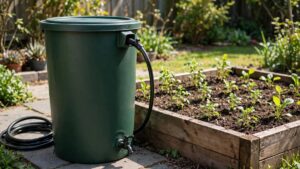
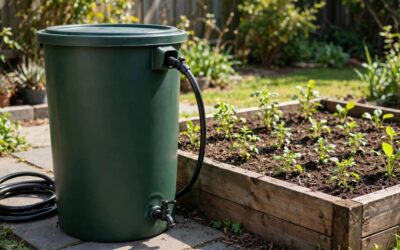
Not every downspout needs a tank. The Trygoal's 50 gallons suit a single productive bed, a herb garden by the kitchen door, or a household trying rain collection for the first season before committing to a bigger installation. Its specification is a tidy version of the class standard: three-layer PVC fabric, a fine mesh top that the maker lists as blocking leaves, insects and dirt, and dual rubber rings sealing both the spigot and the overflow outlet — the two fittings whose slow drips quietly empty lesser barrels.
The soft green shade is a small but real consideration in neighborhoods with tidy frontages or association rules: the maker notes the colour blends with plantings rather than announcing itself. Folded flat, the barrel stores in a fraction of the space of the rigid barrel it replaces, and assembly is listed as quick when the forecast turns.
Pros:
- Right-sized for one bed or a first rain barrel
- Dual rubber rings at spigot and overflow
- Mesh top filtration included
- Green finish blends into plantings
Cons:
- 50 gallons runs dry quickly in a real drought stretch
- No second spigot or hose connector listed
Vasitelan 50 Gallon Folding Rain Barrel
- Capacity: 50 gallons
- Material: PVC frame with PVC mesh fabric, listed as crack-free in cold winter use
- Seals: two rubber rings with each spigot and outflow valve, one inside and one outside
- Inlet: top mesh design
- Extra: outflow valve included for overflow or connecting another rain barrel
The Vasitelan is the starter barrel with a growth path. Its page lists the same sealing discipline as the bigger models — paired rubber rings at the spigot and the outflow valve, one fitted inside the fabric and one outside — and a top mesh to keep leaves out of the water. What sets it apart in the 50-gallon class is the outflow valve's second job: the maker lists it for connecting another rain barrel, so a household can begin with one barrel at the downspout and link a second when the first dry summer proves the concept.
The frame-and-mesh construction is the lightest build in this roundup, and expectations should match: this is an entry model for finding out whether roof water fits your routine, priced accordingly on its page at the time of reading. If it does fit, the linked-barrel route or a step up to the 100-gallon class are both open; if it does not, very little money has been spent learning that.
Pros:
- Outflow valve allows linking a second barrel later
- Paired rubber-ring seals at both fittings
- Top mesh keeps leaves out
- Lowest page price in this group at the time of reading
Cons:
- Lightest construction here; a starter model rather than a decade-long fixture
- 50 gallons is the joint-smallest capacity in the group
Buying guide
Size for the dry spell, not the storm. In a drought-prone neighborhood the question is how many watering days a full barrel buys you. A mature tomato plant in hot weather can drink a gallon a day; a 50-gallon barrel therefore covers a small bed for a few weeks, while 100 to 132 gallons stretches the same bed across a season of rationing and still leaves water for containers. If two downspouts are available, two medium barrels often beat one large one — they catch from two roof faces and give a backup if one fitting fails.
Read the seal design before the capacity. Fabric barrels lose water slowly and invisibly at their fittings. The pages worth trusting describe the sealing explicitly: rubber rings on both sides of the fabric, double-layer washers, or an integrated threaded faucet. Every model in this roundup states its sealing method on its page; that is not a coincidence, it was a selection filter. Whatever you buy, fill it once and watch the fittings for a day before relying on it.
Plan the overflow before the first storm. A full barrel under a running downspout sends water wherever the overflow points, and against a foundation that is the wrong answer. Overflow kits and outlets (listed on the ANTSKU, and as outlets on several others) should be hosed away from the house, ideally to a bed that can use the bonus water. The mesh top is the other half of storm readiness: it keeps the first flush of leaves and grit out of the stored water, which keeps spigots and hose ends from clogging in month two.
Finally, think about the empty months. The collapsible advantage is storage: folded or rolled, these barrels take a shelf instead of a corner of the yard, and they are out of the UV that ages fabric fastest. Store them dry, with the fittings loosened, and bring them out when the forecast turns. In freezing climates, follow the stated temperature range where the maker gives one — the Curifurn lists the widest here — and drain any barrel before a hard freeze regardless, since ice expansion stresses seams and fittings on any fabric design.
FAQ
How much rain can one downspout actually collect?
More than most people expect. A modest roof face in a one-inch storm sheds several hundred gallons; even a 132-gallon barrel fills quickly, which is why overflow routing matters. In drought-prone areas the barrel's job is to bank that brief surplus for the weeks that follow.
Is stored rainwater safe for vegetables?
Rainwater collected from a roof through a mesh filter is widely used on vegetable gardens. The mesh tops on these barrels keep leaves and insects out; keeping the top covered and the barrel shaded also slows algae. If your roof is treated with moss-killing chemicals or is very old asphalt, let the first minutes of a storm bypass the barrel before collecting.
Will a fabric barrel survive a hot summer?
Fabric quality decides it. Heavier cloth — the Curifurn's 1000-denier Oxford with a three-layer PVC coating is the strongest specification here — resists UV and seam stress better than light mesh fabrics. Storing the barrel out of the sun during the dry months, which the collapsible design makes easy, extends any fabric's life.
Can I connect two collapsible barrels together?
Some models are designed for it. The Vasitelan page lists its outflow valve for connecting another barrel, and overflow outlets on other models can be hosed into a second barrel with a short link hose. Linking two medium barrels is a practical way to grow storage without one very wide footprint.
What happens when the barrel is full and it keeps raining?
The overflow fitting takes over — if you have routed it somewhere sensible. Models here list overflow kits, outlets or mesh tops that double as overflow protection. Route the overflow away from foundations, toward a bed or gravel area that can absorb the excess.
Conclusion
For drought-prone neighborhoods, the collapsible barrel's bargain is simple: big storage while the rain lasts, no storage problem when it does not. The ANTSKU 132 Gallon banks the most water at one downspout, the Curifurn 100 Gal wraps slightly less water in the toughest fabric, and the Karelwui and Hikarinowa cover the same 100-gallon class with lighter builds and lighter prices. The Trygoal and Vasitelan 50-gallon models start smaller — one for a single bed, one with a linking valve for growing later. Match the capacity to the beds you must keep alive, check the seals on the page before you buy, and route the overflow before the first storm does it for you.

Write Your Review
No reviews yet. Be the first to share your experience!