
Key takeaways
- Five recycled-rubber edging sets, all verified inside the budget, compared on profile height, section length, staking and flexibility for holding gravel paths.
What's inside
As an Amazon Associate I earn from qualifying purchases. This post may contain affiliate links at no extra cost to you.
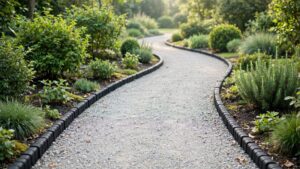
A gravel walkway fails at its edges first. Loose stone migrates into the lawn one footstep at a time, the path narrows, grass creeps in from the sides, and within a season the crisp line you laid in spring is a suggestion rather than a border. Edging is what holds the shape, and rubber edging has become the practical choice for gravel because it does three things rigid materials do badly: it flexes around curves without cutting, it absorbs contact from mower wheels and string trimmers instead of cracking, and it goes in with stakes rather than a trench. The best rubber landscape edging under 200 for gravel walkways also has to pass a budget gate, so every set in this roundup was verified on an opened retailer page at a pack price inside the band named in this guide. Prices live in the research notes for this article, not in the text, but the gate was applied to every pick.
All five sets below are made from recycled rubber, most of it from tires, and all five are no-dig designs that anchor with stakes. They differ in the ways that matter beside a path. Profile height decides how much gravel the edge can hold back and how much of a lip rises above the stone. Section length and connector style decide how straight a long run stays. Weight decides how well the edge resists being kicked out of line. One pick is sold by the single section for small jobs and repairs. Two are cobblestone-look sets that dress up a front walk. One is a tall curb profile for paths that sit above the lawn. One is a scalloped L-profile that reads as a garden border as much as a path edge.
A note on gravel specifically: the stone in a walkway is loose fill, and it pushes outward every time a foot lands near the edge. An edging profile that works for mulch, where the fill is light and interlocked, can be too shallow for gravel. The profiles here run from 3 in to 4.5 in tall, and the buying guide below explains how to match that height to the depth of stone you plan to lay.
Quick verdict
For most gravel walkways, the Vigoro EcoBorder is the default buy: it is sold by the section at home centers, its L profile was designed with a mower edge on one side, and it bends through curves that would defeat a rigid border. Where the walk is a front-of-house feature, the GroundSmart SmartLoc Cobblestone set gives a stone look with interlocking sections that stay aligned. The GroundSmart Curb Edgers are the tallest profile here and the pick for paths that need a real curb face to hold deeper gravel. Rubberific's angled terracotta set brings color and a faux-stone face in a mid-height profile. The Playsafer scalloped edger is the flexible, decorative option for winding garden paths.
| Product | Section length | Profile height | Pack coverage | Anchor style |
|---|---|---|---|---|
| Vigoro EcoBorder Rubber Landscape Edging | 4 ft per section | 3.125 in | Sold per section | Stakes and dowel connectors |
| GroundSmart SmartLoc Cobblestone Edging | 48 in per section | 3 in | 4 sections, 16 ft | 12 stakes and 4 connectors included |
| GroundSmart Curb Edgers | 48 in per section | 4.5 in | 4 sections, 16 ft | 3 stakes per section |
| Rubberific Premium Rubber Angled Terracotta Edging | 4 ft per section | 3.5 in | 4 sections, 16 ft | Hardware included |
| Playsafer L-Shaped Flexible Rubber Scalloped Edger | 4 ft per section | L profile | 6 sections, 24 ft | No-dig staking |
How we chose
Every set in this roundup was verified on a page opened for this guide: retailer specification tables, maker product pages and manuals that reproduce the makers' own figures. Two gates came first. The material gate required rubber, in practice recycled tire rubber, rather than plastic or vinyl edging wearing a rubber name. The budget gate required the pack, as sold, to sit inside the band on an opened page at the time of checking; sets that only fit the budget on a per-foot calculation were left out, because a walkway is bought by the pack, not by the inch.
Specifications were taken from the makers' and retailers' own listings: section dimensions, profile height, included stakes and connectors, and stated flexibility. Flexibility figures are quoted the way the sources state them; the EcoBorder's bend, for example, is described in maker-facing material as flexing up to 70 degrees, which is what allows a section to follow a curved path edge. Sets were also kept distinct from the edging picks used in earlier batches of this project, so the five products here are different models from the edging already covered in sibling guides.
Gravel duty shaped the final cut. Each pick had to present a profile that stands above the soil line far enough to retain loose stone, accept stakes along its length, and tolerate the two routine insults of path-side life: mower wheels rolling over the edge and trimmer line striking it. Rubber's advantage in both cases is that it gives instead of chipping, and every set here shares that trait.
Vigoro EcoBorder Rubber Landscape Edging
The EcoBorder is the edging most likely to be in stock at the home center nearest the reader, and its design explains its staying power. Each 4 ft section is molded from recycled tire rubber in an L profile that stands 3.125 in high. One face of the L forms a mower edge, a flat lip the mower wheel can ride so the cut reaches the border without the blade striking the edging itself. Sections join with 3 in dowel connectors and pin down with 8 in stakes, and the rubber flexes, per the maker's material, up to 70 degrees, which is enough to walk a section around a curved path without cutting it.
- Material: recycled tire rubber
- Profile: L shape, 3.125 in high
- Section length: 4 ft
- Flexibility: bends up to 70 degrees per maker material
- Connectors: 3 in dowels between sections
- Anchoring: 8 in stakes
- Colors: black, brown, gray, green and red
Sold by the section, the EcoBorder suits the way walkway projects actually go: measure the run, buy the sections, and pick up one more next season when a section is damaged or the path grows. Beside gravel, the L profile's vertical face holds stone while the horizontal foot sits under the path edge, so foot traffic pressing down on the gravel side locks the edging in place rather than pushing it out. It is the least decorative pick here, a clean dark line, and for a working path that is usually the point.
Pros
- Sold per section, so repairs and extensions are easy
- Mower-edge lip lets the mower cut right to the border
- Flexes through curves without cutting
- Five color options, including lawn-blending green and brown
Cons
- Plain look next to the stone-effect sets
- Shallowest tall profile among the curb-style picks
- Stakes and connectors add up over very long runs
GroundSmart SmartLoc Cobblestone Edging
GroundSmart's cobblestone set is the dress option. Each 48 in section is molded from 100 percent recycled rubber with a cobblestone face, and the sections interlock through the maker's SmartLoc system, which keeps the joints aligned so the stone pattern reads as one continuous run rather than a row of separate blocks. The 4-pack covers 16 ft and includes 12 anchor stakes and 4 connectors, everything needed for the box's worth of edging in one purchase. The maker notes the rubber is made in the USA.
- Material: 100 percent recycled rubber
- Section size: 48 x 3 x 3 in
- Pack: 4 sections, 16 ft of coverage
- Included: 12 anchor stakes and 4 connectors
- Connection: SmartLoc interlocking ends
- Flexibility: sections follow curves
- Origin: made in the USA
At 3 in tall the profile is a retainer for standard gravel depths rather than deep-filled paths, and the cobblestone face earns its keep on front walks and paths that pass through planted areas, where a plain black line would look like a utility. The interlock matters more than the pattern, though. Gravel paths fail at joints, where one section kicks up and the next stays down; a locked joint line resists that staggered creep. The included stakes are sized to the set, three per section, which is the right density for stone that pushes sideways.
Pros
- Interlocking sections keep joints aligned under gravel pressure
- Cobblestone face suits front walks and visible paths
- Stakes and connectors included in the box
- Made in the USA from recycled rubber
Cons
- 3 in profile is light for deep gravel fills
- Pattern repeat is visible on very long straight runs
- Sold in fixed 4-packs, so short jobs leave spares
GroundSmart Curb Edgers
The second GroundSmart set in this roundup is a different tool: a curb. Each 48 in section stands 4.5 in tall, the highest profile here, and the 4-pack covers 16 ft with a pack weight of 45 lb. That mass is functional. A curb edger holds back deeper gravel, bridges the level change where a path sits above a lawn or bed, and presents a clean vertical face that reads as a finished edge rather than a strip. Three anchor stakes per section pin it down, and the no-dig design keeps installation to a mallet and an hour.
- Material: 100 percent recycled rubber
- Section size: 48 in long, 4.5 in product height
- Pack: 4 sections, 16 ft of coverage
- Pack weight: 45 lb
- Anchoring: 3 anchor stakes per section
- Installation: no-dig
Choose the curb where the walkway carries real fill: gravel laid 3 to 4 in deep, a path terraced into a slope, or a border where stone meets a bed that sits lower. The taller face also gives the string trimmer a target it can strike without the line wandering into the path. The trade-offs are weight and presence. At over 11 lb per section this is not the edging to reposition casually, and a 4.5 in curb line is a strong visual statement that suits formal paths better than cottage-garden curves.
Pros
- Tallest profile in the roundup at 4.5 in
- Heavy sections resist being kicked out of line
- Holds deeper gravel fills than 3 in edging
- No-dig install with three stakes per section
Cons
- Heavy to handle and reposition
- Strong curb look will not suit every garden style
- Fixed 4-pack sizing
Rubberific Premium Rubber Angled Terracotta Edging
Rubberific's angled set brings color into a category that defaults to black and gray. The sections are molded from recycled rubber with an angled, faux-stone face in terracotta, standing 3.5 in high and 4 in deep, in 4 ft lengths. The angled profile sheds the eye along the path rather than presenting a flat wall, and the depth of the section gives it a stable base on the soil. The 4-pack covers 16 ft and ships with the hardware to install it.
- Material: recycled rubber
- Section size: 4 ft long, 3.5 in high, 4 in deep
- Profile: angled faux-stone face
- Color: terracotta
- Pack: 4 sections, 16 ft of coverage
- Hardware: included
Terracotta is a deliberate choice: beside gravel it warms the path and pairs with clay pots, brick and the red-brown tones of many garden paths. The 3.5 in height sits in the middle of this roundup, enough for standard gravel depths with a visible lip above the stone. The angled face has a practical side as well, since a sloped profile deflects a mower wheel rather than stopping it, and the 4 in depth spreads the load where the soil is soft.
Pros
- Terracotta faux-stone face adds color beside gravel
- Angled profile deflects mower wheels
- Mid-height 3.5 in profile suits standard gravel depths
- Install hardware included
Cons
- One color only, and it will not blend into green borders
- Faux-stone texture is simpler than the cobblestone sets
- Fixed 4-pack sizing
Playsafer L-Shaped Flexible Rubber Scalloped Edger
The Playsafer edger is the garden-border personality of the group. Its sections run 4 ft in an L-shaped profile with a scalloped face, the classic border silhouette, molded in flexible rubber and installed without digging. The 6-pack covers 24 ft, the longest coverage in this roundup, which makes it the economical shape for winding paths through planted ground, where the edge is as much about separating path from bed as about retaining stone.
- Material: flexible rubber
- Profile: L shape with scalloped face
- Section length: 4 ft
- Pack: 6 sections, 24 ft of coverage
- Installation: no-dig
The L profile works the same way as the EcoBorder's: a vertical face against the gravel and a foot that tucks under the path edge so traffic locks it down. The scallops are decoration, but honest decoration, softening the line where a path curves through flowers. Flexibility is the functional headline; this is the set to thread around trees, boulders and the S-curves that gravel paths take through informal gardens. Its retention is border-grade rather than curb-grade, so keep gravel depths moderate and let the profile do the shaping.
Pros
- Longest pack coverage here at 24 ft
- Scalloped face suits garden paths and planted edges
- Flexible sections follow tight curves
- No-dig L profile installs fast
Cons
- Border-grade retention, not for deep gravel
- Scalloped style will not suit formal paths
- Thinner presence than the curb and cobblestone sets
Buying guide
Match profile height to gravel depth. Gravel in a walkway typically sits 2 to 4 in deep over a compacted base. The edging should stand at least an inch above the finished stone surface to hold the top layer, which is the layer that migrates. A 3 in profile works over a shallow 2 in fill. A 4.5 in curb earns its height over deep fill or where the path is raised above the surrounding grade. Measure your planned depth before choosing, not after.
Count the stakes, not just the sections. Gravel pushes sideways with every footstep, and edging holds its line because stakes resist that push. Three stakes per 4 ft section is a sound density for path work; sets that include their stakes and connectors in the box are simpler to budget than sets where the hardware is a second purchase. On curves, add stakes at the bend points, where the push concentrates.
Plan joints on long runs. Sections fail as a line when joints stagger. Interlocking ends, dowel connectors and locked joints all fight the same creep. On a straight front walk, an interlocking set keeps the line true with less adjustment over the years. On a curved path, flexibility matters more than joint rigidity, because a section that bends smoothly needs fewer joints in the first place.
Think about the mower and the trimmer. A path edge meets both tools weekly. A mower-edge lip lets the wheel ride the edging so the cut finishes at the border. Rubber tolerates trimmer line that would chip stone and crack plastic, which is the core reason to choose it beside a path you maintain often. Taller profiles give the trimmer a face to work against; low profiles nearly disappear, which some gardeners prefer and some find harder to edge along.
Buy for the path you will extend. Walkways grow. A set sold by the section, or in packs that stay in the maker's catalog year after year, lets you match the line when you add a spur to the compost bins or a loop to the side gate. Fixed decorative packs are fine for a finished front walk that will not change.
FAQ
How tall should edging be for a gravel walkway?
Tall enough to stand about an inch above the finished gravel surface. For a standard 2 to 3 in gravel depth, a 3 to 3.5 in profile does the job. For deeper fills, raised paths or borders where the lawn sits lower than the path, step up to a curb profile around 4.5 in.
Does rubber edging hold gravel as well as stone or metal?
For walkway depths, yes, provided it is staked at the density the maker supplies and the profile height matches the fill. Rubber's advantage is resilience: it flexes under a mower wheel or a frost heave and returns, where rigid materials crack or shift and stay shifted. Its limit is depth; very deep loose fill belongs behind a curb-height profile.
Can rubber edging follow a curved path?
That is one of its strengths. Flexible sections bend through garden curves without cutting; maker material for the EcoBorder describes flex up to 70 degrees. For tight bends, use shorter effective lengths, stake at the bend, and let the connectors between sections absorb the angle.
Will the color of recycled rubber edging fade?
Recycled tire rubber starts dark and weathers to a softer charcoal over seasons outdoors. Molded color sets, such as the terracotta and cobblestone options here, hold their tone better because the color runs through the material rather than sitting on it as paint. None of the sets in this roundup relies on a surface coating for its color.
How much edging do I need for a walkway?
Measure both sides of the path; gardeners routinely under-order by counting one edge. A 20 ft walk needs 40 ft of edging. Then add one section for cuts, corners and the inevitable mis-measure. Packs in this roundup cover 16 to 24 ft, and the per-section EcoBorder makes top-ups simple.
Conclusion
Gravel walkways stay handsome exactly as long as their edges hold, and rubber edging holds them with the least fuss: no trench, no mortar, no cracked units after the first frost. The EcoBorder is the versatile default, sold by the section with a mower edge built in. The GroundSmart cobblestone set dresses a front walk while locking its joints, and its curb sibling handles deep fill and raised paths. Rubberific brings terracotta warmth in a mid-height angled profile, and the Playsafer scalloped edger covers long, winding garden paths in a single pack. Every set here was verified inside this guide's budget band on an opened page, in recycled rubber, with the stakes to hold a line. Measure your depth, count both edges, and the path you lay this spring will still have its shape next year.
Write Your Review
No reviews yet. Be the first to share your experience!