
Key takeaways
- Stackable rain barrels and tanks for harvesting rainwater from gutters, compared on capacity, footprint, diverters, spigots and how each design stacks or links.
What's inside
As an Amazon Associate I earn from qualifying purchases. This post may contain affiliate links at no extra cost to you.
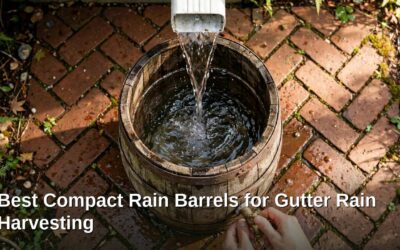
A standard rain barrel claims a round patch of ground beside the downspout and gives back about fifty gallons. Gardeners comparing the best stackable rain barrels for rainwater harvesting from gutters usually want more from that same patch: storage that grows upward or links in a row, so a single downspout can bank two or three times the water against a dry spell without taking over the side of the house.
Stackable means three related things in this market, and each product section says which one applies. Some tanks are tapered, narrower at the base than at the top, so units nest for shipping and stand as stable, space-efficient columns in a preconfigured harvesting system. Some storage tanks are built to stack one on another when space is tight. And some compact barrels pair a stackable profile with linking, so capacity grows one unit at a time along a wall. All seven picks below carry a stacking or stackable claim on an opened page.
The set runs from a 45 gallon diverter kit for a single downspout to preconfigured RainFlo systems at 200, 800 and 1,000 gallons that arrive with filtration, gauge and pump hardware already fitted. Between them sit two 55 gallon stackable tanks and a 30 gallon stackable tank for households that want gutter water banked in a garage bay, a side yard or a narrow strip behind the house.
Quick verdict
For most homes, the WaterPrepared 55 gallon tank is the practical starting point: a stackable HDPE vessel with a spigot and utility valve that can sit at the downspout or stack in storage, while the EarthMinded RainStation 45 is the neatest true barrel kit here, with its FlexiFit diverter and planter top. Gardeners banking serious volumes should look at the RainFlo systems: the TST-200AGS covers a large garden by gravity, and the TST-800AGS and TST-1000AGS arrive as complete pumped harvesting systems on the same stackable tank design. The two Emergency Water Tanks models, at 55 and 30 gallons, suit households that want stackable capacity with a brass spigot in the smallest footprints of the set.
| Product | Key spec | Best for |
|---|---|---|
| WaterPrepared 55 Gallon Stackable Water Storage Tank | 55 gal HDPE, stackable design, spigot and utility valve | Stackable storage that can work at the downspout or indoors |
| EarthMinded RainStation 45 Gallon Rain Barrel (RS45-TC) | 45 gal, FlexiFit diverter, reversible planter top lid | One downspout, one tidy barrel, planter on top |
| RainFlo TST-800AGS Stackable Rainwater Collection System | 800 gal stackable tank, upper dia 72 in, 1/2 HP pump, 3 in plumbing | Serious gutter harvesting for large gardens |
| Emergency Water Tanks 55-Gallon Tank | 55 gal, stackable design, brass spigot, 22 lb | A stackable tank with a metal spigot at barrel capacity |
| RainFlo TST-200AGS Gravity Rainwater Collection System | 200 gal stackable tank, gravity delivery, Quattro collector | Large gardens watered by gravity alone |
| Emergency Water Tanks 30-Gallon Tank | 30 gal, stackable design, brass spigot, 17 lb | The smallest stackable footprint for tight side yards |
| RainFlo TST-1000AGS Stackable Rainwater Collection System | 1,000 gal stackable tank, upper dia 76 in, 1/2 HP pump, 3 in plumbing | Roof-scale harvesting for irrigation zones |
How we chose
The first rule was the keyword itself: the maker, retailer or system page for every pick describes the vessel as stackable, or builds it on the tapered stackable tank design, and ordinary barrels with no stacking claim were left out. The second rule was the gutter connection. Each pick either ships with a diverter or collector, or is a tank format that plumbs to a standard downspout diverter, because a barrel that cannot be filled from a gutter is storage, not harvesting.
Capacity, footprint and outlet were recorded exactly as listed. The RainFlo systems quote upper and lower tank diameters because the tapered profile is the point of the design, and their included hardware, from floating filters to the automatic pump, is listed as the system page prints it. The smaller tanks are quoted with their spigot and valve arrangements, since a gravity spigot at the base decides how the stored water actually gets used.
Finally, the set was balanced across scales on purpose: two compact barrels and tanks for one downspout and a modest garden, one mid-size gravity system, two large pumped systems, and two small stackable tanks for tight spaces. Prices and ratings played no part in the selection.
WaterPrepared 55 Gallon Stackable Water Storage Tank

- Capacity: 55 gallons
- Material: HDPE, BPA free, FDA and NSF compliant materials as listed
- Design: stackable, UV resistant as listed
- Outlets: spigot and utility valve
- Fill: large cap opening
The WaterPrepared tank takes the stackable idea literally: the vessel is designed to stack, so a household can bank water in a vertical column in a garage bay or utility corner, or set a single unit at the downspout with a diverter feeding its large cap opening. The listing describes HDPE construction with BPA free, FDA and NSF compliant materials and UV resistance, which covers both indoor storage and an outdoor life beside the house.
Water leaves through a spigot for can filling and a utility valve for draining or hose work, the two outlets a gutter-fed tank actually needs. At 55 gallons it matches a standard barrel's capacity while changing the shape of the storage entirely. Gardeners planning a downspout installation should budget for a diverter kit, since the tank is sold as storage first; gardeners planning a stacked column should level and brace the base unit carefully, because a stacked column of water is a serious weight on a small footprint.
Pros:
- True stacking design for vertical storage
- Spigot and utility valve cover drawing and draining
- Materials listed to food-contact standards
Cons:
- Diverter kit is a separate purchase for gutter use
- Stacked columns need a level, braced base
- Storage-first design lacks a planter top or screen extras
EarthMinded RainStation 45 Gallon Rain Barrel (RS45-TC)
- Capacity: 45 gallons
- Size: 23.5 in diameter x 35.5 in high
- Diverter: FlexiFit diverter included, fits 2×3 and 3×4 in downspouts as listed for the range
- Lid: reversible planter top
- Outlets: spigot and drain with garden hose connection
- Design: stackable and linkable design, as described in range coverage
- Weight: 17 lb dry, as listed in range coverage
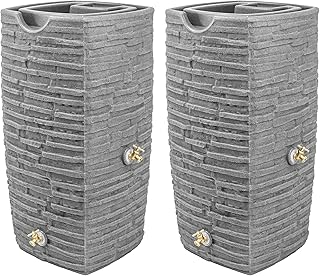
The RainStation is the most complete small harvesting kit in this set. The FlexiFit diverter in the box routes gutter water into the barrel and returns overflow to the downspout once the barrel is full, which is the arrangement that keeps foundations dry and the system sealed against debris. Range coverage of the model describes a stackable and linkable design, so a second unit can join the first as the garden's appetite grows.
The reversible lid flips between a flat top and a planter, a small pleasure that makes a downspout barrel look like garden furniture instead of plumbing. The spigot fills cans at the front, and the drain fitting takes a garden hose connection for emptying or linking. At 45 gallons it is the smallest vessel here, sized for one downspout serving beds and pots rather than a whole lawn, and its 23.5 inch round footprint needs a proper corner rather than a narrow strip.
Pros:
- Diverter included, overflow returns to the downspout
- Planter top lid softens the look beside the house
- Stackable and linkable format grows with the garden
Cons:
- Smallest capacity in this set at 45 gallons
- Round footprint needs more width than flat-back barrels
- Planter top adds soil weight to the lid
RainFlo TST-800AGS Stackable Rainwater Collection System
- Capacity: 800 gallons
- Tank: black open top stackable vertical tank, upper dia 72 in, lower dia 54 in, height 80 in with lid
- Lid: removable top with 18 in screw top lid
- Pump: RainFlo MHP50A automatic pump, 1/2 HP, up to 17.6 GPM and 78 ft head as listed
- Plumbing: 3 in, with fittings, tank gauge, floating filter and overflow installed
- Collector: system components ship inside the tank, as listed
The TST-800AGS is a preconfigured harvesting system built on RainFlo's stackable tank: a tapered vessel, narrower at the bottom than the top, in black material that the maker notes gives extra protection from ultraviolet light and reduces algae growth. At 800 gallons it banks the runoff from a large roof through a wet month and feeds a serious garden through a dry one, and the taper is what lets a tank this size ship and handle like a smaller object.
Everything else arrives fitted. The system page lists the tank drilled with fittings, gauge, floating filter and overflow installed, plus the MHP50A automatic surface pump, rated up to 17.6 GPM and 78 feet of head, which starts when a tap or irrigation valve opens and stops when flow stops. That turns stored gutter water into pressurised water for hoses and drip lines without a separate pump project. The footprint, six feet across at the top, is the real decision: this system needs a planned pad, not a spare corner.
Pros:
- Very large capacity on a space-efficient tapered tank
- Pump, gauge, filter and overflow fitted before delivery
- Black tank limits algae growth in stored water
Cons:
- Six foot top diameter needs a planned site
- System weight and cost suit committed harvesters
- Pump needs a mains supply at the tank
Emergency Water Tanks 55-Gallon Tank
- Capacity: 55 gallons
- Design: stackable, as listed in range coverage
- Material: food-grade, BPA-free plastic, as listed
- Outlet: brass spigot, as listed
- Weight: 22 lb, as listed
This 55 gallon tank pairs the two features gutter harvesters ask for most: a stackable body, so storage can grow upward in a side yard or garage, and a brass spigot, the metal fitting that keeps turning smoothly season after season where plastic taps grow stiff. Range coverage of the model lists food-grade, BPA-free construction, and at 22 lb empty it is a one-person carry to wherever it will stand.
As a harvesting vessel it works the way the WaterPrepared does: a downspout diverter feeds the fill opening, the spigot draws water for cans and short hoses, and a second tank stacks or stands alongside when the first proves too small. The listing evidence for this model is thinner than for the RainFlo systems, so buyers should confirm the fill opening size and stacking guidance on the product page before ordering a pair.
Pros:
- Brass spigot at a standard barrel capacity
- Stackable body for vertical growth
- Light empty weight for positioning
Cons:
- Diverter and fittings are separate purchases
- Listing detail is thinner than system rivals
- Storage-first design, no planter or screen extras
RainFlo TST-200AGS Gravity Rainwater Collection System
- Capacity: 200 gallons
- Tank: black open top stackable vertical tank, upper dia 43 in, lower dia 32 in, height 60 in
- Lid: 18 in lid, as listed
- Delivery: gravity, no pump in this configuration
- Collector: Quattro collector, as listed
- Outlet: Aqua-Go nozzle and hose, 3/4 in NPT, as listed
The TST-200AGS takes the same tapered stackable tank as its larger pumped siblings and keeps the delivery simple: gravity. The Quattro collector feeds gutter water into the 200 gallon tank, and the Aqua-Go nozzle and hose draw it out at whatever pace a head of water gives, which for cans, soaker lines and patient watering is all a garden needs. With no pump, there is nothing to wire, prime or maintain, and nothing to fail in a dry July.
The tapered profile, 43 inches across the top and 32 at the base, stands five feet tall, so siting means a level pad against a wall or fence where the height reads as a feature rather than an obstacle. Two hundred gallons is a meaningful bank: it covers weeks of bed and container watering for most homes, and because the tank belongs to a system family, its fittings and collectors follow the maker's standard pattern. Gardeners who later want pressure can look to the pumped versions of the same design.
Pros:
- 200 gallons with no pump to run or maintain
- Collector included in the system
- Tapered tank stands stable on a modest base
Cons:
- Gravity pressure will not run sprinklers
- Five foot height needs the right wall or fence line
- No gauge or pump in this configuration
Emergency Water Tanks 30-Gallon Tank
- Capacity: 30 gallons
- Design: stackable, as listed in range coverage
- Outlet: brass spigot, as listed
- Weight: 17 lb, as listed
The 30 gallon model is the small end of the stackable idea: a compact tank for the downspout that serves a patio garden, a herb bed and a row of containers, in the spaces where even a standard barrel crowds the path. Range coverage lists a stackable design and a brass spigot, and at 17 lb empty it can be carried through a side gate and positioned by one person without a trolley.
Thirty gallons is a working buffer rather than a drought bank, refilling with every decent rain and emptying across a few dry days of container watering. The stacking format is what rescues the small capacity: a second unit doubles the store without doubling the footprint. As with its 55 gallon sibling, the diverter for gutter duty is a separate purchase, and confirming the fill arrangement on the product page before ordering is the sensible step.
Pros:
- Smallest footprint in this set
- Stacking doubles capacity in the same space
- Brass spigot at this size is uncommon
Cons:
- 30 gallons empties quickly in a dry spell
- Diverter is a separate purchase
- Listing detail is limited
RainFlo TST-1000AGS Stackable Rainwater Collection System
- Capacity: 1,000 gallons
- Tank: black open top stackable vertical tank, upper dia 76 in, lower dia 59 in, height 77 in with lid
- Lid: removable top with 18 in screw top lid
- Pump: RainFlo MHP50A automatic pump, 1/2 HP, up to 17.6 GPM and 78 ft head as listed
- Plumbing: 3 in, with fittings, tank gauge, floating filter and overflow installed
- Filtration: floating filter draws the cleanest water in the tank, as listed
The TST-1000AGS is the largest system in this guide: a thousand gallons of gutter water on the same tapered stackable tank design as the 800, scaled to a 76 inch top diameter. It suits big roofs, long gardens and small irrigation zones, where a single storm can deliver more water than a row of barrels could ever hold and a dry month can be watered from storage rather than from the mains.
Like the 800, it arrives as a system rather than a vessel: fittings, gauge, floating filter and overflow installed, the other components shipped inside the tank, and the MHP50A automatic pump turning stored water into line pressure on demand. The floating filter deserves its line in the specification, because it draws water from below the surface, the cleanest part of the tank, which keeps drip emitters happier over a season. Siting is a project in itself: a level, load-bearing pad and a planned overflow route are part of the purchase.
Pros:
- Largest capacity here at 1,000 gallons
- Complete pumped system, fitted before delivery
- Floating filter protects drip lines from sediment
Cons:
- Largest footprint and site preparation in the set
- Pump needs power at the tank
- Capacity exceeds what small gardens can use
Buying guide
Stackable harvesting succeeds or fails on siting and plumbing rather than on the vessel itself. The sections below cover the four decisions that matter: how the gutter water gets in, how much storage the roof and garden justify, how the water gets out again, and how the system is kept clean across seasons.
Getting gutter water in: diverters and collectors
Every system here fills one of two ways. A diverter, like the RainStation's FlexiFit, cuts into the downspout, sends the first water to the barrel and returns overflow to the downspout once the vessel is full, which keeps the whole arrangement sealed and foundation-safe. A collector, like the RainFlo Quattro, does the same job at system scale. Storage-first tanks, the WaterPrepared and Emergency Water Tanks models, need a diverter kit bought alongside, and that kit's hose diameter should match the tank's fill opening.
Whichever route is chosen, plan the overflow before the first storm. A full tank in heavy rain passes a surprising volume of water, and that water needs a route away from foundations, paths and the neighbour's fence line.
How much storage do the roof and garden justify?
A rough water budget keeps expectations honest. One inch of rain on 100 square feet of roof yields roughly 60 gallons of runoff, so a modest roof section fills a 45 or 55 gallon barrel in a single decent storm, and fills it again every storm after. Small barrels therefore work as flow-through buffers for regular watering, while drought banking is the job of the 200 gallon and larger systems.
Match the vessel to the thirst, not the roof. Containers and beds in a small garden may drink ten gallons on a hot day; a large vegetable plot with drip lines can drink ten times that. The right size is the one that empties across a typical dry spell and refills in a typical storm, and the stackable formats in this guide exist precisely so that size can grow after a season of watching both numbers.
Getting water out: spigots, gravity and pumps
A base spigot and a watering can remain the simplest delivery system in gardening, and both small tanks and the RainStation are arranged around exactly that. Gravity systems like the TST-200AGS add a hose outlet and enough head for soaker lines and patient hand watering, provided the tank stands a little above the beds where the layout allows.
Pressure is the pumped systems' contribution. The RainFlo MHP50A fitted to the 800 and 1,000 gallon systems starts when a valve opens and stops when it closes, delivering up to 17.6 GPM on the maker's figures, which runs drip zones and hose work the way mains water does. Choose gravity for simplicity and silence; choose the pump when the garden's watering already assumes pressure.
Keeping stored water clean
Sealed systems age best. A diverter-fed barrel with a screened inlet keeps leaves, grit and insects out of the store, and the black material of the RainFlo tanks limits the light that algae need. The floating filters on the pumped systems draw from below the surface, away from both the floating debris and the bottom sediment.
Once a season, draw the system down, rinse the base, and check the diverter and overflow paths for blockages. In freezing climates, follow the maker's winter guidance for the vessel and any pump, since ice expansion is the one force no tank design argues with.
FAQ
What does stackable actually mean for a rain barrel?
It describes how the storage grows or packs. Tapered tanks like the RainFlo design are narrower at the base, so they nest for shipping and stand as stable columns in use. Storage tanks like the WaterPrepared are built to stack one on another. Linkable barrels grow sideways instead, adding a unit at a time along a wall. Each product section in this guide states which format its maker lists.
Can one downspout fill a stackable system?
Yes. A diverter or collector routes the downspout's flow into the vessel and sends overflow back once it is full. Large systems fill more slowly from one downspout simply because they hold more, and some owners feed the biggest RainFlo tanks from two downspouts; the fittings follow the maker's standard pattern either way.
How much rain does a roof actually deliver?
As a working figure, one inch of rain on 100 square feet of roof gives roughly 60 gallons of runoff before losses. A single storm can therefore fill a small barrel outright, which is why small barrels suit regular watering and large systems suit banking water against dry spells.
Will gravity from a tank run my drip lines?
Low-pressure drip and soaker lines usually run happily on gravity, especially with the tank standing above the beds. Emitter-heavy drip designs that expect mains pressure may dribble unevenly, and that is the case the pumped RainFlo systems exist for, since their automatic pump delivers line pressure on demand.
Do stackable tanks keep mosquitoes out?
Sealed, diverter-fed systems with screened inlets give mosquitoes no way in, which is one reason to prefer a diverter over an open top under a cut downspout. Any opening, including an overflow, should be screened, and the lid should sit closed between uses.
What maintenance does a harvesting system need?
An annual draw-down and rinse, a check of the diverter, screen and overflow path each spring, and winter care that follows the maker's guidance in freezing climates. Pumped systems add one item: confirm the pump's intake filter is clear at the start of the season.
Conclusion
Stackable harvesting is how a single downspout becomes a water bank instead of a single barrel. Start small with the WaterPrepared 55 or the RainStation 45 if the garden is modest and the space is tight, step up to the gravity TST-200AGS when beds multiply, and treat the pumped TST-800AGS and TST-1000AGS as the roof-scale answer for irrigation zones and long dry spells. The two Emergency Water Tanks models fill the gaps where footprint matters most. Whichever scale fits, plan the diverter, the overflow and the pad first, and the vessel will reward the planning every time it rains.
Related guides
More from Amazon
Programs that pair well with the guide above. Offers and eligibility are set by Amazon and may change.
Collect the home and kitchen items you want in one registry that guests can shop from.
Create a wedding registrySet up recurring deliveries of everyday items on eligible products. Terms and savings are set by Amazon.
Explore Subscribe & SaveFree shipping on eligible items, Prime Video and more. Eligible new members can start with a free trial.
Start a Prime free trialAudiobooks and podcasts to listen to on the go. Eligible new members can start with a free trial.
Try Audible freeAs an Amazon Associate we earn from qualifying purchases.
More ways to save on your garden
Programs that pair well with the guide above. Offers and eligibility are set by Amazon and may change.
Fast, free shipping on eligible items, plus Prime Video and more. Eligible new members can start with a free trial.
Start a Prime free trialSet up recurring deliveries of everyday items on eligible products. Terms and savings are set by Amazon.
Explore Subscribe & SaveRead from a huge library of eBooks, including how-to guides and cookbooks. Eligible new members can start with a free trial.
Try Kindle UnlimitedAudiobooks and podcasts for the commute, the garage or the kitchen. Eligible new members can start with a free trial.
Try Audible freeAs an Amazon Associate we earn from qualifying purchases. Using these links costs you nothing extra.



Write Your Review
No reviews yet. Be the first to share your experience!