
Key takeaways
- Seven plastic rain barrels for harvesting rainwater from gutters, compared on capacity, spigots, overflow routing, planter tops, flat back shapes, and drainage.
What's inside
As an Amazon Associate I earn from qualifying purchases. This post may contain affiliate links at no extra cost to you.
A gutter delivers water in bursts. A moderate storm can send hundreds of gallons off a roof in an hour, and the barrel under the downspout has to accept that surge, hold what it can, and pass the rest somewhere safe without undermining the foundation. Plastic barrels dominate this job because they are light enough to position by hand, molded into shapes that sit flat against a wall, and fitted with the screens, spigots, and overflow ports that gutter harvesting needs. The shortlist for the best plastic rain barrels for rainwater harvesting from gutters compares seven molded barrels on the details that decide how well they work under a real downspout: capacity, how the water gets in, how it gets out, and where the overflow goes when the barrel fills mid-storm.
Most residential barrels cluster at 50 gallons, and six of the seven here sit at or near that size, with one much larger 158 gallon model for big roofs. The differences that matter are in the fittings. A barrel with two spigots can fill a watering can at the top fitting while a hose stays connected at the bottom one. A routed overflow channel can carry surplus water back into the downspout path or away from the house, while a simple overflow port needs a hose the owner must aim. Planter tops turn the lid into a flower bed, flat backs reclaim the dead space between barrel and wall, and linkable ports let two barrels act as one store. The sections below take each barrel on those terms, using only the specs its product page or listing states.
Quick verdict
The RTS Home Accents 50-Gallon Flat Back in walnut is the default pick for a standard downspout: a flat back that sits tight to the wall, a brass spigot, and an overflow valve in a UV-stabilized polyethylene body. The Good Ideas Savannah 42 trades a little capacity for a planter top and two brass spigots. The Good Ideas Impressions Bark 50 adds a routed overflow channel and a textured finish. The Graf Antique Amphora is the outlier at 158 gallons for large roofs and long dry spells. The RTS ECO Flat Back is built from recycled plastic with dual overflow ports and linking capability. The Algreen Castilla brings a bottom drain that empties the barrel fully, and the Algreen Agua pairs a planter top with dual overflows in a rotomoulded body.
| Product | Key spec | Best for |
|---|---|---|
| RTS Home Accents 50-Gallon Flat Back Rain Barrel Walnut | 50 gal, flat back, brass spigot, overflow valve | Standard downspouts against a wall |
| Good Ideas Savannah 42 Rain Barrel Planter | 42 gal, planter top, two brass spigots | Visible corners where the barrel should look planted |
| Good Ideas Impressions Bark 50 Rain Barrel | 50 gal, routed overflow, two metal spigots | Homes that want overflow handled inside the barrel design |
| Graf Antique Amphora Rain Barrel 158 Gallon | 158 gal, integrated planter, closed design | Large roofs and long gaps between rains |
| RTS Home Accents 50-Gallon ECO Flat Back Rain Barrel Black | 50 gal, recycled plastic, dual overflow, linkable | Linking two barrels on one downspout |
| Algreen Castilla 50-Gallon Rain Barrel | 50 gal, brass spigot, bottom drain, dual rear overflow | Owners who drain barrels fully each season |
| Algreen Agua 50 Gallon Rain Barrel | 50 gal, planter top, brass spigot, dual overflows | Planter top styling with flexible overflow routing |
How we chose
Every barrel here is a molded plastic model — polyethylene or rotomoulded resin — sold as a specific product for collecting roof water, with a screened inlet or a diverter connection for a downspout. Wooden barrels, steel drums, and collapsible bags were left out because the keyword asks for plastic barrels, and rigid plastic is what holds a spigot thread and an overflow fitting season after season. Each entry was checked against its product page or retailer listing for capacity, dimensions where listed, spigot count and material, and overflow arrangement, and those are the figures used in the article.
The comparison weights the gutter connection heavily. A barrel that accepts a standard 2×3 or 3×4 downspout through a diverter or a cut-in opening, screens out roof grit and mosquitoes, and routes overflow away from the foundation will serve better than a larger barrel missing any of those pieces. Spigot placement matters too: a low spigot empties more of the barrel into a can, while a second higher spigot keeps a soaker hose fed without disturbing the can filling routine. Where a listing did not state a figure, the entry notes the gap rather than estimating, and no prices appear anywhere in the article.
One scope note: these barrels store water for garden use — watering beds, rinsing tools, filling cans. None of them is presented as a drinking water store, and roof water should be treated as non-potable regardless of the barrel chosen.
RTS Home Accents 50-Gallon Flat Back Rain Barrel Walnut
- Capacity: 50 US gal (190 L)
- Dimensions: 21 x 19 x 34 in
- Weight: 18 lb
- Material: UV-stabilized polyethylene
- Spigot: brass
- Overflow: overflow valve listed
- Shape: flat back
The flat back is the whole idea here. A round barrel against a house wall wastes a crescent of space and rocks on its curved side; this body molds one side flat so the barrel sits flush, stable, and closer to the downspout it serves. At 21 x 19 x 34 inches it fits the standard spot beside a downspout without crowding a path, and at 18 lb empty one person can carry it into place and level it on a paver or stand. The listing describes UV-stabilized polyethylene, which is the right material call for a barrel that will live in sun beside a south wall.
The brass spigot is a durable fitting at the point that gets the most use, and the listed overflow valve gives surplus storm water a defined exit instead of a sheet spilling over the lid seam. For a single-barrel installation on a typical roof section, this is the balanced specification: standard capacity, standard fittings, no feature that needs explaining to a guest. Its limits are the standard ones. One spigot means a hose and a can take turns, the 50 gallon store fills fast in a big storm and empties fast in a dry week, and the walnut finish, while tidy, reads as a barrel rather than disguising itself as garden furniture.
Pros:
- Flat back sits flush and stable against a wall
- Brass spigot at the main draw point
- UV-stabilized polyethylene body
- Light enough at 18 lb to position alone
Cons:
- Single spigot, so hose and can share one outlet
- Standard 50 gal capacity only
- Overflow valve still needs a hose or route planned by the owner
Good Ideas Savannah 42 Rain Barrel Planter
- Capacity: 42 gal
- Model: SV-ERS-CG2C
- Planter top: 1 cu ft
- Spigots: two brass spigots
- Shape: flat back
- Material: polyethylene
The Savannah answers the most common objection to rain barrels: that they look like utility drums parked by the house. Its lid is a planter with a cubic foot of soil capacity, deep enough for annuals or herbs, so the barrel reads as a planted container with a spigot rather than a tank. The flat back keeps it against the wall like the RTS above, and the body is polyethylene. Two brass spigots are fitted, which changes daily use more than any styling point: a hose can stay threaded onto the lower fitting while the upper one fills cans, and neither job waits for the other.
The cost of the planter styling is capacity. At 42 gallons this is the smallest barrel on the list, and on a large roof section it will reach its overflow sooner and run dry sooner in a rainless stretch. The planter top also asks for a decision about watering: the plants in the lid need moisture, and owners typically water them from the barrel below, a pleasant loop that still takes a minute of attention. For a front-of-house downspout where appearance decides whether a barrel is allowed at all, the trade is usually worth it; for a back garden focused on storage volume, a plainer 50 gallon body serves better.
Pros:
- Planter top disguises the barrel as a container planting
- Two brass spigots allow a hose and a can at once
- Flat back shape for wall placement
- Polyethylene body
Cons:
- 42 gal is the smallest capacity here
- Planter top needs its own watering attention
- Fills and empties faster than 50 gal models
Good Ideas Impressions Bark 50 Rain Barrel
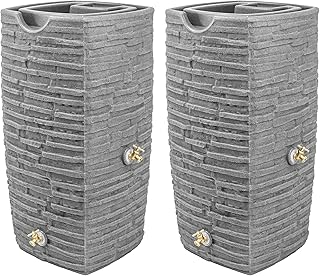
- Capacity: 50 gal
- Dimensions: 23 x 23 x 34 in
- Weight: 21 lb
- Material: polyethylene
- Spigots: two metal spigots
- Overflow: routed overflow channel
- Top: planter top
The Impressions Bark 50 is built around a textured bark finish and the most thought-through overflow arrangement in this group: a routed overflow channel molded into the barrel. Instead of a port that the owner must fit with a hose, the channel directs surplus water down and away as part of the barrel's own shape, which keeps the top of the barrel tidy and reduces the chance of water sheeting down the wall side. Two metal spigots are fitted, and the top carries a planter surface, so the barrel combines the Savannah's disguise trick with a full 50 gallon store.
At 23 x 23 x 34 inches and 21 lb, it is a slightly larger footprint than the flat back models, and the round profile means it stands a little further from the wall. That is the honest trade for the routed channel and the bark texture: this barrel is meant to be seen, placed at a corner or beside a porch where a round, textured body looks intentional. The planter top shares the Savannah's minor upkeep. For owners whose overflow path has caused trouble — water staining a wall, pooling at a foundation corner — a routed channel is a functional reason to choose this model, not just a styling one.
Pros:
- Routed overflow channel handles surplus water cleanly
- Two metal spigots
- Full 50 gal capacity with a planter top
- Textured bark finish suits visible placements
Cons:
- Round body stands further from the wall than flat back models
- Slightly heavier at 21 lb
- Planter top adds a small upkeep task
Graf Antique Amphora Rain Barrel 158 Gallon
- Capacity: 158 gal (600 L)
- Material: LLD-PE, UV-stable
- Top: integrated planter
- Design: closed design
- Spigot: fast-flow spigot listed
- Weight: 43 lb
The Amphora is in a different class from the 50 gallon barrels: at 158 gallons it stores roughly three standard barrels of water in one footprint, shaped like a garden amphora with an integrated planter at the top. The body is LLD-PE described as UV-stable, and the design is closed, which limits debris entry and mosquito access compared with open or loosely lidded barrels. The listing mentions a fast-flow spigot, a fitting that matters more as capacity grows, because drawing 158 gallons through a slow spigot turns every watering session into a wait.
This is the barrel for a large roof plane, a long run between storms, or a garden that draws stored water daily. The cautions scale with the size. At 43 lb empty it is still movable, but full it holds well over half a ton of water, so the base must be level, compacted, and close to the downspout before the first fill — repositioning is not an option afterward. Its height and presence also make it a garden feature rather than a utility hidden at the back wall, and a small roof will take a long time to fill it, which can leave water standing old. Match the capacity to the roof area and the garden's actual draw, not to the appeal of the biggest number.
Pros:
- 158 gal capacity triples the standard barrel store
- Closed design limits debris and mosquito entry
- Integrated planter top
- UV-stable LLD-PE body
Cons:
- Needs a properly prepared, level base for the full weight
- Oversized for small roofs that fill it slowly
- A prominent garden feature, not a discreet utility barrel
RTS Home Accents 50-Gallon ECO Flat Back Rain Barrel Black
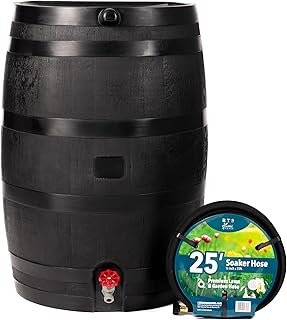
- Capacity: 50 gal
- Weight: 18 lb
- Material: 100 percent recycled plastic per the listing
- Screen: fitted inlet screen listed
- Overflow: dual overflow ports
- Linking: linkable design listed
- Shape: flat back
The ECO Flat Back takes the standard 50 gallon flat back format and builds the body from recycled plastic, which suits a product whose whole purpose is resource saving. The listing describes a fitted screen, dual overflow ports, and a linkable design. The dual overflows give the installer a choice of exit side, useful when one side of the barrel faces a path and the other faces a bed. Linking is the feature with the longest payoff: a second barrel can be connected so one downspout fills a 100 gallon store, with the second barrel placed where a downspout is not available.
Like the walnut RTS, the flat back keeps the body against the wall and the 18 lb weight keeps setup a one-person job. The black finish absorbs sun warmth, which some owners count as a mild benefit against algae-friendly light inside the barrel, since the opaque body blocks the light algae need; the same warmth is worth noting in very hot climates where stored water temperature matters for sensitive plants. Against the walnut model, the ECO trades the single overflow valve for dual ports that need hoses or caps planned by the owner, and the recycled body carries the same 50 gallon ceiling as every standard barrel here.
Pros:
- Body made from recycled plastic
- Dual overflow ports give routing choices
- Linkable for a two-barrel store on one downspout
- Flat back, light 18 lb body
Cons:
- Overflow ports need owner-fitted hoses or caps
- Standard 50 gal capacity per barrel
- Black body warms stored water in hot sun
Algreen Castilla 50-Gallon Rain Barrel
- Capacity: 50 gal
- Dimensions: 23 x 33 in
- Material: roto moulded resin
- Spigot: brass
- Drain: bottom drain listed
- Overflow: dual rear overflow
- Warranty: 2 year warranty listed
The Castilla's distinguishing fitting is at the bottom: a bottom drain, in addition to its brass spigot. Most barrels never fully empty through a spigot mounted a few inches above the base, and the last few gallons go stale, grow sediment, and complicate winterizing. A bottom drain lets the owner empty the barrel completely for cleaning, for moving, or before a freeze, without tipping a heavy, sloshing body. The dual rear overflow ports keep surplus water exits at the back, against the wall side, where hoses are less visible and trips are less likely.
The body is roto moulded resin at 23 x 33 inches, a construction the maker pairs with a listed 2 year warranty. Rotomoulding produces a one-piece body without seams, which removes the seam-split failure that ends the life of cheaper two-piece barrels. In daily use the Castilla behaves like the other 50 gallon barrels here — a brass spigot for cans and hoses, a screened top for the downspout — and its argument is about the end of the season and the years after, when drainage and a one-piece body decide whether the barrel is still in service. It lacks a planter top, so it looks like what it is; owners who need the disguise should look at the Savannah or the Bark 50.
Pros:
- Bottom drain empties the barrel fully for cleaning and winter
- One-piece roto moulded body
- Dual rear overflows keep hoses out of sight
- Listed 2 year warranty
Cons:
- No planter top to disguise the barrel
- Single spigot for daily drawing
- Standard 50 gal capacity
Algreen Agua 50 Gallon Rain Barrel
- Capacity: 50 gal
- Dimensions: 33 in high x 23 in wide
- Material: rotomoulded plastic
- Spigot: brass
- Top: planter top
- Overflow: dual overflows
The Agua combines the Castilla's rotomoulded construction with the planter top format. The listing gives a 50 gallon capacity in a body 33 inches high and 23 inches wide, a brass spigot, and dual overflows. The planter top here is a shallow tray style that suits bedding plants and herbs, softening the barrel's outline at a porch or patio downspout. Dual overflows mean the installer can route surplus water to the side that suits the site, or run one overflow to a second barrel and cap the other.
Against the Savannah, the Agua offers the full 50 gallons and the one-piece rotomoulded body, in exchange for one spigot instead of two. Against the Castilla, it trades the bottom drain for the planter top. That triangle — capacity, drainage, disguise — is the real decision among the Algreen and Good Ideas models, and the Agua sits at the capacity-plus-disguise corner. As with every planter top barrel, the lid planting needs watering and the roots stay shallow, so choose compact annuals or herbs rather than anything that wants depth. The rotomoulded body should shrug off the knocks of a working garden, and the brass spigot avoids the cracked plastic tap that is the most common failure on budget barrels.
Pros:
- Full 50 gal capacity with a planter top
- Rotomoulded one-piece body
- Dual overflows for flexible routing
- Brass spigot
Cons:
- Single spigot
- No bottom drain, so full emptying means tipping
- Planter top suits only shallow-rooted plants
Buying guide
Match capacity to roof area and garden draw
A barrel's job is to bridge the gap between storms and watering days. Fifty gallons covers a modest bed area for a few dry days; a large vegetable garden in a hot spell can draw that in one session. Estimate the roof area draining to the downspout as well: a big roof fills a small barrel early in every storm and sends the rest to overflow, which wastes the harvest, while a small roof may never fill a 158 gallon barrel. Where one downspout serves a big roof and the garden draws heavily, two linked 50 gallon barrels or the Amphora class of barrel keeps more of each storm.
Plan the overflow before the first storm
Overflow is not an edge case; it is the normal state of a barrel in wet weather. Decide where surplus water goes — back down the downspout line through a diverter that closes when the barrel is full, along a hose to a bed or a gravel area, or through a routed channel like the Impressions Bark uses — and make sure that path leads away from the foundation. A barrel that overflows against the house wall trades a watering asset for a damp problem. Dual overflow models let the installer pick the exit side; single valve models need the hose run planned at install.
Screens, mosquitoes, and water quality
Roof water carries grit, leaf fragments, and asphalt granules, and an open barrel breeds mosquitoes within a week in summer. Every barrel here is a closed or screened design; keep the screen intact, check it when cleaning gutters, and empty and scrub the barrel at least once a season. Stored rainwater suits ornamental beds, lawns, and — with the usual local guidance — vegetable gardens when applied at soil level rather than on edible leaves. It is not drinking water, and no barrel fitting changes that.
Placement and the weight of water
Water weighs about 8.3 lb per gallon, so a full 50 gallon barrel stands at over 400 lb and the Amphora at well over 1,300 lb. Set the barrel on a level, compacted base — pavers, a gravel pad, or a purpose stand — never on soft soil that will tilt as it settles. A stand that raises the barrel adds gravity pressure for hose use and room for a watering can under the spigot, and it must be rated for the full weight. Keep the barrel close to the downspout it serves; long diverter hoses sag, clog, and freeze.
Winter care in cold climates
Ice expansion splits barrels that enter winter full. Drain the barrel before hard freezes — the Castilla's bottom drain makes this the work of minutes — leave the spigot open, and either store the barrel inverted or disconnect it and restore the downspout's direct path to the ground. Plastic bodies tolerate cold well when empty; the fittings, especially spigot threads, are the parts to protect. A barrel winterized this way should give many seasons; a barrel left full through a freeze often gives one.
FAQ
How much water does a 50-gallon barrel collect from a roof?
Faster than most owners expect. One inch of rain on 100 square feet of roof produces roughly 62 gallons of runoff, so a modest roof section can fill a 50 gallon barrel in a single moderate storm. That arithmetic is why overflow routing matters as much as capacity, and why linking a second barrel often adds more real storage than choosing a slightly larger single barrel. In dry weeks the same barrel empties just as fast through daily watering, which is the other half of the sizing decision.
Do I need a diverter, or can the downspout pour straight in?
Both arrangements exist. A diverter kit cuts into the downspout and sends water to the barrel through a hose, returning flow to the downspout when the barrel is full; it is the tidy option and keeps the downspout functional. A barrel with a top opening can also sit under a shortened downspout that pours directly in, which is simpler but means overflow spills at the barrel unless the barrel's own overflow is routed away. Whichever route is chosen, the inlet should be screened to keep out debris and mosquitoes.
Can barrels be linked for more storage?
Yes, and two models here — the RTS ECO explicitly, and any barrel with dual overflows by arrangement — support it. A linking hose connects the barrels so they fill and draw as one store, with the second barrel placed beside the first or around a corner. Linked barrels must sit at the same base height so water levels equalize, and the draw spigot can stay on the first barrel. Linking is usually the practical way past 50 gallons without moving to a large single body like the Amphora.
Where should overflow water go?
Away from the foundation, always — to a splash area, a gravel strip, a rain garden, or back into the downspout's own drainage path through a diverter. Never let overflow sheet down the wall side of the barrel or pool at the base, because the barrel sits exactly where the foundation is closest. Route the overflow hose at install, while the barrel is empty and movable, and check the route during the first big storm to confirm the water lands where intended.
Can stored rainwater be used on vegetable beds?
Common practice is yes, applied at soil level with a can or soaker hose, and avoided on the edible portions of leafy crops close to harvest. Roof material matters: water from asphalt shingle roofs is widely used on gardens, while roofs treated with moss killers or made of treated materials deserve more caution. Local extension guidance is the authority for a specific roof and crop. What no guidance supports is drinking the water untreated; keep barrel water for the garden, tools, and outdoor cleaning.
How do I keep the water from smelling or turning green?
Keep light and debris out. An opaque, closed, screened barrel — the format of every model here — denies algae the light it needs and keeps leaf litter from rotting in the store. Draw water regularly so the store turns over, scrub the inside at the seasonal drain-down, and clear the inlet screen when it mats over. A barrel that smells is usually a barrel with debris decaying in it; the fix is cleaning, not chemicals, since the water is bound for the garden.
Conclusion
The seven barrels divide along three decisions: how the barrel should look, how its overflow behaves, and how it empties at the end of the season. The RTS Flat Back Walnut is the balanced standard for a single downspout, the RTS ECO adds recycled construction and linking, the Savannah and the Impressions Bark 50 disguise the store as a planter, the Algreen pair trade a bottom drain against a planter top on one-piece rotomoulded bodies, and the Graf Amphora serves roofs and gardens whose scale makes 50 gallons a token. Choose by the downspout and the draw, route the overflow with care, set the base for the full weight of water, and a plastic barrel will turn gutter runoff into the garden's most reliable water supply.
Related guides
More from Amazon
Programs that pair well with the guide above. Offers and eligibility are set by Amazon and may change.
Collect the home and kitchen items you want in one registry that guests can shop from.
Create a wedding registrySet up recurring deliveries of everyday items on eligible products. Terms and savings are set by Amazon.
Explore Subscribe & SaveFree shipping on eligible items, Prime Video and more. Eligible new members can start with a free trial.
Start a Prime free trialAudiobooks and podcasts to listen to on the go. Eligible new members can start with a free trial.
Try Audible freeAs an Amazon Associate we earn from qualifying purchases.
More ways to save on your garden
Programs that pair well with the guide above. Offers and eligibility are set by Amazon and may change.
Fast, free shipping on eligible items, plus Prime Video and more. Eligible new members can start with a free trial.
Start a Prime free trialSet up recurring deliveries of everyday items on eligible products. Terms and savings are set by Amazon.
Explore Subscribe & SaveRead from a huge library of eBooks, including how-to guides and cookbooks. Eligible new members can start with a free trial.
Try Kindle UnlimitedAudiobooks and podcasts for the commute, the garage or the kitchen. Eligible new members can start with a free trial.
Try Audible freeAs an Amazon Associate we earn from qualifying purchases. Using these links costs you nothing extra.



Write Your Review
No reviews yet. Be the first to share your experience!