
Key takeaways
- Compare compact rain barrels for rainwater harvesting from gutters, with capacities, footprints, spigots, overflow designs, and linking options for spaces.
What's inside
As an Amazon Associate I earn from qualifying purchases. This post may contain affiliate links at no extra cost to you.
A rain barrel only harvests what its placement allows, and at most houses the downspout corner is a tight, visible, awkward patch of ground. Compact barrels answer that constraint with flat backs, shallow depths, and footprints that leave the path and the planting bed alone. This guide compares best compact rain barrels for rainwater harvesting from gutters using models whose capacities, dimensions, spigots, and overflow designs were read on opened retailer and review pages.
Compact here means honest numbers: capacities from 40 to 50 gal, depths as shallow as 16 in, and bodies shaped to sit against a wall rather than squat in the open. Every model below includes a spigot for drawing water and a plan for overflow, because a barrel without an overflow route simply moves the flood to the foundation. Screens, linking options, and planter tops separate the group further, and the right pick depends on the corner you actually have, not the one in a catalog photo.
Quick verdict
For most gutter corners, the FCMP Raincatcher 4000 is the easiest start because its box includes the screen, overflow tube, linking tube, and hose. Tight spaces split two ways: the FCMP Slim Line at 16 in deep for the narrowest walls, and the RTS flat back at 19 in deep with a full 50 gal. The Rain Wizard 40 is the lightest small option, the Rain Wizard 50 adds capacity in the same shape, and the two Good Ideas Impressions models add dual spigots and planter styling for visible spots.
| Product | Key spec | Best for |
|---|---|---|
| FCMP Outdoor Raincatcher 4000 Rain Barrel | 50 gal, flat back, two spigots, linking and overflow tubes | Best for a complete downspout kit in one box |
| Good Ideas Rain Wizard 40 Rain Barrel (RW40-OAK) | 40 gal, flat back, brass spigot, 18 lb | Best for the smallest gutter-side footprint |
| Good Ideas Rain Wizard 50 Rain Barrel | 50 gal, flat back, brass spigot, 20 lb | Best for more storage in the same flat-back shape |
| RTS Home Accents 50-Gallon Flat Back Rain Barrel with Brass Spigot | 50 gal, 21 x 19 x 34 in, overflow valve | Best for narrow side yards beside a downspout |
| Good Ideas Impressions Bali 50 Rain Barrel | 50 gal, two brass spigots, routed overflow channel | Best for filling buckets and running a hose at once |
| Good Ideas Impressions Palm 50 Rain Saver (IMP-L50-DAR) | 50 gal, planter top, dual spigot locations | Best for a barrel that doubles as a planter |
| FCMP Outdoor Slim Line Rain Barrel | 45 gal, 16 in depth, flat back, wood-grain finish | Best for the tightest wall spaces |
How we chose
Models were included only when an opened page listed the barrel's capacity and dimensions, so compact could be judged by numbers rather than by naming. Each model also had to show the working parts of gutter harvesting: a spigot for drawing water, an overflow path for when the barrel fills mid-storm, and a screened or covered inlet to keep debris and insects out of stored water. Barrels without a stated footprint, and oversized tanks that no reasonable reading calls compact, were left out.
Within that gate, the comparison weighs depth first, since depth is what a wall-side placement runs out of, then capacity, then the quality of the water access: brass against plastic spigots, one draw point against two, and whether linking a second barrel is supported now or later. Included hardware was recorded model by model, because a barrel that arrives with its overflow and linking tubes saves a second order, while a barrel that needs a separate diverter or linking kit should be budgeted as such from the start.
FCMP Outdoor Raincatcher 4000 Rain Barrel

- Capacity: 50 gal
- Shape: flat back for placement against a wall
- Dimensions: 24 x 24 x 32 in as listed
- Material: polyethylene
- Spigots: two side spigots as listed
- Included: debris screen, shut-off valve, overflow tube, linking tube, 40 in garden hose
The Raincatcher 4000 is the most complete gutter kit in this group. Listings describe a 50 gal flat-back polyethylene barrel with a debris screen, a shut-off valve, an overflow tube, a linking tube, and a 40 in garden hose, so the barrel can be plumbed to a downspout, drained by hose, and linked to a second barrel later without a parts hunt. The flat back sits the barrel against the wall under the gutter, and the two side spigots give a hose point and a linking point. At 24 by 24 by 32 in it is a real footprint, so measure the downspout corner before ordering.
Pros: Most complete included kit in this group; Flat back suits wall placement under gutters; Linking parts included for a second barrel.
Cons: 24 in depth is not the slimmest here; Rigid body does not fold for storage.
Good Ideas Rain Wizard 40 Rain Barrel (RW40-OAK)
- Capacity: 40 gal
- Dimensions: 28.25 x 22 x 21.5 in as listed
- Weight: 18 lb empty
- Spigot: brass spigot with overflow spout
- Material: BPA-free resin as listed, recycled plastic family
- Design: flat back, linkable with a separately sold kit
- Screen: mesh screen to keep out debris and insects
The Rain Wizard 40 is the compact end of this group: 40 gal in a flat-back body that measures about 28.25 by 22 by 21.5 in and weighs 18 lb empty, light enough to position under a downspout without help. The retailer lists a brass spigot, an overflow spout, and a mesh screen, and the flat back lets the barrel sit against the house where the gutter drops. It is linkable to a second barrel with a separately sold kit, so a small start does not block a bigger system later. For a single downspout serving beds and containers, this is the tidy fit.
Pros: Smallest capacity and footprint in this group; Light empty weight for easy placement; Brass spigot and overflow spout listed.
Cons: 40 gal fills quickly in a big storm; Linking kit sold separately.
Good Ideas Rain Wizard 50 Rain Barrel
- Capacity: 50 gal
- Dimensions: 30 x 23 x 21.5 in as listed
- Weight: 20 lb empty
- Spigot: heavy duty 3/4 in brass spigot as listed
- Material: UV-protected, BPA-free recycled plastic as listed
- Design: flat back with front-side overflow
- Screen: plastic mesh screen, removable for cleaning
The Rain Wizard 50 keeps the same flat-back, wall-hugging shape as the 40 and adds ten gallons, at 30 by 23 by 21.5 in and 20 lb empty. The retailer lists a heavy duty 3/4 in brass spigot that takes a standard garden hose, a front-side overflow that directs excess water away from the wall, and a mesh screen that lifts out for cleaning. The body is described as UV-protected, BPA-free recycled plastic. For a gutter that drains a large roof section, those extra gallons delay the moment the overflow takes over, without asking for a wider patch of ground.
Pros: More capacity with a shallow 21.5 in depth; Front overflow directs water away from the wall; Standard hose thread on a brass spigot.
Cons: Lid does not come off for deep cleaning; Linking kit sold separately.
RTS Home Accents 50-Gallon Flat Back Rain Barrel with Brass Spigot
- Capacity: 50 gal (190 L)
- Dimensions: 21 x 19 x 34 in as listed
- Weight: 18 lb as listed
- Material: UV-stabilized polyethylene
- Spigot: brass spigot
- Overflow: built-in overflow valve, can support linking barrels
- Design: flat back for wall or fence placement
Depth is the scarce dimension beside most houses, and this RTS barrel is built around that fact: the listing gives a 19 in depth with a flat back, in a 21 in wide, 34 in tall body holding 50 gal. That profile slides into a side passage or a fence line where a round barrel would block the path. The specification lists UV-stabilized polyethylene, a brass spigot, and a built-in overflow valve that can also support linking barrels. At 18 lb empty it is easy to place, and the walnut tone finish suits a visible front-of-house downspout.
Pros: Shallowest depth in this group at 19 in; Overflow valve supports linking; Light 18 lb empty weight.
Cons: Tall profile needs a level, firm base; Single spigot point.
Good Ideas Impressions Bali 50 Rain Barrel
- Capacity: 50 gal
- Dimensions: 22.25 x 22.25 x 36 in as listed
- Weight: 21 lb as listed
- Spigots: two brass spigot locations
- Overflow: integrated routed channel directs excess to the front
- Downspout fit: opening designed for 2×3 or 3×4 downspouts
- Screen: fine mesh screen as listed
The Bali 50 arranges its water access better than most barrels here. The listing describes two brass spigot locations, one suited to a hose and one placed for filling a five-gallon bucket, plus a fine mesh screen and an integrated routed channel that sends overflow to the front of the barrel instead of down the foundation wall. The square 22.25 in footprint and 36 in height give a predictable shape to plan around, and the top opening is designed for standard 2×3 or 3×4 downspouts. It is a considered design for a barrel that will be used daily, not just looked at.
Pros: Two spigots for hose and bucket at once; Routed overflow protects the foundation line; Fits standard downspout sizes as listed.
Cons: Square footprint is wider than the slim models; Taller body is top-heavy when empty in wind.
Good Ideas Impressions Palm 50 Rain Saver (IMP-L50-DAR)

- Capacity: 50 gal
- Top: planter top as listed
- Spigots: dual spigot locations for hose or bucket use, brass spigot listed
- Overflow: routed channel diverts excess water to the front
- Screen: meshed screen blocks debris
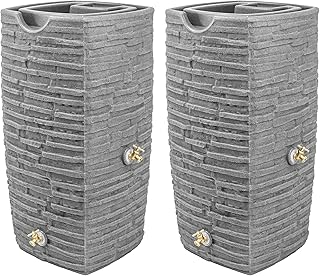
- Finish: palm trunk texture in dark granite as listed
The Palm 50 hides the barrel in plain sight. The listing describes a 50 gal rain saver with a planter top, a palm trunk finish, a meshed screen, a brass spigot, and dual spigot locations for a hose or a bucket. A routed channel moves overflow to the front, away from the foundation. Planted with herbs or flowers, the top turns a utility object at the downspout into part of the garden, which matters when the only good gutter position is beside a front door or patio. Under the styling it keeps the same working parts as the plainer barrels in this group.
Pros: Planter top disguises the barrel; Dual spigot locations for hose and bucket; Routed front overflow channel.
Cons: Planter top adds soil weight up high; Texture shows dirt more than smooth finishes.
FCMP Outdoor Slim Line Rain Barrel
- Capacity: 45 gal
- Dimensions: 22 x 16 x 32 in as listed
- Design: flat back for wall placement
- Depth: 16 in, the slimmest in this group
- Finish: wood-grain look as listed
- Spigots: side spigots with linking ability as listed for the model family
When the space beside the downspout is measured in inches, the Slim Line is the barrel that fits. Listings give a 45 gal capacity in a body only 16 in deep with a flat back, so it can stand in a narrow side yard, behind a gate swing, or along a garage wall where the 24 in models simply cannot go. The wood-grain finish softens the look against siding. Giving up five gallons against the 50 gal models buys a placement the others cannot make, and for harvesting from one gutter into beds and pots, 45 gal of stored rain is a working reserve, not a compromise.
Pros: Slimmest depth here at 16 in; Flat back for true wall placement; Wood-grain finish blends with siding.
Cons: 45 gal is the second smallest capacity here; Narrow body needs a level base to stand steady.
Buying guide
Measure the corner before falling for a capacity figure. The numbers that decide fit are depth from the wall and width along it, and a flat-back barrel uses both honestly: the RTS model here needs 19 in of depth, the Slim Line only 16 in, while the round-shouldered Raincatcher 4000 needs a full 24 in square. Leave room to stand at the spigot with a watering can, and check that a gate, a path, or a hose run does not cross the spot, because a barrel is a decade-long fixture once the downspout is cut to meet it.
Plan the overflow on paper before the first storm does it for you. A 50 gal barrel under a large roof section can fill in a single heavy rain, and everything after that must go somewhere deliberate: an overflow tube or routed channel sending water to a bed, a gravel patch, or a drain line, always away from the foundation. Models differ here in ways that matter, from included overflow tubes to channels molded into the body, so treat the overflow design as a headline feature, not a footnote in the parts list.
Think about how the water comes out, not just how it goes in. A low brass spigot fills a watering can slowly by gravity and threads a standard hose for soaking beds near the barrel. Two spigot locations, as on the Bali 50, let a hose stay connected while a bucket fills at the second point. Gardeners who want stronger flow can raise the barrel on a sturdy stand, which adds pressure and room for a can under the spigot, provided the base is level, solid, and rated for the weight of a full barrel.
Screens and lids decide water quality over a season. A fine mesh screen keeps leaves, roof grit, and insects out of the stored water, and it should lift out easily because it needs rinsing whenever debris mats on it. A closed, screened barrel also denies mosquitoes a breeding site, which open-topped storage cannot claim. If the barrel will feed drip lines or a pump later, cleaner intake water pays off twice, once in the barrel and once in every small fitting downstream of it.
Finally, plan for growth and for winter. Linking kits let a second barrel join the first at the overflow or side ports, doubling storage without moving the downspout work, so a linkable 40 or 50 gal start is a system, not a dead end. In freezing climates every model here must be drained before hard frost, with the spigot left open and the barrel stored dry or inverted as its maker directs. A compact barrel that is easy to empty, move, and store will still be harvesting long after a heavier, grander tank has been abandoned in place.
Roof material and gutter condition shape the water a barrel collects. The first rain after a dry spell washes dust, pollen, and bird droppings off the roof, and many gardeners let that first flush run to the overflow or a diverter bypass before filling the barrel for garden use. Clean gutters deliver cleaner water and fewer screen blockages, so a gutter sweep before the wet season is part of rain barrel care, and a screen that is easy to lift out, as several models here offer, is a screen that actually gets rinsed.
Use the stored water with intention. Rain barrel water is at its best used within days to a couple of weeks, drawn from the spigot for soil-level watering of beds, containers, and new plantings where soft, untreated water is welcome. If the barrel stands full and unused through a long wet spell, link a second barrel or route regular draws to trees and shrubs so the store turns over. A barrel that cycles is a working part of the garden; a barrel that only fills and overflows is a ornament with a spigot.
Label the barrel's jobs by season to get full value from it. In spring it waters new transplants and seedbeds, in summer it carries containers and beds through dry spells, and in autumn it can supply late plantings and wash tools before storage. Keeping the barrel in active use through the year also keeps the water fresh and the fittings exercised, so valves do not seize and screens do not cement with debris. When a barrel is drained for winter, note any slow drip or stiff spigot in a garden notebook so spring setup starts with the small repair already known.
Placement height is a quiet performance feature. Every foot the barrel stands above the bed it waters adds a little gravity pressure at the spigot, which is why a modest, solid stand often matters more than another ten gallons of capacity. Build or buy the stand for the full weight, keep it level so the barrel does not lean as it fills, and leave enough clearance under the spigot for the watering can you actually own. Gardeners who skip the stand can still work by hose on flat ground, but the can-filling routine, repeated hundreds of times a season, is where a few inches of height turn into real daily convenience.
FAQ
How much rain can one downspout barrel actually catch?
More than most gardeners expect. A modest roof section sheds hundreds of gallons in a moderate storm, so a 40 to 50 gal barrel fills quickly and the overflow design does the rest of the work. The barrel's job is not to catch a whole storm but to hold a useful reserve for the dry days after it. Gardeners who consistently drain the barrel between rains can add a second linked barrel and double the reserve without new downspout work.
Where should a compact rain barrel sit?
On a firm, level base directly under or beside the downspout it serves, with the flat back against the wall when the design offers one. The base must carry the full weight of the water, which is several hundred pounds for a 50 gal barrel, so solid blocks or a purpose stand beat bare soil. Keep the spigot reachable for a watering can, keep overflow routed away from the foundation, and avoid spots where a full barrel would block a path, gate, or meter.
Do I need a diverter to connect a barrel to a gutter?
Not always. Some barrels sit under a shortened downspout that ends above the screened top opening, which is the simple route the Rain Wizard pages describe. A diverter kit, fitted into the downspout, routes water to the barrel and sends excess down the original line when the barrel is full, which is tidier for finished homes. Either way, the barrel still needs its own overflow path, because diverters and screens do not change what happens once storage is full.
Is rain barrel water safe for vegetable gardens?
Roof runoff collected in a screened barrel is widely used on vegetable beds, applied to the soil rather than poured over leaves, and many gardeners let the first flush of a storm bypass the barrel to leave roof dust behind. Barrels here are listed for garden and outdoor use, not for drinking water, and the Rain Wizard page states plainly that its barrels are not certified for potable storage. Keep the screen in place, use the water regularly so it does not sit stagnant, and follow local guidance for edible crops.
How do I winterize a compact rain barrel?
Drain it fully before freezing weather, leave the spigot open so any remaining water can escape, rinse the screen, and store the barrel dry, ideally inverted or under cover as the maker directs. Water left inside expands as it freezes and can split seams or crack fittings on any plastic barrel. Disconnect hoses and linking tubes, store small parts together, and spring setup becomes a rinse, a level check, and a reconnection rather than a repair job.
Conclusion
Compact rain barrels succeed by fitting the corner that exists: a flat back against the wall, a depth the side yard can spare, and an overflow route that respects the foundation. The Raincatcher 4000 brings the fullest kit, the Slim Line and RTS models win the tightest spaces, the Rain Wizard pair balance weight and capacity, and the Impressions models dress the barrel for visible spots. Measure the corner, plan the overflow, and one downspout will quietly bank water against every dry week of the season.
Related guides
More from Amazon
Programs that pair well with the guide above. Offers and eligibility are set by Amazon and may change.
Collect the home and kitchen items you want in one registry that guests can shop from.
Create a wedding registrySet up recurring deliveries of everyday items on eligible products. Terms and savings are set by Amazon.
Explore Subscribe & SaveFree shipping on eligible items, Prime Video and more. Eligible new members can start with a free trial.
Start a Prime free trialAudiobooks and podcasts to listen to on the go. Eligible new members can start with a free trial.
Try Audible freeAs an Amazon Associate we earn from qualifying purchases.
More ways to save on your garden
Programs that pair well with the guide above. Offers and eligibility are set by Amazon and may change.
Fast, free shipping on eligible items, plus Prime Video and more. Eligible new members can start with a free trial.
Start a Prime free trialSet up recurring deliveries of everyday items on eligible products. Terms and savings are set by Amazon.
Explore Subscribe & SaveRead from a huge library of eBooks, including how-to guides and cookbooks. Eligible new members can start with a free trial.
Try Kindle UnlimitedAudiobooks and podcasts for the commute, the garage or the kitchen. Eligible new members can start with a free trial.
Try Audible freeAs an Amazon Associate we earn from qualifying purchases. Using these links costs you nothing extra.




Write Your Review
No reviews yet. Be the first to share your experience!