
Key takeaways
- Compare solar fountain pump kits for raised pond water features, with honest battery status, listed lift and flow figures, tubing, nozzles and panel notes.
What's inside
As an Amazon Associate I earn from qualifying purchases. This post may contain affiliate links at no extra cost to you.
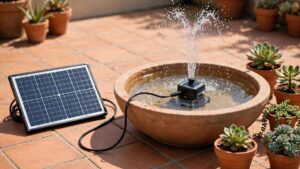
A raised pond changes the job a solar fountain pump has to do. The water sits above ground level inside a wall, a timber frame, a stock tank, or a masonry surround, and the display point — a nozzle, a small spout, or the top of a short riser — sits higher still. A pump that looks lively in a shallow bowl at ground level can produce a thin, uneven trickle once it has to push water up the inside of a raised wall and out through a fitting. That is why the search for the best solar fountain pumps for raised pond water features should start with two plain questions: how far does the water have to climb, and does the kit store any energy for the moments when a cloud crosses the sun?
Those two questions shape everything in this guide. The first is about lift and flow. A maximum lift figure, where a product page lists one, describes the highest point the pump can push water to under the conditions the maker states; it is not a promise of a strong display at that height. A maximum flow figure describes output with little or no climb involved. None of the product pages opened for this guide lists a flow-at-head figure or a performance curve showing output at a specific working height, and this article says so plainly wherever that gap matters, rather than filling it with invented numbers. The second question is about battery status, and the answers vary more than marketing language suggests: some kits in this set carry a built-in battery, and some have no battery at all and run only while direct sun reaches the panel.
The six kits below were chosen for raised features specifically. Kits with a separate panel, a length of tubing, and a submersible pump suit a raised wall well, because the panel can sit in open sun on top of the wall or on a nearby stake while the pump stays below the waterline. Floating one-piece fountains are included too, but with a clear warning: a floating unit sits on the water surface, so it adds spray at surface level and does not, by itself, lift water to a spout mounted higher up the wall. Reading each entry with your own wall height and outlet position in mind will matter more than any single headline wattage figure.
Quick verdict
For a raised feature where the outlet sits above the waterline, the Antfraer 8W kit leads this set: the product page lists a built-in 3600mAh battery, dry-run protection, double-layer nozzles, and 5 feet of tubing, which is the combination a raised wall usually needs. The Biling 5.5W kit is the only entry here with a maximum lifting height stated on its opened page, at 33 inches, and its page confirms batteries are included. The AISITIN 6.5W floating fountain offers a 3000mAh battery, 10 nozzles, and a remote control for surface-level display inside a wide raised basin. The SZMP 3.5W is a smaller glass-panel floating unit with a built-in battery listed at 2000 and filter sponges in the box. The AISITIN 1.5W DIY kit and the Mademax 1.4W fountain are the direct-sun entries: neither carries a battery, both pause when the sun leaves the panel, and both suit modest spray at or near the water surface rather than a tall climb.
| Product | Key spec | Best for |
|---|---|---|
| Antfraer 8W Solar Fountain Pump | Built-in 3600mAh battery; 5 ft tubing listed | Raised outlets above the waterline |
| Biling 5.5W Solar Fountain SP055B | Maximum lifting height 33 inches listed | Measured climbs inside a raised wall |
| AISITIN 6.5W Solar Fountain Pump | 3000mAh battery; 10 nozzles listed | Wide raised basins with surface spray |
| SZMP 3.5W Solar Fountain | Built-in 2000 battery; 7 nozzles listed | Smaller raised basins with a glass panel |
| AISITIN 1.5W DIY Solar Water Pump Kit | Panel 7V/1.5W; maximum water height 71 cm listed | Low, simple DIY raised displays in full sun |
| Mademax 1.4W Solar Fountain Pump | Maximum flow 160 L/H listed; no battery | Small raised bowls in steady direct sun |
How we chose
The starting point was the shape of a raised feature itself. The pump sits in water contained above ground, the panel needs open sky, and the display point is often partway up or at the top of the surrounding wall. Kits were therefore sorted into two honest groups. The first group is made up of kits with a separate pump and tubing, where water can be carried from the submerged pump to an outlet positioned higher than the surface. The second group is made up of floating fountains, where the panel and pump move together on the surface and the spray starts at surface level. Both groups appear below, and each entry states which group it belongs to, because treating a floating fountain as if it were a lift pump is the most common buying mistake for raised water.
Battery status was recorded exactly as each opened product page lists it. Where a page states a built-in battery or confirms that batteries are included, the entry says so and gives the capacity the page lists. Where a page describes a pump powered by direct sunlight with no battery mentioned, the entry says there is no battery and that the kit is direct-sun only. No entry in this guide describes a battery as included when the page does not, and no entry assumes that a battery can be added later unless the page itself says so. This matters for raised features because a battery-backed kit keeps a steadier spray through passing cloud, while a direct-sun kit rises and falls with the light.
Lift and flow were handled with the same strictness. Only figures printed on the opened pages are used. The Biling page lists a maximum lifting height, the Mademax page lists a maximum flow and a maximum spray height, and the AISITIN DIY page lists a maximum water height. Several pages list no flow figure and no lift figure at all, and those entries say that plainly instead of estimating. Spray height and lift are also kept separate throughout: a spray height describes how high a free jet rises above the nozzle, while lift describes how high the pump can push water through a tube or riser before it comes out. A tall spray figure does not mean a pump can feed a spout at that height on a raised wall.
Noise was left out of the scoring entirely, because none of the opened pages lists a decibel figure for these kits. Panel and cord details were noted where a page lists them, since a raised wall often casts shade across its own water at some point in the day, and a panel that can be moved to the sunny side of the structure is easier to live with than one fixed to the pump. No product in this set appears on any recall list applied to this programme, and every model named below is a specific kit sold on Amazon US and verified on a page that was actually opened.
Antfraer 8W Solar Fountain Pump
- Solar panel power: 8W, as listed in the product name on the product page
- Battery status: built-in 3600mAh battery backup, as listed on the product page; battery included as part of the kit
- Tubing: 5 ft tubing listed on the product page
- Nozzles: double-layer nozzles listed on the product page
- Protection: dry-run protection listed on the product page
- Flow and lift: the product page opened for this kit lists no maximum flow figure and no maximum lift figure, so neither is stated here
The Antfraer leads this set because its listed parts match the geometry of a raised feature. A separate pump with 5 feet of tubing can sit low in the raised basin while the tubing carries water up to a nozzle or spout set into the wall, and the built-in battery is there to smooth out the dips that passing cloud would otherwise cause at the outlet. The product page lists dry-run protection, which is relevant in a raised structure where evaporation and splash loss can drop the water level faster than owners expect, and where a pump left running in shallow water can be damaged. Because the page lists no lift and no flow figure, buyers should treat the working height conservatively: keep the outlet modestly above the waterline, route the tubing with gentle bends, and expect the display to weaken as the outlet rises, even though the page gives no number for that fall-off.
Pros: Built-in battery listed for steadier output through cloud; tubing listed for feeding a raised outlet; dry-run protection listed on the page
Cons: No lift or flow figure listed on the opened page; battery capacity is modest for long dull spells; output at a high outlet cannot be judged from listed figures
Biling 5.5W Solar Fountain SP055B
- Solar panel power: 5.5W size listed on the product page
- Battery status: battery backup listed in the product name, with a 3000mAh capacity stated there; the product page also lists Batteries Included as Yes and battery cell type as NiMH
- Maximum lifting height: 33 inches, as listed on the product page
- Tubing: 5 ft tubing listed in the product name on the product page
- Nozzles: 5 nozzles listed in the product name on the product page
- Model number: SP055B, as listed on the product page
- Flow: the product page opened for this kit lists no maximum flow figure, so none is stated here
The Biling is the most useful entry in this set for planning, because it is the only one whose opened page states a maximum lifting height. A figure of 33 inches gives a raised-pond owner a concrete ceiling to design against: the vertical distance from the pump outlet to the display point should stay well inside that figure, because a maximum is reached under favourable sun and with output reduced to a small stream. The confirmed battery status also matters. The page lists batteries as included rather than sold separately, and names the cell type, so the kit arrives as a battery-backed unit without a second purchase. With 5 feet of tubing and 5 nozzles in the box as listed, the kit covers the common raised layouts, from a nozzle at the top of a low wall to a short spout partway up a taller surround, provided the actual climb stays modest.
Pros: Only kit here with a maximum lift figure listed on its page; batteries confirmed as included on the page; tubing and nozzle set listed in the box
Cons: No flow figure listed, so display strength at working height is unlisted; 33-inch maximum leaves little room for tall walls; NiMH cell type listed rather than lithium
AISITIN 6.5W Solar Fountain Pump with LED Lights
- Solar panel power: 6.5W, as listed in the product name on the product page
- Battery status: 3000mAh battery listed in the product name on the product page; battery included as part of the kit
- Nozzles: 10 nozzles listed in the product name on the product page
- Features listed: colourful LED lights, anti-drift brackets, and remote control, all as listed in the product name on the product page
- Flow and lift: the product page opened for this kit lists no maximum flow figure and no maximum lift figure, so neither is stated here
This AISITIN is a floating fountain, and it should be bought as one. Inside a wide raised basin — a large stock tank, a broad masonry pond, or a raised liner pond with plenty of surface — a floating unit with a built-in battery can keep a lively surface display going through brief shade, and the anti-drift brackets listed on the page help hold it in position instead of letting it wander to one edge and splash the wall. The 10 nozzles listed give a wide choice of spray shapes at surface level, and the LED lights and remote control listed on the page are convenience features for evening viewing. What this kit does not do is lift water to a raised spout: the page lists no lift figure and the design sprays from the surface, so a raised feature designed around a high outlet still needs a separate pump-and-tubing kit such as the two entries above.
Pros: Battery listed in the kit for surface spray through passing cloud; largest nozzle count listed in this set; anti-drift brackets and remote control listed on the page
Cons: Floating design does not feed a raised outlet; no lift or flow figure listed on the opened page; lights add draw on a modest battery
SZMP 3.5W Solar Fountain
- Solar panel power: 3.5W, as listed in the product name on the product page
- Battery status: built-in 2000 battery, as listed in the product name on the product page; the page lists the battery as built in rather than sold separately
- Panel: glass panel, listed as a 100 percent glass panel in the product name on the product page
- Included components: 1 solar fountain, 7 nozzles, 4 fixators, and 3 filter sponges, as listed on the product page
- Dimensions: 6.7 x 6.5 x 1.97 inches, as listed on the product page
- Warranty: the product page lists a 1 year warranty description
- Flow and lift: the product page opened for this kit lists no maximum flow figure and no maximum lift figure, so neither is stated here
The SZMP occupies the same floating category as the larger AISITIN, in a smaller body. Its listed size suits a compact raised basin where a 6.5W floating unit would crowd the surface, and the filter sponges listed in the box are a practical touch for raised ponds, which collect wind-blown dust and leaf fragments against their walls. The glass panel listed on the page is the surface that faces the sky all day, and the fixators listed among the components are there to hold the unit in place on the water. As with the AISITIN above, the honest limits are the same: the page lists no lift and no flow, the spray begins at the surface, and the built-in battery listed at 2000 is a buffer for passing cloud rather than a store for long evening runs. Buy it for a small raised basin where surface movement is the goal, not for feeding a spout.
Pros: Built-in battery listed in a compact floating body; filter sponges and fixators listed in the box; glass panel listed on the page
Cons: No lift or flow figure listed on the opened page; floating design cannot supply a raised outlet; smaller panel gathers less energy in weak light
AISITIN 1.5W DIY Solar Water Pump Kit
- Solar panel power: 7V/1.5W, as listed on the product page
- Pump power: 7V/1W, as listed on the product page
- Solar panel size: 16 cm x 16 cm, as listed on the product page
- Maximum water height: 71 cm, as listed on the product page; the page lists this as water height, not as a lift figure
- Battery status: no battery; the product page describes the pump as powered by direct sunlight, so this kit is direct-sun only
- Minimum water depth: 2.5 cm, as listed on the product page
- Lifespan: 10,000 hours, as listed on the product page; start delay of 3 seconds also listed
- Flow and lift: the product page opened for this kit lists no maximum flow figure and no maximum lift figure, so neither is stated here
- Package: 1 solar fountain, 6 nozzles, 1 connector, and 1 adapter, as listed on the product page
The smaller AISITIN DIY kit is the simplest separate arrangement in this set: a small panel, a small pump, and a set of nozzles for a modest display. For a low raised feature — a shallow raised bowl, a small tank with a low rim, or a table-height basin — a maximum water height of 71 cm as listed can be enough for a gentle jet, provided the owner accepts the direct-sun behaviour that the page describes. When the sun is on the panel, the pump runs; when cloud or the shadow of the raised wall crosses the panel, the display falls back or stops, because there is no battery in this kit to bridge the gap. Panel placement therefore does much of the work: the small 16 cm square panel needs a spot that stays in open sun for the hours the display is wanted, which on a raised structure often means the top of the sunny wall rather than beside the water.
Pros: Separate DIY arrangement with 6 nozzles listed; panel and pump figures both listed on the page; low minimum water depth listed for shallow raised bowls
Cons: No battery, so the display stops when direct sun leaves the panel; no lift or flow figure listed on the opened page; small panel and pump suit only modest displays
Mademax 1.4W Solar Fountain Pump
- Solar panel: 7V/1.4W, with a panel diameter of 16 cm (6.3 inches), as listed on the product page
- Pump input: brushless pump input DC 4.5-10V, as listed on the product page
- Maximum pump flow: 160 L/H, as listed on the product page
- Maximum water spray height: 70 cm (27.55 inches), as listed on the product page; the page lists this as spray height, not as a lift figure
- Battery status: no battery; the product page states the fountain will only work under direct sunlight, so this kit is direct-sun only
- Nozzles: 6 nozzles, as listed in the product name on the product page
- Model number: AS10B, as listed on the product page
- Lift: the product page opened for this kit lists no maximum lift figure, so none is stated here
The Mademax is the smallest kit in this set, and its listed figures describe a small, honest job. A maximum flow of 160 L/H and a maximum spray height of 70 cm, both as listed on the page, are figures for a free jet at the surface in direct sun, and the page is clear that the fountain only works under direct sunlight. In a raised setting, that makes this a surface accent for a small raised bowl or the top tier of a raised feature where the water is already at the height the viewer sees. It is not a way to move water up a wall, and the page lists no lift figure to suggest otherwise. Its strengths are simplicity and size: the floating unit drops onto the water, starts in sun, and needs no tubing run, no panel stake, and no outlet fitting, which suits owners who want movement on a small raised surface and nothing more.
Pros: Flow and spray height figures both listed on the page; very small floating body for tight raised bowls; 6 nozzles listed for spray choice
Cons: No battery, so output follows the sun exactly; no lift figure listed and the design does not feed a raised outlet; small flow limits the display to modest spray
Buying guide
Start with a tape measure, not with wattage. Measure the vertical distance from the water surface in your raised pond to the point where water should come out. Then add the distance from the submerged pump up to the surface if the outlet draws from the pump position, and keep the total climb in view while reading every product page. Where a page lists a maximum lift, treat that number as a ceiling reached with a thin stream in strong sun, and design well inside it. Where a page lists no lift figure at all, as several pages in this set do, the honest response is to keep the climb small or choose a different kit, not to assume the pump will cope because its panel wattage looks large.
Separate spray height from lift in every comparison. A spray height describes a free jet rising into the air from a nozzle at the surface; gravity is the only load. Lift describes work against gravity inside a tube or riser, and friction in the tubing adds to that load, more so with narrow tubing, long runs, and sharp bends. A kit can list an appealing spray height and still be a poor choice for a spout halfway up a raised wall. If your design has the outlet above the waterline, look for a separate pump, listed tubing, and a listed lift figure first, and treat everything else as secondary.
Decide how much the display should care about cloud. A built-in battery, where a page lists one, stores energy while the sun is strong and spends it when light dips, which keeps a raised spout running more evenly and can extend a display into the early evening. Battery capacity is listed in this set in milliamp hours, and larger figures store more, but no page here promises all-day running from its battery alone, and this guide does not claim it either. A kit with no battery is not a faulty kit; it is a simpler one whose display honestly follows the weather. Choose it when the raised feature sits in open sun for most of the day and a pause under cloud is acceptable.
Place the panel for the shadow your own structure casts. A raised wall shades its water in the morning or the afternoon depending on orientation, and a floating fountain drifts into that shade with the water it sits on. A separate panel on a stake or a wall-top mount can stay in the sun while the pump stays submerged, which is one reason separate kits suit raised features so well. Check what each page lists for cord and tubing before buying, route tubing up the inside of the wall where it is hidden and protected, and keep bends wide so the pump is not working against a kink as well as a climb.
Plan for falling water levels and simple upkeep. Raised ponds lose water to splash and evaporation, and several kits in this set list dry-run protection or low-water behaviour on their pages; where a page lists such protection, it is noted in the entry above, and where it does not, the entry does not claim it. Keep the pump below the lowest level the water normally reaches, top the pond up in hot spells, and lift the pump out on a regular rhythm to clear the intake of the algae, dust, and leaf matter that collect against raised walls. No page opened for this guide lists a decibel figure, so sound cannot be compared from listed figures; if a quiet corner matters, that is a question to put to the seller rather than a figure to guess at.
Finally, match the kit to the feature you actually built. A wide raised basin that needs surface movement can use a floating fountain well. A raised wall with a spout, a drilled outlet, or a small upper tier needs a pump-and-tubing kit with a listed lift that covers the climb. A tiny raised bowl in full sun can be served by the smallest direct-sun kits in this set. Buying the shape of kit that matches the shape of the feature matters more than buying the largest panel in the list.
FAQ
Can a floating solar fountain feed a spout on a raised wall?
No, not in the way a raised spout needs. A floating fountain sprays from the water surface where it floats, and the floating pages opened for this guide list no lift figure. Feeding a spout set into a raised wall calls for a separate submerged pump with tubing, and for a lift figure on the product page that covers the climb from pump to spout with room to spare.
What does maximum lift mean for a raised pond?
Maximum lift is the highest point the maker lists for the pump to push water to, under the conditions on the product page. It is a ceiling, not a working height: output falls as the climb grows, and at the maximum the flow is small. None of the pages opened for this guide lists flow at a specific working height, so the sound approach is to keep the outlet well below the listed maximum and accept a gentler display near the top of the range.
Do these solar fountain kits need a battery?
Some do and some do not, and each entry above states the position exactly as its page lists it. Kits with a built-in battery listed keep a steadier spray through passing cloud. Kits with no battery run only while direct sun reaches the panel and pause when it does not. A battery is not listed as sold separately for any kit in this set; where a kit has one, the page lists it as built in or included.
Why does the spray from a raised feature look weaker than the listed spray height?
Because spray height and working climb are different loads. The listed spray height is measured on a free jet at the surface. In a raised feature the pump may also be pushing water up tubing to an outlet, and that climb, plus friction in the tubing, uses part of the pump output before any spray forms. Weak sun lowers output further, and a battery-free kit has no stored energy to cover the dip.
Where should the solar panel go on a raised pond?
In the longest stretch of direct sun you can give it, clear of the shadow the raised wall itself casts. For separate kits, that often means the top of the sunny wall or a stake beside the structure, with the pump submerged below. For floating fountains, the panel moves with the unit, so the basin itself needs a sunny position, and brackets or fixators listed on some pages help hold the unit in the sunny part of the surface.
How often should the pump in a raised pond be cleaned?
On a regular rhythm rather than a fixed promise, because raised ponds gather dust, algae, and leaf fragments against their walls and intakes narrow gradually. Lift the pump out, clear the intake and any filter sponge the kit lists, and check the tubing run for kinks or growth at the same time. A display that fades over days in steady sun is often a clogged intake rather than a failing panel.
Conclusion
A raised pond rewards a buyer who reads product pages literally. Choose the kit shape first: a separate pump with tubing for any outlet above the waterline, or a floating fountain for surface spray inside a raised basin. Then read the battery line exactly as the page writes it, because the difference between a built-in battery and no battery at all decides how the display behaves every time a cloud crosses. Then respect the lift figures that are listed, note plainly where no lift or flow figure is listed at all, and keep the working climb well inside any maximum. Judged that way, the Antfraer 8W leads this set for raised outlets, the Biling 5.5W offers the only listed lift figure to plan against, and the remaining kits each serve a clear, narrower job, from wide-basin surface spray to the smallest direct-sun accent on a raised bowl.

Write Your Review
No reviews yet. Be the first to share your experience!