
Key takeaways
- Extra long window boxes for winter evergreen displays, with documented lengths, mounting, drainage and reservoir details for five-foot and six-foot picks today.
What's inside
As an Amazon Associate I earn from qualifying purchases. This post may contain affiliate links at no extra cost to you.
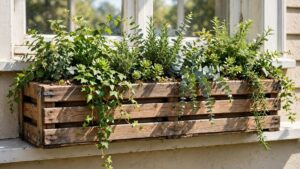
A winter window display lives or dies on scale. A short box under a wide window tends to look like a token gesture once the summer annuals are gone, while a long box can carry a steady line of evergreen foliage from one end of the sill to the other. Dwarf boxwood, small upright conifers, heuchera, trailing ivy and winter pansies all read better when they have room to repeat in a rhythm, and repetition is exactly what an extra long planting run makes possible. Shoppers looking for the best extra long window boxes for winter evergreen displays are usually working with a wide front window, a pair of windows that read as one, or a long low sill where two short boxes would leave an awkward gap in the middle.
Length, however, is only useful when it is documented for the exact model, and when the box can be mounted soundly along its whole span. A five-foot or six-foot box filled with damp potting mix and evergreen shrubs is a considerable load hanging on brackets, so the number of brackets, the wall surface, and the drainage path matter as much in January as the planting plan does. Cold rain, short days and long gaps between waterings also change what a winter display needs from a container. This guide works through six extra long models with documented lengths, from a 72-inch vinyl kit that can be cut to a custom fit down to a 48-inch double-wall box, and explains how to plant and maintain an evergreen display through the winter months using only the material, mounting and drainage wording the makers themselves list.
Quick verdict
The Mayne Yorkshire 6 FT Window Box (4826) is the longest documented pick here at 72 inches, and its vinyl panels can be cut to custom lengths, which makes it the natural lead choice for a very wide window or a run that needs trimming to fit between shutters. The Mayne Fairfield 5 FT Window Box (5824) and the Mayne Nantucket 5 FT Window Box (4832) both give a full 60 inches with double-wall construction and an integrated sub-irrigation water system, differing mainly in width and panel styling. The Mayne Horizon 5 FT Window Box adds a modern woodgrain look at 60 inches with four wall mount brackets listed in its spec sheet. The 60 inch Parisian Window Box Planter from Windowbox is the metal entry, in wrought iron and black, for gardeners who prefer an open cage style used with a liner. The Mayne Cape Cod 4 FT Window Box (4841), at 48 inches, is the shortest pick and suits a single wide window where a five-foot box would crowd the trim. None of these boxes should be chosen on length alone: check the bracket count, the reservoir or drainage arrangement, and whether the planting will stay in place all winter before ordering.
| Product | Key spec | Best for |
|---|---|---|
| Mayne Yorkshire 6 FT Window Box (4826) | 72 x 12 x 10 inches, vinyl, panels can be cut | Best for very wide windows and custom fits |
| Mayne Fairfield 5 FT Window Box (5824) | 60 x 11 x 10.8 inches, double wall, sub-irrigation | Best for a classic five-foot evergreen run |
| Mayne Nantucket 5 FT Window Box (4832) | 60 x 11.5 x 10 inches, double wall, sub-irrigation | Best for a wider planting trough at five feet |
| Mayne Horizon 5 FT Window Box | 60 x 9 x 10 inches, 17 gallon soil capacity, 4 brackets | Best for a modern woodgrain finish |
| 60 inch Parisian Window Box Planter | 60 inches, metal and wrought iron, black | Best for a liner-based metal display |
| Mayne Cape Cod 4 FT Window Box (4841) | 48 x 11 x 10.8 inches, double wall, sub-irrigation | Best for a single wide window |
How we chose
Length came first, and it had to be documented for the exact model on a page opened for this guide. That rule is stricter than it sounds. Many window boxes are sold in families where a listing headline covers several sizes at once, and a shopper can easily carry a dimension from the largest variant into a plan for a smaller one. Each pick below is tied to a named model and a stated length: 72 inches for the Yorkshire 6 FT, 60 inches for the Fairfield 5 FT, the Nantucket 5 FT, the Horizon 5 FT and the Parisian, and 48 inches for the Cape Cod 4 FT. Where a maker catalog lists a whole size range, the dimensions used here are the row for that specific model, not a neighbouring size.
Mounting came second. A long box spreads its load across brackets, so the product page lists and maker documents were read for what is included in the box. The Mayne window boxes in this guide list steel wall mount brackets and mounting hardware as included, and the Horizon spec sheet states a bracket count for the five-foot size. The Parisian listing, by contrast, lists no assembly, which suits a cage style that is hung or set in place and used with a liner the gardener supplies. Those differences shape the buying advice: a box with included brackets still needs a sound wall and correct fixings, while a cage style needs a liner and a support plan worked out before planting.
Materials and water handling came third, because a winter evergreen display stays outdoors for months. The maker lists polyethylene and vinyl across the Mayne range, double-wall construction on the Fairfield, Nantucket and Cape Cod, and an integrated sub-irrigation water system on those same models plus the Yorkshire. The Horizon spec sheet describes high-grade luxury vinyl and Sure Fit assembly. For the Parisian, the product page lists metal and wrought iron in black. No claim in this guide goes beyond that wording. In particular, nothing here states that a box shields roots from frost. Winter suitability is discussed only in terms of the materials, mounting and drainage arrangements the makers list, plus ordinary planting practice that any gardener can apply, such as siting, watering before a cold snap arrives, and keeping drainage paths clear.
Mayne Yorkshire 6 FT Window Box (4826)
- Length: 72 inches, listed as 72 x 12 x 10 inches in the maker catalog
- Material: high grade vinyl, and the maker lists that this collection can be painted
- Water system: integrated sub-irrigation water system
- Assembly: ready-to-assemble kit with grooved panels; the maker lists assembly in approximately 10 to 15 minutes in the collection notes
- Fit: panels can be cut to custom lengths, and vinyl glue is provided to create a leak proof seal
- Mounting: steel wall mount brackets and mounting hardware included
- Surface: built-in UV inhibitors listed
At six feet, the Yorkshire is the box that turns a wide front wall into one continuous evergreen line. Three or four dwarf conifers can be spaced evenly with low heuchera or ivy between them, and the 12-inch width gives a slightly deeper planting profile than the five-foot Mayne boxes below. Because the panels can be cut, a run that measures a little under six feet between shutters does not force a jump down to a five-foot box. The trade-off is work at the start: this is a kit to assemble and glue, not a one-piece molding, and a painted finish, if wanted, is a job for the gardener rather than a factory option beyond the listed white. For a winter display that will be seen from the street every day, that extra length and the cut-to-fit option are worth the assembly time.
Pros: Longest documented length in this guide at 72 inches; panels can be cut to custom lengths; steel brackets and hardware included; vinyl can be painted to match trim.
Cons: Kit assembly and gluing are required before planting; a six-foot span needs a long, sound mounting surface; corbels and deck rail brackets are optional extras rather than included parts.
Mayne Fairfield 5 FT Window Box (5824)
- Length: 60 inches, listed as 60 x 11 x 10.8 inches in the maker catalog
- Construction: double wall construction
- Water system: integrated sub-irrigation water system
- Mounting: steel wall mount brackets and mounting hardware included
- Surface: built-in UV inhibitors listed
- Options: deck rail brackets designed for a 2×4 or 2×6 hand railing are listed as an optional extra, and decorative corbels are listed as compatible
The Fairfield is the settled, classic choice at five feet. Its inset panel styling reads like painted wood from the street, which pairs well with traditional evergreen planting: a row of dwarf boxwood with ivy trailing at the front edge is the obvious scheme, and the 60-inch run is long enough for five small shrubs without crowding. The double-wall build and the sub-irrigation system are the practical points for winter. The reservoir arrangement described by the maker means water is held below the planting zone rather than relying only on top watering, which helps even out the long gaps between waterings that cold, dark weeks tend to create. Gardeners should still check soil moisture by hand through winter, since evergreen foliage keeps drawing water on bright, windy days even when growth is slow.
Pros: Full 60-inch length with double-wall construction; integrated sub-irrigation water system; brackets and hardware included; classic panel styling suits traditional facades.
Cons: At 11 inches wide it offers less planting depth than the Yorkshire; deck rail mounting needs brackets bought separately; the reservoir does not remove the need for moisture checks in winter.
Mayne Nantucket 5 FT Window Box (4832)
- Length: 60 inches, listed as 60 x 11.5 x 10 inches in the maker catalog
- Construction: double wall construction
- Water system: integrated sub-irrigation water system
- Mounting: steel wall mount brackets and mounting hardware included
- Surface: built-in UV inhibitors listed
- Options: decorative corbels listed as an optional extra compatible with Nantucket window boxes; deck rail brackets listed as optional
The Nantucket matches the Fairfield on length and on the core water and mounting package, but it is a touch wider at 11.5 inches and a touch lower at 10 inches. That half inch of extra width is not a headline on its own, yet in a winter scheme it gives trailing plants a fraction more room to spill and lets a staggered planting, taller conifers at the back and low spreaders at the front, sit more comfortably. The beadboard-style face of the Nantucket line suits cottages and coastal-style homes, and it carries a mixed evergreen planting well: small spruce or juniper at intervals, with heuchera foliage holding colour between them. As with the Fairfield, the honest way to describe the winter benefit is narrow and factual: the maker lists double-wall construction and a sub-irrigation system, and the gardener supplies the siting, planting and watering judgement around them.
Pros: 60-inch length with the widest profile among the five-foot Mayne picks; double-wall construction; sub-irrigation system and included steel brackets.
Cons: Slightly lower height than the Fairfield at 10 inches; corbels and rail brackets are separate purchases; five feet of planted box is heavy to lift into place, so mounting is a two-person job.
Mayne Horizon 5 FT Window Box
- Length: 60 inches, listed as 60 x 9 x 10 inches on the maker spec sheet
- Material: high-grade luxury vinyl, per the spec sheet
- Soil capacity: 17 gallons, per the spec sheet
- Weight: 27 pounds, per the spec sheet
- Mounting: 4 wall mount brackets included for the 5 ft size, per the spec sheet
- Assembly: Sure Fit assembly, per the spec sheet
- Style: woodgrain panels with a charcoal finish on the listed variant
The Horizon is the modern entry in this line-up. Where the Fairfield and Nantucket borrow from traditional panel and beadboard styling, the Horizon uses clean lines and a woodgrain panel look in charcoal, which sets off silver-green foliage such as lavender, dwarf blue spruce and variegated euonymus particularly well. Its spec sheet is unusually direct about the numbers a winter planter needs: a 17-gallon soil capacity gives evergreen roots a shared body of mix, and four wall mount brackets are listed for the five-foot length, so the load is spread at four points rather than carried on a pair. At 9 inches wide it is the narrowest box here, which suits a slim sill or a facade where a deep box would crowd a walkway, but it also means large root balls will not fit; choose compact evergreen cultivars sold in small pots for this one.
Pros: Documented 60-inch length with four brackets listed for the size; generous 17-gallon soil capacity; modern woodgrain styling in charcoal; Sure Fit assembly.
Cons: Narrowest planting width in this guide at 9 inches; 27-pound box weight before soil is added; the charcoal finish limits colour matching on pale facades.
60 inch Parisian Window Box Planter
- Length: 60 inches, per the product title on the product page
- Brand: Windowbox, per the product page
- Material: metal and wrought iron, per the product page
- Colour: black, per the product page
- Assembly: the product page lists assembly required as no
The Parisian is the different route to a five-foot winter display. Instead of a molded trough, it is a black wrought iron style cage, the kind used with a coir or fabric liner, or with individual pots set inside the frame. That arrangement has real advantages for winter evergreens. Plants can be lifted out and swapped without disturbing their neighbours, a tired specimen can be replaced in minutes, and excess water drains freely through a liner rather than sitting in a sealed base. The disadvantages are the mirror image: a liner-based box dries out faster than a reservoir box, holds less soil around each root ball, and the liner itself is a consumable that will need replacing over time. The product page lists no assembly, so the work is in hanging the cage level and choosing a liner that fits its depth. For a gardener who likes to rearrange a display through the season, this is the most flexible five feet in the guide.
Pros: True 60-inch metal cage in black wrought iron styling; no assembly listed; plants in liners or pots can be swapped individually; free drainage through a liner.
Cons: Liner or pots are needed to hold soil and are not the box itself; dries out faster than the reservoir models; the product page gives limited dimension detail beyond the 60-inch length.
Mayne Cape Cod 4 FT Window Box (4841)
- Length: 48 inches, listed as 48 x 11 x 10.8 inches in the maker catalog
- Construction: double wall construction
- Water system: integrated sub-irrigation water system
- Mounting: steel wall mount brackets and mounting hardware included
- Surface: built-in UV inhibitors listed
- Options: decorative corbels listed as compatible, and deck rail brackets listed as an optional extra
Four feet may sound modest beside the six-foot Yorkshire, but 48 inches is still twice the length of the small boxes sold for single narrow windows, and for one wide window it is often the proportion that looks right: long enough for three dwarf conifers with planting between them, short enough to sit within the trim without crowding the shutters. The Cape Cod carries the same core package as its five-foot Mayne relatives, with double-wall construction, an integrated sub-irrigation water system and included steel brackets, so choosing it is a sizing decision rather than a step down in features. It is also the most manageable install here. A 48-inch box is easier for one person to handle during mounting, and it suits a first long-box project before committing to a five- or six-foot span on a front wall.
Pros: Same double-wall and sub-irrigation package as the longer Mayne picks; included steel brackets and hardware; easier handling and mounting at 48 inches.
Cons: Shortest length in this guide, so very wide windows may still show gaps at the ends; holds fewer evergreen plants in a repeating pattern; rail mounting needs optional brackets.
Buying guide
Start with the window, not the catalog. Measure the full width of the window including its trim, then decide how the box should sit against that width. A box that runs close to the full width of the trim gives the strongest winter line, while a box a few inches narrower at each end looks deliberate and leaves room for shutters or corbels. Write the measurement down and match it against documented model lengths: 72 inches for the Yorkshire 6 FT, 60 inches for the Fairfield, Nantucket, Horizon and Parisian models, and 48 inches for the Cape Cod. If the ideal length falls between sizes, the Yorkshire panels can be cut to custom lengths, per the maker, which is the only cut-to-fit option in this guide. Never assume a size from a product family headline; check the row, title or spec line for the exact model being ordered.
Next, plan the mounting before the planting. Every long box in this guide is a load-bearing install once it is filled with damp mix and evergreen shrubs. The Mayne boxes list steel wall mount brackets and mounting hardware as included, and the Horizon spec sheet lists four brackets for the five-foot size. Count the brackets for the model chosen, and think about what they will fix into: masonry, timber framing and siding over sheathing all call for appropriate fixings and a level line, and a long box shows a slope far more than a short one does. If the display is going on a deck railing instead of a wall, note that deck rail brackets are listed as an optional extra for the Mayne boxes, designed for a 2×4 or 2×6 hand railing. For the Parisian cage, plan the hanging points and the liner at the same time, since the cage alone holds no soil.
Then think about water in winter terms. Evergreens keep their foliage all winter, and foliage keeps losing moisture, especially on windy, bright days, so a winter display is not a plant-and-forget display. The reservoir models here, with the integrated sub-irrigation systems the maker lists for the Fairfield, Nantucket, Cape Cod and Yorkshire, hold water below the planting zone and can smooth out the gaps between checks. The Horizon lists a large soil capacity, 17 gallons on its spec sheet, and a bigger body of mix dries more slowly than a small one. The Parisian, draining freely through a liner, sits at the other end of the scale and will need the most frequent checking. Whichever box is chosen, drainage paths should stay clear through winter: a blocked outlet in freezing weather leaves mix waterlogged at exactly the moment roots are least active, and standing water that freezes and thaws repeatedly is hard on both mix structure and container joints. Check moisture with a finger pushed into the mix rather than working to a calendar.
Planting design is where a long box earns its keep. A repeating pattern reads best from the street: an upright dwarf conifer or a clipped boxwood ball at regular intervals, with lower planting between and at the ends. In a 60-inch box, three uprights with two low groups between them is a reliable rhythm; in the 72-inch Yorkshire, four uprights work. Trailing ivy or creeping jenny at the front edge softens the line, and heuchera holds foliage colour through much of winter in many climates. Keep plant sizes modest. Compact cultivars sold in small pots establish in a box far better than a large shrub forced into a narrow trough, and the Horizon's 9-inch width in particular calls for small root balls. Leave a little space between plants rather than packing the run solid on day one; evergreens in a winter display are chosen for structure, and structure needs air around it to read clearly.
Finally, be honest about what a box can and cannot do in winter. The makers of the picks here list materials, construction and water systems: polyethylene and vinyl bodies, double-wall construction on several models, built-in UV inhibitors, and reservoir systems. Those are the documented facts. No box in this guide is described by its maker as frost protection for roots, and this guide does not claim otherwise. Gardeners in cold regions can still take ordinary steps that sit outside any product claim: site the box on a wall that avoids the harshest wind, water the mix before a hard freeze arrives so roots are not dry going into it, group the display where it can be reached for checks, and accept that the hardiest compact evergreen cultivars suited to local conditions will always matter more than the container around them. Choose cultivars rated for a zone colder than the local one where possible, since roots in a box live in thinner insulation than roots in open ground, and treat that as planting judgement rather than a product feature.
Price and value need the same discipline as sizing. Long boxes cost more to ship and more to mount than short ones, and the extras differ by model: corbels, deck rail brackets and liners sit outside the headline item for several picks here. Add those pieces into the comparison before deciding, and remember that a reservoir model that suits the household's watering rhythm may serve a winter display better than a cheaper cage that dries unnoticed for a fortnight. The right choice is the one whose documented length fits the window, whose brackets fit the wall, and whose water arrangement fits the gardener's winter routine.
FAQ
How long should a window box be for a winter evergreen display?
Match the box to the window rather than to a fixed ideal. For a single wide window, 48 to 60 inches usually carries a repeating evergreen pattern well. For a very wide window or a pair of windows read as one frontage, the 72-inch Yorkshire in this guide gives a continuous line. What matters most is that the length is documented for the exact model, as each pick here is, so the planting plan is built on a real measurement.
Can these long boxes stay mounted all winter?
The makers list outdoor materials and construction for these models, including polyethylene and vinyl bodies, double-wall construction on the Fairfield, Nantucket and Cape Cod, and built-in UV inhibitors across the Mayne range. The Horizon spec sheet describes all-season durability in its feature wording. Staying mounted is therefore the intended use described by the makers, but the gardener still owns the practical side: sound fixings, clear drainage, and moisture checks through cold spells.
Will a long window box keep evergreen roots safe from frost?
No claim of that kind is made here, because the makers do not list frost protection as a product feature for these boxes. Double-wall construction and a large body of mix are documented facts, and ordinary practice such as watering before a freeze and choosing hardy compact cultivars can help a display through winter, but a window box should not be bought as a substitute for plant hardiness suited to the local climate.
How many evergreen plants fit in a five-foot box?
As a planning guide, three upright dwarf conifers or clipped boxwood, spaced evenly along 60 inches, with low heuchera, ivy or winter pansies between and at the ends, gives a balanced display without crowding. The 72-inch Yorkshire takes four uprights on the same spacing. Compact cultivars in small pots suit these boxes best, and the narrow Horizon, at 9 inches wide per its spec sheet, calls for the smallest root balls of all.
Do reservoir window boxes need watering in winter?
Yes, though usually less often than in summer. Evergreen foliage continues to lose moisture in winter, particularly in wind and sun, and the sub-irrigation systems listed for several picks here hold water below the planting zone rather than removing the need for water altogether. Check the mix by hand every week or so in cold weather, and water on a milder day when the mix is dry, so the water can soak in before night temperatures fall.
What if the window is an unusual width between standard sizes?
The Yorkshire line is the flexible option in this guide, because the maker lists that its panels can be cut to custom lengths, and the kit includes vinyl glue to create a leak proof seal at the joints. Measure carefully, plan the cut before assembly, and keep the bracket spacing even along the shortened run. For one-piece molded boxes such as the Fairfield and Nantucket, choose the documented size that sits best within the window trim instead of planning to alter the box.
Conclusion
An extra long window box changes a winter facade more than any other single container, because it replaces a small cluster of planting with a continuous evergreen line that holds its structure from the first cold weeks to the last. The six picks here cover the documented lengths that matter: 72 inches from the cut-to-fit Mayne Yorkshire 6 FT, a four-way choice at 60 inches between the double-wall Fairfield and Nantucket, the modern charcoal Horizon with its 17-gallon soil capacity and four listed brackets, and the open wrought iron style Parisian cage, plus the 48-inch Cape Cod for a single wide window. Choose by measured fit first, then by mounting, then by how the listed water system matches a realistic winter routine. Plant compact, hardy evergreens in a repeating rhythm, keep drainage clear and moisture checked, and a long box will carry a display through winter on the strength of its structure rather than on any promise a container cannot keep.
Write Your Review
No reviews yet. Be the first to share your experience!