
Key takeaways
- The seven vertical stackable planters tall enough to screen a balcony, with heights, pocket counts and weights to plan a living privacy wall that stays safe.
What's inside
As an Amazon Associate I earn from qualifying purchases. This post may contain affiliate links at no extra cost to you.
A balcony is overlooked almost by design: the neighbour's window, the next balcony along, the street below. A living screen solves it more kindly than a fence panel, and a stackable tower is the most plant-dense way to build one on a small floor. The best vertical stackable planters for privacy plants on balconies combine real height, enough pockets to close the gaps between plants, and a footprint that leaves room for a chair. A tower at 52 to 56 inches, planted with grasses, trailing herbs and leafy greens, puts a soft wall of foliage exactly where sight lines cross.
Privacy planting is a different brief from crop growing. Coverage matters more than yield, so pocket count and spacing decide how fast the screen closes, and the plants are chosen for habit: upright grasses and leafy fillers in the middle tiers, trailers over the edges to break the outline, and something evergreen or structural where winter cover matters. Weight matters too, because a filled tower is heavy and a balcony is a structure with limits. Every entry below states its filled or empty weight where the page gives one, and the buying guide covers the safety checks that come before the planting plan.
Specs come from the maker and retailer pages in the sources file. Heights are for the planter alone; the screen you actually get is planter height plus plant height, which the guide explains how to estimate before you buy.
Quick verdict
The GreenStalk 7 Tier Leaf Vertical Planter makes the most complete screen: 56 inches of tower, 42 pockets at 7 inches deep, and a 19 inch footprint that fits a balcony corner. Planted with grasses and trailers, it reads as a green column rather than a planter. The VECELO 5-tier framed bed, at about 52 inches with long boxes on a wheeled frame, suits a screen that must run along a railing rather than stand in a corner, and its casters let you roll the wall aside for cleaning or a storm.
For a lighter, cheaper screen, the 6-tier and 7-tier wheeled towers stack high on small footprints, and the Garden Tower 2 grows the densest planting of all, up to 50 plants around a compost core, at the cost of the greatest filled weight here. Check your balcony's load guidance before choosing it.
| Product | Key spec | Best for |
|---|---|---|
| GreenStalk 7 Tier Leaf Vertical Planter | 7 tiers, 42 pockets at 7 in deep, 19 in wide x 56 in tall | The tallest planted screen for a balcony corner |
| VECELO 5-Tier Vertical Raised Garden Bed with Wheels THD-ET-HPJ01-BLK | 52.36 in tall framed tiers, boxes 23.23 in long, locking casters | A movable screen running along a balcony railing |
| 6-Tier Stackable Vertical Planter Tower with Casters | 6 tiers, ABS body, casters for repositioning | Tall budget screen that can follow the sun |
| 7-Tier Stackable Vertical Planter with Wheels and Drainage | 7 tiers, PP body, drainage mesh per tier, bottom tray | Maximum tier count for a fast-closing screen |
| Amazing Creation 5-Tier Stackable Planter | 5 tiers, up to 15 plants, reservoir per level, separator grates | Neat mid-height screen with easy watering |
| Mr. Stacky 5-Tier 13 Inch Stackable Planter (1305) | 5 tiers, 20 pockets, 12 x 12 x 28 in, flow-through design | Compact screen for a small balcony corner |
| Garden Tower 2 | 50 plants, 43 in tall x 24.5 in wide, compost core, rotates | The densest possible living screen |
How we chose
Height and coverage set the shortlist. A privacy tower needs to reach at least chest height on its own so that planter plus plants break the sight line of a seated or standing neighbour, so every model here stands 28 inches or taller, with most at 38 inches and above. Pocket count came next, because a screen with gaps is just a planter: the entries state plant counts from 15 up to 50, and denser towers close cover in a single season.
Balcony practicalities filtered the rest. Footprint had to stay small, casters and wheels scored well because a screen that can move can be cleaned behind and sheltered in a storm, and stated weights were recorded wherever a page gives them so load can be planned. Watering design mattered because a screen against a railing is awkward to water from behind; top-down systems that feed every tier from one filling point were preferred. All figures trace to opened product pages in the pool for this group.
GreenStalk 7 Tier Leaf Vertical Planter
- Tiers: 7, with 42 pockets
- Pocket depth: 7 in each, the retailer lists
- Size: 19 in wide x 56 in tall
- Soil volume: 5.5 cu ft, about 42 gal of mix
- Material: food-grade, UV-resistant plastic, the maker lists
- Warranty: 5 year warranty on colour and functionality, the retailer lists
Fifty-six inches of tower on a 19 inch footprint is a privacy ratio few balcony planters can match. The Leaf line's 42 pockets at 7 inches deep suit leafy and trailing plants rather than deep-rooted crops, which is exactly the privacy palette: lettuce-leaf basil, trailing rosemary, nasturtiums, leafy herbs and ornamental grasses in the top tiers where their height adds most. Planted densely, the pockets disappear behind foliage by midsummer and the tower reads as a planted column.
The screen maths work in its favour. Fifty-six inches of planter plus 12 to 24 inches of plant growth breaks the sight line from a neighbouring balcony at seated and standing eye level, and the narrow round footprint tucks into the corner where two sight lines cross. Watering runs from the top reservoir, so the wall-facing side needs no access. In winter the tiers unstack for storage, or the tower can stay planted with hardy herbs in sheltered districts; either way, check the filled weight against your balcony guidance, because 42 gallons of wet mix is a serious load on a 19 inch circle, best placed near a load-bearing wall.
Pros:
- Tallest tower here at 56 in on a 19 in footprint
- 42 pockets plant densely enough to close gaps in one season
- Top watering needs no access behind the screen
Cons:
- Heavy when filled; position near a structural wall
- 7 in pockets suit leafy plants, not deep-rooted shrubs
VECELO 5-Tier Vertical Raised Garden Bed with Wheels THD-ET-HPJ01-BLK
- Model: THD-ET-HPJ01-BLK, the retailer lists
- Tiers: 5
- Overall size: 28.35 x 26.38 x 52.36 in
- Each box: 23.23 x 8.27 x 5.71 in
- Frame: powder-coated metal with PP plastic boxes
- Materials listed as UV-resistant
- Mobility: 4 swivel casters, 2 with brake locks
- Drainage: drainage grooves in each box
- Frame detail: reinforced X-frame
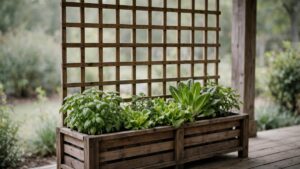
Where the GreenStalk is a column, the VECELO is a wall unit: five long boxes on a powder-coated frame, standing about 52 inches tall, each box 23 inches long. Run along a railing, it screens a length of balcony rather than a point, and the shallow, wide boxes suit the plants that make a soft screen at seated height, such as bushy herbs, dwarf grasses, chillies and trailing petunias woven through the tiers. The reinforced X-frame and locking casters keep the unit steady and let you roll it out to clean the balcony floor or bring it in from a storm warning.
The boxes are shallow at 5.71 inches deep, so this is a screen for fibrous-rooted, bushy plants rather than anything woody, and it will want regular watering in summer because shallow boxes dry quickly. Drainage grooves in each box stop the tiers from waterlogging in a wet spell. For privacy, plant the top box with the tallest grasses, the middle boxes dense and leafy, and let trailers from the second box soften the frame lines; the metal structure disappears behind growth by midsummer.
Pros:
- Long boxes screen a stretch of railing, not just a corner
- Locking casters make the screen movable for storms and cleaning
- Sturdy framed build at about 52 in tall
Cons:
- Shallow 5.71 in boxes dry fast and suit smaller plants
- Frame footprint is larger than a round tower
6-Tier Stackable Vertical Planter Tower with Casters
- Tiers: 6
- Material: ABS, the retailer lists
- Mobility: casters fitted
- Listed uses include succulents, the retailer lists
Six tiers on casters is a flexible privacy tool. The tower stacks high enough that, with upright plants in the top tiers, it closes the view from a higher neighbouring window, and the casters let the whole screen track the problem: rolled to the exposed end of the balcony in the morning, turned as the sun moves, and pushed flat against the wall when a storm is forecast. The retailer lists the body as ABS, a hard, smooth plastic that wipes clean, which matters on balconies where dust and city grime settle on everything.
The listing gives less detail than the branded towers here, so treat pocket depth and soil volume as figures to confirm on the product page before ordering, and plant accordingly with compact, fibrous-rooted screening plants: herbs, small grasses, trailing lobelia and ivy-style trailers that knit the tiers together. Keep the heaviest, wettest tiers low in the stack and the overall centre of gravity down, especially on a high balcony where a caster-mounted tower can catch the wind like a sail.
Pros:
- Six tiers give real screen height on a small footprint
- Casters let the screen move with the sun and the sight line
- Smooth ABS body wipes clean in dusty city air
Cons:
- Listing leaves pocket depth and volume unstated
- Caster towers need care in high wind on exposed balconies
7-Tier Stackable Vertical Planter with Wheels and Drainage
- Tiers: 7
- Material: PP, the retailer lists
- Drainage: drainage mesh in each tier
- Base: bottom tray
- Mobility: 4 casters
Seven tiers is the tallest stack in this roundup by count, and for privacy the count itself is the argument: more tiers mean more planting rows between you and the neighbouring window, and rows at close spacing close their gaps weeks earlier than a four or five tier tower planted the same way. Drainage mesh in each tier keeps every level from sitting wet, excess collecting in the bottom tray, and the four casters make the finished screen repositionable, which on a balcony is worth tiers of extra height.
The retailer lists the body as PP without detailed dimensions, so check the product page for the assembled height and pocket sizes before committing, and plan plants in the compact class: trailing and mounding herbs, small ornamental grasses, strawberries for an edible screen, and flowers for the face. Build the stack on the spot where it will stand, keep the planting densest at the eye-level tiers, and let the top tier carry the tallest grass so the screen's silhouette breaks well above the tower itself.
Pros:
- Seven tiers close a screen faster than any rival here
- Per-tier drainage mesh and a bottom tray manage runoff
- Casters make a tall screen movable
Cons:
- Listing gives few dimensions; confirm sizes on the product page
- Tall stacks need the heaviest planting kept low for stability
Amazing Creation 5-Tier Stackable Planter
- Tiers: 5
- Planting: up to 15 plants
- Pockets: fit 5 in plants, the retailer lists
- Material: polypropylene, crack and fade resistant, the retailer lists
- Watering: reservoir per level with a soil separator grate
The Amazing Creation stack holds up to 15 plants in five tiers, with a reservoir at each level separated from the soil by a grate. For a balcony screen that specification translates into reliability: each tier carries its own small water store, so the face of the screen stays evenly green instead of thriving at the top and crisping at the bottom, which is the usual failure of flow-down towers in a hot week. The polypropylene is listed as crack and fade resistant, suiting a tower that lives outdoors against a bright wall.
Fifteen plants will not close a screen alone in the first month, so plant it as the framework of the screen and weave trailers through it: one trailing plant per tier, allowed to fall across the face, closes gaps far faster than upright plants alone. Pockets fit 5 inch plants, so start with well-grown nursery stock rather than seedlings if the screen is needed by early summer. At five tiers the height suits screening a seated area, a reading chair zone or a low table, especially with a tall grass in the top pocket.
Pros:
- Per-level reservoirs keep the whole screen evenly watered
- Crack and fade resistant polypropylene for outdoor life
- Separator grates keep soil out of the water store
Cons:
- 15 plant capacity is the smallest count here
- Mid-height stack screens seated areas better than standing views
Mr. Stacky 5-Tier 13 Inch Stackable Planter (1305)
- Tiers: 5, with 20 pockets
- Soil capacity: 22.5 qt
- Size: 12 x 12 x 28 in
- Material: food-grade polypropylene, UV-resistant, the retailer lists
- Base: bottom saucer
- Watering: flow-through design
The 13 inch Mr. Stacky is the small-balcony answer: a 12 inch square footprint carrying 20 pockets in five tiers, 28 inches tall. On its own that height screens a seated person, and on a sturdy stand, a wide crate or a low table it becomes a standing-height screen without taking the floor space of the bigger towers. The flow-through design waters every pocket from the top pour, and the bottom saucer catches the excess, which protects the balcony floor and the neighbour below from drips, a real consideration in apartment blocks.
Twenty pockets at this size suit herbs, strawberries, small flowers and trailers, and a privacy planting should lean on the trailers: creeping thyme, trailing lobelia and small ivies knit across the pocket openings and turn a stack of pots into a green surface. The food-grade, UV-resistant polypropylene is listed by the retailer, and the whole stack lifts apart for winter storage or a deep clean. Keep it out of the windiest corner or weight the base, because a 12 inch footprint is a small stance for a planted tower in a gust.
Pros:
- 20 pockets on a 12 in square footprint
- Bottom saucer protects floors and neighbours from drips
- Lifts apart for storage and cleaning
Cons:
- 28 in height screens seated areas unless raised on a stand
- Small footprint needs shelter or ballast in wind
Garden Tower 2
- Planting: up to 50 plants
- Size: 43 in tall x 24.5 in wide
- Weight: 36 lb empty and about 220 lb filled, the reviewer lists
- Material: UV-stable, food-grade HDPE, the maker lists
- Core: central compost tube
- Drawer: 2 gal drawer at the base
- Movement: rotates 360 degrees
- Warranty: 5 year, the maker lists
The Garden Tower 2 is less a planter than a planted barrel: up to 50 plants around a central compost tube, in UV-stable food-grade HDPE, standing 43 inches tall and 24.5 inches wide. For privacy, density is destiny, and fifty planting pockets produce the fullest screen in this list, a genuine green wall segment that also grows salads and herbs. The compost core feeds the planting from inside, and the tower rotates 360 degrees, so the shaded face can be turned to the sun weekly and the screen grows evenly on every side, including the side facing the neighbours.
The figure that decides everything is about 220 lb filled. That is a load to place deliberately, close to a load-bearing wall or over a supporting structure, and only after checking the balcony guidance for your building. The 2 gallon drawer at the base collects the compost liquid, which dilutes into a feed for the tower itself. If the load check passes, this is the screen that also feeds you; if it does not, the GreenStalk 7 Tier gives a similar column effect at a fraction of the weight per pocket.
Pros:
- Up to 50 plants give the densest screen available here
- Rotates so every face grows evenly
- Compost core feeds plants and handles kitchen scraps
Cons:
- About 220 lb filled demands a proper balcony load check
- Largest footprint and the heaviest lift when servicing
Buying guide
Screen height is planter height plus plant height
Work out your sight line before choosing a tower. Sit in the chair you want to screen and note where a neighbour's eye level crosses your railing; for most balconies the screen needs to reach about 5 to 6 feet at that point. A 56 inch tower such as the GreenStalk 7 Tier needs only a modest grass or tall herb on top to get there. A 28 inch stack such as the small Mr. Stacky needs either tall plants, which its pockets cannot support, or a stand that raises the whole planter, which is why small towers are usually seated-area screens.
Plant height is not the number on the label alone. A grass in a top pocket grows from the pocket, so its full height counts. A trailer contributes downward cover, closing the middle of the screen where upright plants leave stems and gaps. The fastest-closing screens combine all three habits in layers: tall on top, dense and leafy in the middle, trailing over every edge.
Balcony load and wind: the two safety checks
A filled tower is heavy, and the weights in this list run from a few pounds of plastic to about 220 lb of planted Garden Tower 2. Balconies have load limits that vary by building and age, and the safe habit is to place heavy planters against the load-bearing wall, spread weight where possible, and check the building guidance before installing anything over about 100 lb in one spot. When in doubt, choose two lighter towers instead of one very heavy one; the screen effect is similar and the load is distributed.
Wind is the second check. A planted screen is a sail, and a high balcony funnels gusts. Towers on casters should have their brakes set and be turned or moved against a wall when storms are forecast. Tall narrow stacks belong in corners, and any tower raised on a stand must be fixed so the stand and planter move as one piece or not at all. A screen that ends up on the floor, or worse, over the railing, is a failure no amount of foliage makes up for.
Planting a screen that closes fast
Start with the structure plants in the top tiers: ornamental grasses, tall herbs such as rosemary where the climate suits, or a small fountain-shaped plant that arches over the rim. Fill the middle tiers densely, closer than you would plant for crops, because the goal is leaf cover, not individual plant size; leafy herbs, bushy flowers and salad greens all knit together within weeks. Then add trailers at every tier edge so growth falls across the pocket lines and the planter disappears behind the planting.
Feed and water for cover, not for harvest. A balanced liquid feed every couple of weeks through the growing season keeps the foliage coming, and top-watering towers should be watered slowly so every tier takes its share. Turn rotating or movable towers weekly so the neighbour-facing side is not the only one in shade; a screen that is lush on your side and thin on theirs does the job, but an even screen looks better from both sides and lasts longer.
Watering a screen you cannot walk behind
A screen usually stands against the railing, which means its back is unreachable. Choose watering systems that work from the front or the top: reservoir towers filled from above, flow-through stacks watered from the top pocket, and per-level reservoirs that only need the top-up to reach each tier in turn. The drip tray or saucer under the tower is not optional on a balcony; runoff that drips onto the balcony below is the fastest way to fall out with the neighbours the screen was meant to politely ignore.
In a hot week a dense screen drinks heavily, because fifty leaves transpire more than five. Check the bottom tiers as well as the top; in flow-down systems the top can look moist while the lowest pockets are dry if the water channels straight through. A finger in the lowest pocket tells the truth in two seconds.
FAQ
How tall does a balcony privacy screen need to be?
For most balconies, the screen should reach about 5 to 6 feet where it crosses the sight line between you and the neighbouring window or balcony. That total is planter plus plant: a 56 inch tower needs only a short grass on top, while a 43 inch tower such as the Garden Tower 2 needs taller top planting. Measure from your seated eye level in the chair you actually use, because a screen for a dining set and a screen for a sun lounger need different heights, and screening a standing view along a whole railing is a job for a long framed unit such as the VECELO rather than a single tower.
Will a stackable planter screen survive balcony wind?
A well-sited one will. Place tall stacks in corners or against walls, keep the heaviest planting low, set caster brakes, and move wheeled towers flat to the wall when a storm is forecast. The planted weight that makes towers a load question also makes them steadier than empty-looking screens and panels, which catch wind without ballast. Long framed units should run parallel to the railing they screen, fixed or braked, rather than standing free in the middle of the balcony where gusts can work on them from any side.
What plants make the fastest privacy screen?
Combine habits rather than relying on one plant. Ornamental grasses give height and movement on top, dense leafy herbs and flowers close the middle, and trailers such as lobelia, creeping thyme and trailing rosemary fall across the pocket lines and hide the planter itself. For an edible screen, strawberries, chillies, bush basil and cut-and-come-again salads close cover quickly and repay the space. Evergreen cover through winter is the hard part in cold districts; in mild ones, hardy herbs in the top tiers of a GreenStalk or similar tower carry a thinner but real screen through the year.
How much weight can my balcony take in planters?
There is no universal figure, because limits depend on the building's design, age and local rules, and this guide cannot set one for you. The working habits are these: keep individual heavy planters against the load-bearing wall, prefer several medium towers over one very heavy unit, and treat anything around the 220 lb filled weight of a Garden Tower 2 as a load to verify with the building guidance or a professional before installing. Lighter stacks in this list, planted, still weigh more than they look, so weigh a filled tier on bathroom scales if you want certainty.
Can a privacy tower also grow food?
Yes, and on a small balcony it probably should earn its keep twice. The GreenStalk Leaf tower was designed for leafy greens and herbs, the Garden Tower 2 grows up to 50 plants around its compost core, and the Mr. Stacky stacks are strawberry classics. Plant the food crops on your side and the tallest, densest foliage toward the sight line, and the same tower screens your morning coffee and supplies it with mint. Just keep the feeding and watering up; a screen planted densely drinks and eats more than a crop tower planted at normal spacing.
Conclusion
A stackable tower turns balcony privacy into a planting project instead of a building project: no fixings in the railing, no panels to store, and a screen that improves every week it grows. The GreenStalk 7 Tier Leaf is the most complete corner screen, the VECELO frame runs a movable wall along a railing, and the Garden Tower 2 plants the densest cover where its filled weight is welcome. Do the two safety checks first, load and wind, then plant in layers, tall, dense and trailing, and by midsummer the neighbours will be looking at foliage instead of into your morning.




Write Your Review
No reviews yet. Be the first to share your experience!